

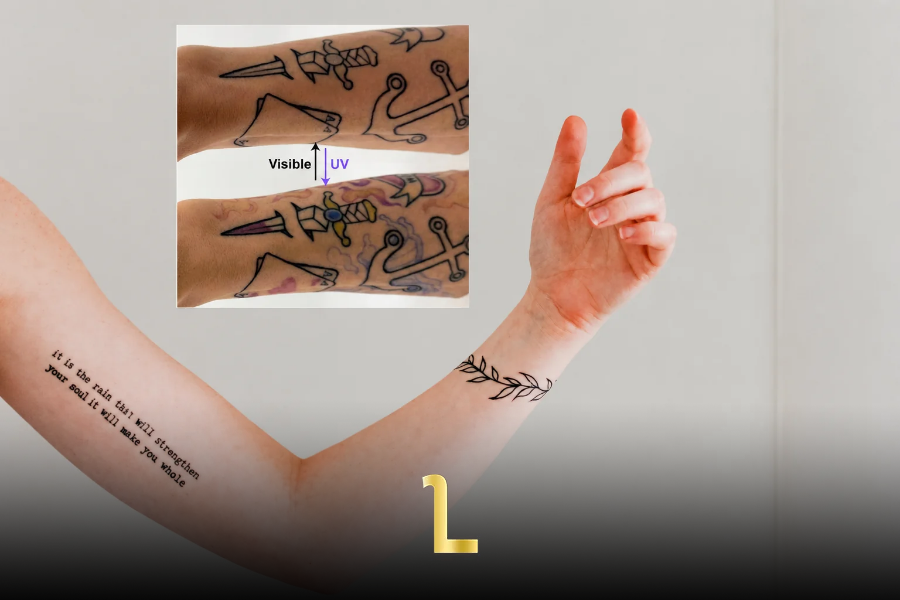
Fez — A tattoo you can hide before a family visit and reveal again afterward may be moving beyond wishful thinking.
Researchers led by Carson Bruns at the University of Colorado Boulder have developed PhotoTat, experimental inks whose visibility changes under different types of light.
Ultraviolet light activates the colors. Bright visible light switches them off again. The pigment stays beneath the skin throughout.
The team describes its findings in a paper published October 9 in “Matter & Light.” Its experiments include artificial skin, pig skin, and a preliminary demonstration on one person.
Permanent ink, changeable appearance
PhotoTat contains color-changing dyes enclosed in tiny polymer particles. The researchers developed blue, magenta, and yellow inks that can combine into different shades.
Under ultraviolet light, the colors appear within seconds. They can remain visible for hours or days indoors, while bright visible light makes them disappear more quickly.
Patterned light also allows researchers to create and rewrite images within an area containing the pigment. Switching off the color does not remove the tattoo or extract anything from the skin.
“PhotoTat is like a switch,” Bruns said in a Cell Press announcement.
For the researcher, who has tattoos himself, the project combines engineering with a personal interest in body art. It raises thean appealing possibility of: keeping a tattoo while choosing when other people can see it.
The scientist became the test subject
Bruns tested the pigments on his own leg, creating a pattern resembling colorful fish scales, according to the university’s account.
“It opens up a new dimension to what your body art could do,” he said.
That demonstration remains a limited experiment. One person’s experience cannot establish how the inks would behave across a larger population or establish their long-term safety. The university says the pigments still require clinical and safety testing.
Beyond hiding a tattoo
The researchers also see potential uses in medical tattoos, including marks used during cancer treatment.
Such markings could become visible when clinicians need them, then disappear from view outside appointments. For patients, that could mean greater control over a lasting physical reminder of treatment. This remains a proposed application.
PhotoTat is not available in tattoo parlors, and the team plans further development.
For now, its appeal rests on a small but meaningful distinction: a permanent mark would no longer have to be permanently on display.