

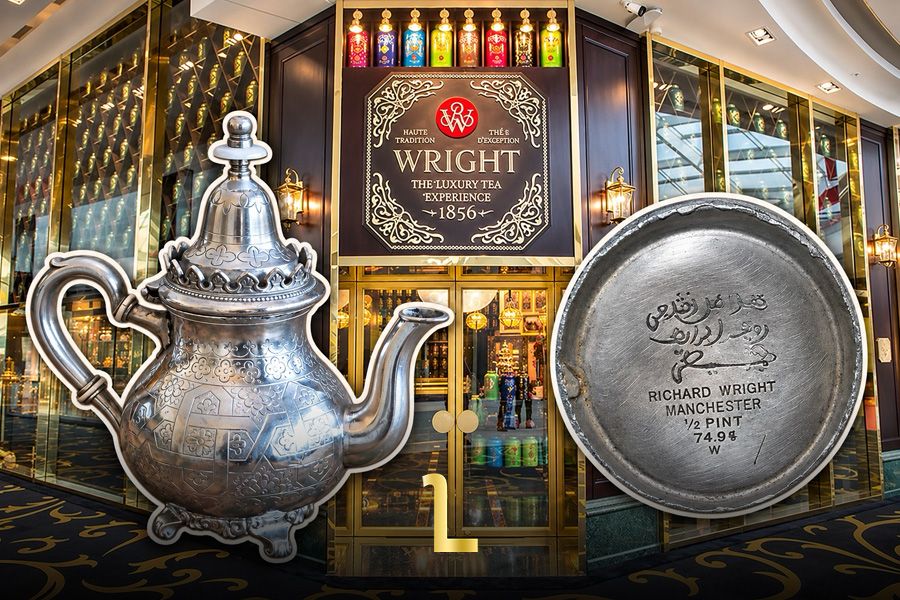
Fez — An English surname found its way into Morocco’s tea vocabulary, carried by the objects surrounding the drink.
Richard Wright, a manufacturer associated with Manchester, supplied metalware for the Moroccan market. His name became “rayt,” a term associated with fine tea trays and other metal objects.
In a 2017 essay, researcher Iziar de Miguel traces that linguistic connection through the “Colin Dictionary of Moroccan Dialectal Arabic.” The dictionary links the term, probably, to Wright and describes its use for a superior white metal.

A Moroccan connection in Manchester
The trade involved Moroccan initiative as well as European manufacturing.
Anthropologist Baptiste Buob’s 2006 study describes a Moroccan merchant in Manchester partnering with Wright to produce luxury goods for customers in Morocco.
Their range extended beyond teapots to trays, sugar containers, kettles, and incense burners. The objects combined English decoration with the ornamental vocabulary of Fez metalworkers.
Buob also notes that some English tea utensils carried Arabic stamps. Manufacturers adapted their products to local tastes, sometimes making their foreign origin less immediately apparent.
A teapot that carries the evidence
A silver-plated teapot in the “Museum With No Frontiers” database offers a physical example.
The record identifies Richard Wright’s Manchester manufactory as its maker and lists the Tea Museum in Essaouira as its holding institution.
Its description draws attention to the combination: a form associated with Moroccan teapots and floral decoration inspired by European designs. It also records “Right” as the name used in Morocco.
How an import became familiar
Buob explains that tea and its utensils first circulated among Morocco’s elites, including through diplomatic gifts. Their wider adoption followed the prestige of those households.
For people adopting the practice, drinking tea could mean participating in the habits of prosperous Moroccans. Local metalworkers subsequently adapted imported models through their own skills and decorative choices.
The history complicates any simple division between imported objects and Moroccan tradition. Merchants selected, artisans reworked, and households gave the objects their place in daily life.
A teapot’s silhouette may look familiar. Its name can still carry the memory of a much longer journey.