

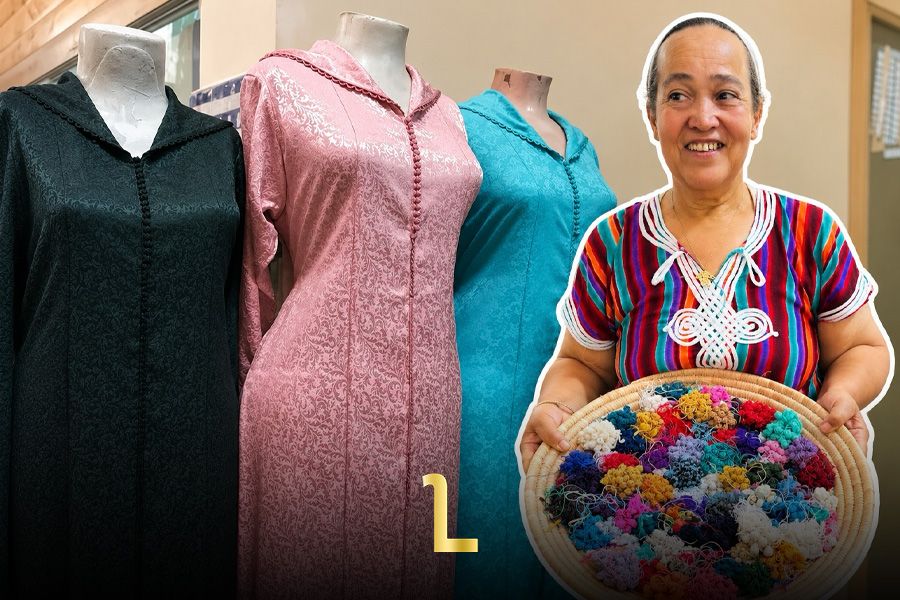
Fez — A small piece of paper sits at the center of a story about Moroccan clothing, skilled hands, and who earns money from them.
During a visit to Sefrou’s Cherry Buttons Cooperative, writer Kathleen Curtis Wilson watched an artisan named Siham shape paper around a needle and secure it with thread.
The little form became the foundation of a button, aakda (singular for aakad). Siham then worked thread around it, controlling the tension and dimensions as the design emerged.

Wilson’s 2019 account for the Textile Society of America describes a technique easily overlooked once the finished button joins a garment.
The work behind the fastening
The visit revealed a varied craft rather than a single repeated shape.
Wilson reported that the cooperative offered around 40 designs at the time. Makers combined strands of artificial silk according to each button’s size and construction.
Her guide identified one design as Siham’s particular specialty, which other members of the cooperative could not duplicate.
That detail makes the finished object easier to appreciate: even within something small enough to pass unnoticed, an individual maker could leave a recognizable signature.
Changing who controlled the sale
For cooperative founder Amina Yabis, the challenge extended beyond making beautiful buttons.
ClothRoads’ account, drawing on Susan Schaefer Davis’s research, recounts how Yabis learned the craft to contribute to her family’s income. Her experience with the trading system helped drive her decision to organize other women.
She founded the Sefrou Women’s Silk Button Cooperative in July 2000, known locally as Cherry Buttons.
The organization expanded beyond supplying loose buttons, developing products that incorporated the makers’ work and opening additional routes to customers.
A 2021 account by former cooperative worker Kirsten Mullin explains the underlying problem: intermediaries bought women’s buttons cheaply and resold them at higher prices. The cooperative sought to bring production and selling into the women’s hands.
A pastry, a flower, a sun
The buttons’ names preserve another layer of everyday creativity.
ClothRoads describes a round, flat “bstilla” button resembling the pastry, a “boushniqa” associated with a dried flower, and “shems,” meaning sun.
These details bring the craft close enough to examine: paper beneath thread, familiar shapes translated into tiny designs, and specialized knowledge held by individual women.
Yabis’s story adds another question to that close inspection. Once the button reaches a finished garment, how much of its value reaches the person who made it?