

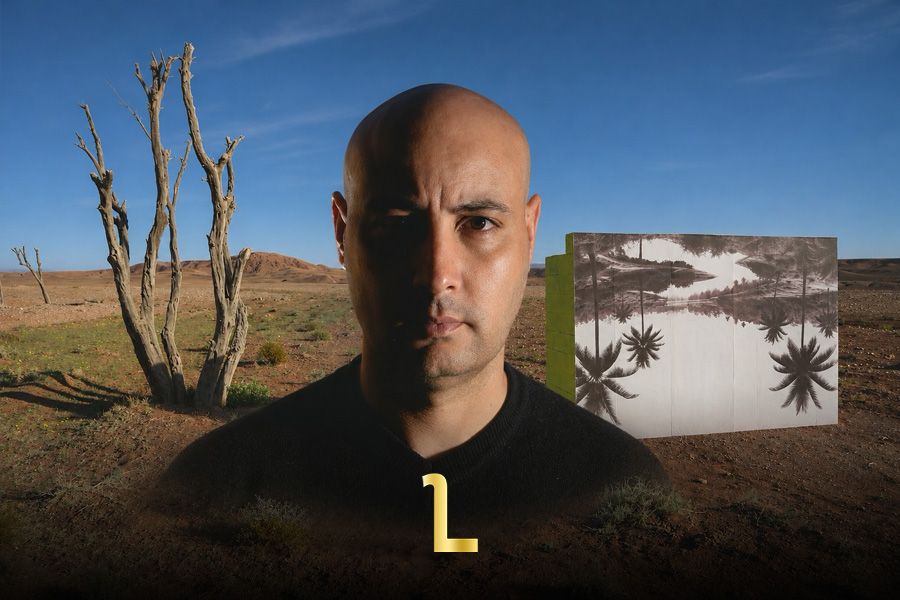
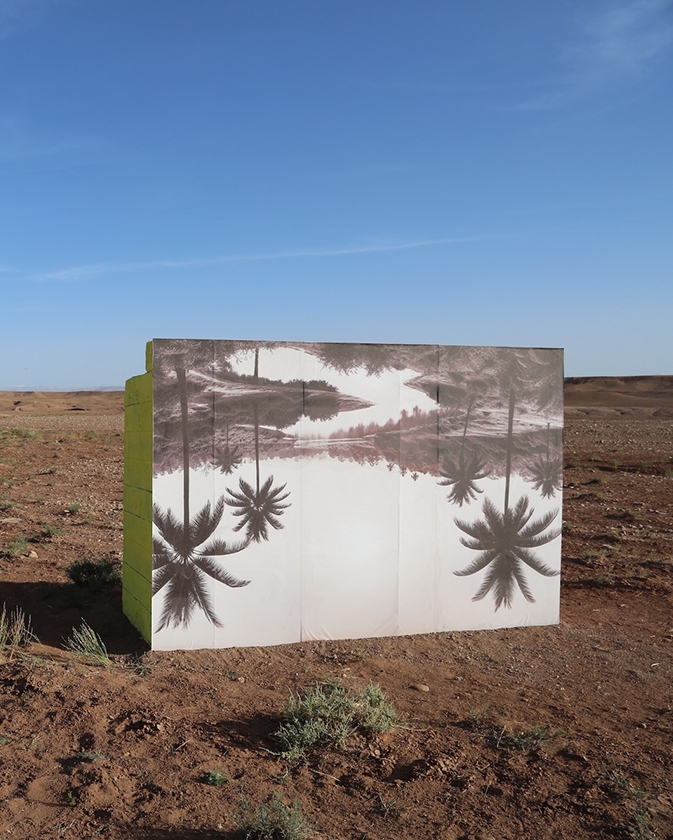
Fez — Wallpaper usually tells you that you’re indoors. In Hicham Benohoud’s photographs, it does its job for a moment. You recognize the wall of a room. Then you see the dry ground around it and realize there is no room.
For his series “Papier peint,” the Moroccan photographer had a concrete-block wall built in the arid landscape of southern Morocco and covered with wallpaper. That order of operations matters. The light falling on the paper and the ground around the wall belonged to the same place at the same moment. What looks improbable in the photograph once stood there.
Casablanca gallery L’Atelier 21 will present “Papier peint” and a second new series, “Perchoirs,” alongside photographs from “Landscaping” at the Grand Palais in Paris, November 12–15. The gallery’s stand, B11, offers three ways to see how much Benohoud can change a landscape before he presses the shutter.
The view from one spot
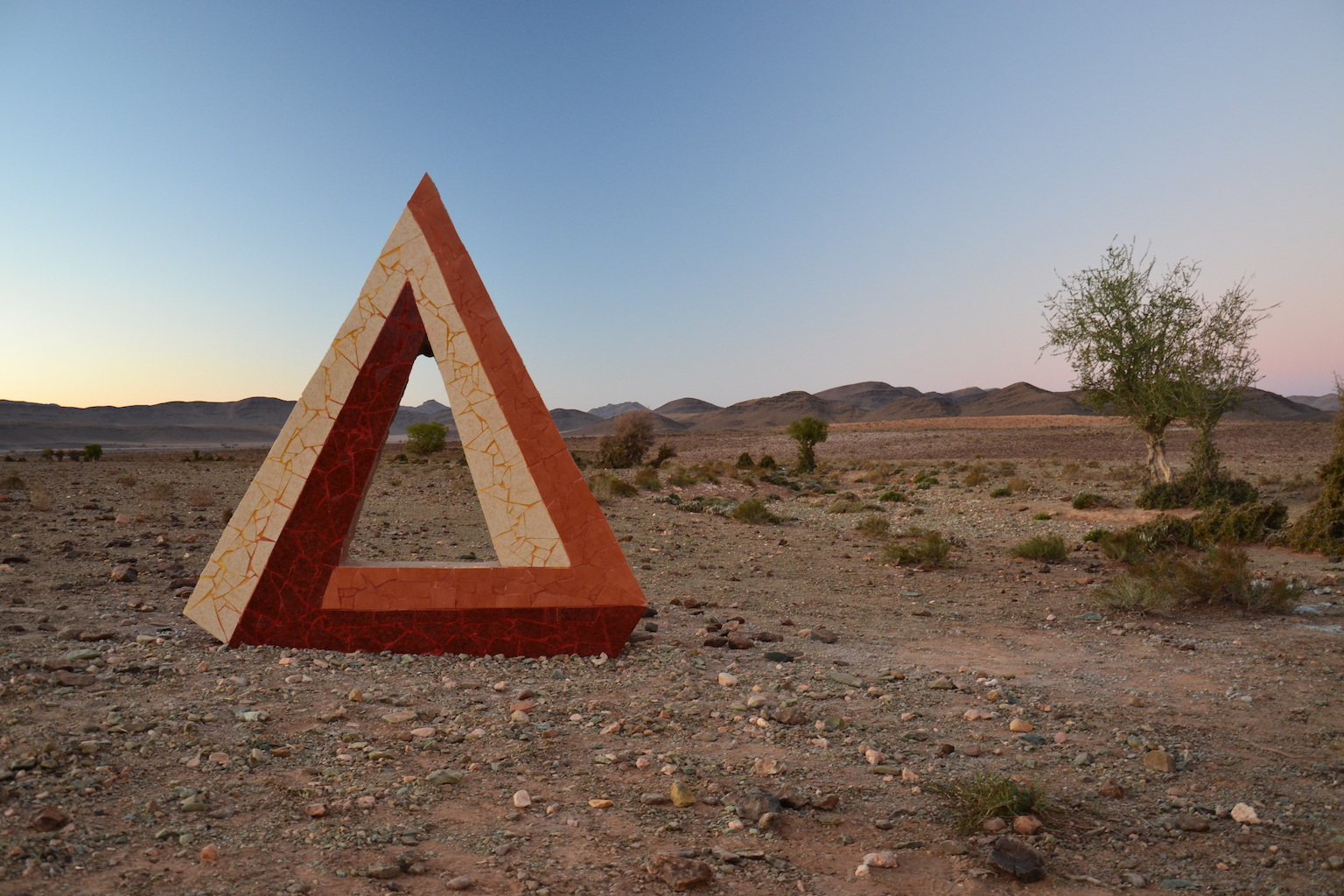
In “Landscaping,” the position of the camera is part of the construction. Benohoud arranges tiles and other materials on the ground. Seen from the precise spot he has chosen, the flat arrangement takes on volume. Someone standing beside the photographer and someone looking through his lens could see two quite different things.
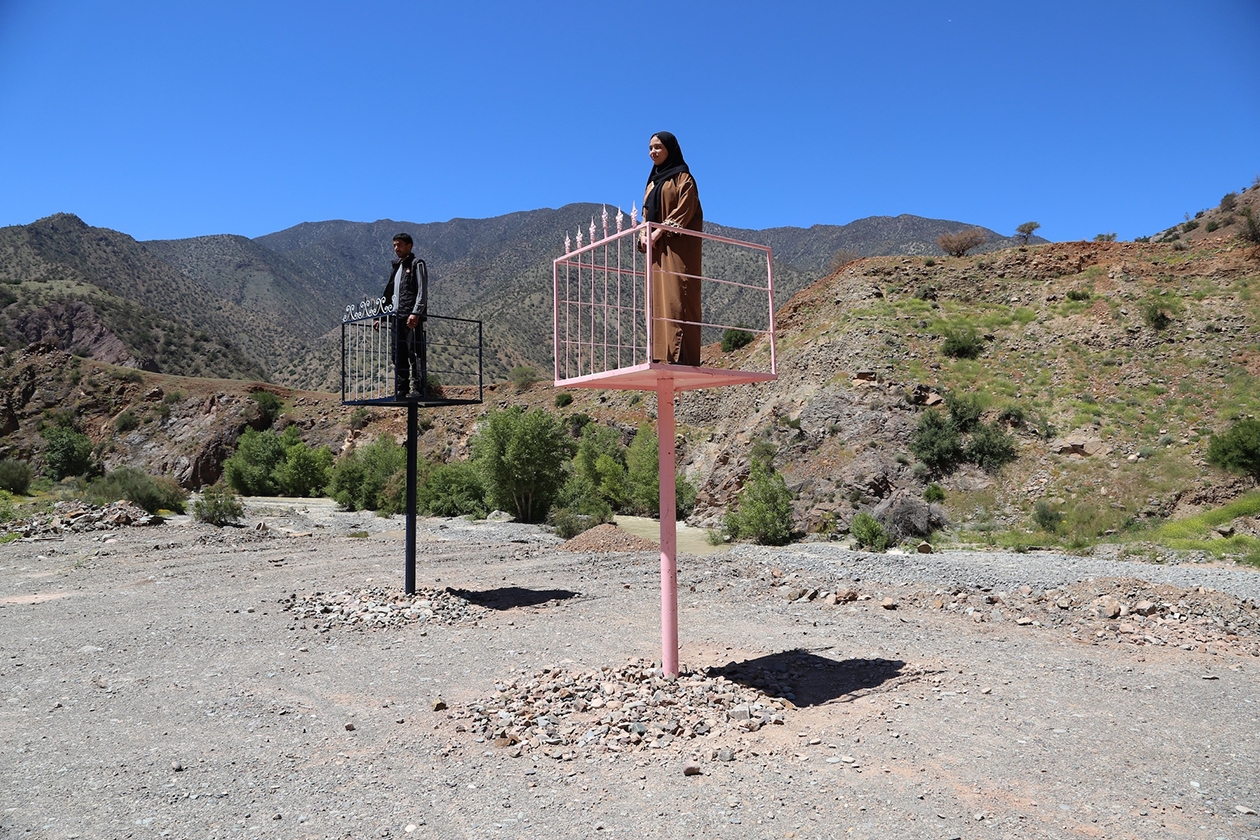
“Perchoirs” asks something different of the people in the picture. Metal structures rise out of open country, with men and women perched on them. Residents of nearby villages sometimes take part in Benohoud’s setups. Fabrication, placement, and positioning can occupy enough of the day to yield a single photograph.
Before the desert, a classroom in Marrakech
Benohoud first worked out what he could do with a familiar space while teaching art at a Marrakech secondary school. Between 1994 and 2002, he made “The Classroom” with his students. Desks, chairs, string, cardboard, and paper supplied the sets. “The Classroom” won him the Paris Photo Photobook award in 2025.
The furniture belonged exactly where it stood. It was what Benohoud and the students did with it, concealing or suspending a body, that made the classroom strange. L’Atelier 21 revisits that collaboration in its account of the series.
The wallpaper photographs reverse the experiment. In Marrakech, Benohoud started with a whole room and rearranged what was inside. In the south, he took a single familiar piece of the interior outdoors. One wall turns out to be enough for the viewer to supply the rest.