

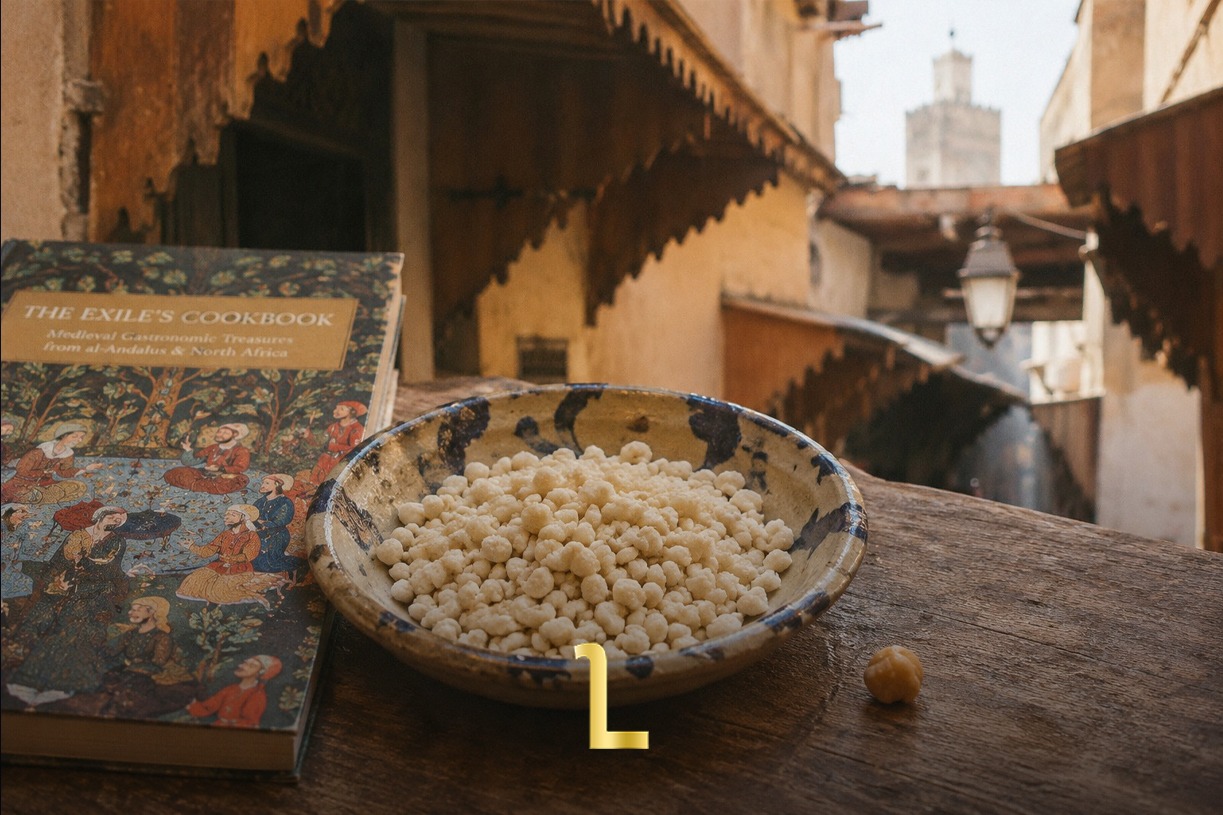
Fez — Give a cook in Fez a bowl of flour, a little water, and a chickpea. The chickpea stays out of the bowl. Its job is to tell the cook when to stop.
That was the measure for zabzin, a dish that a 13th-century cookbook associated with the Andalusian quarter of Fez.
The cook sprinkled water over flour and ran their fingers through it until the grains grew as large as small chickpeas. We have the name, the neighborhood, and the motion of the hand. Would a cook in Fez today recognize what they were making?
The dish every reader was supposed to know
The author, Ibn Razīn al-Tujībī, grew up in Murcia, left for North Africa in 1247, and eventually settled in Tunis. He wrote several books.
His cookbook is the one that survives, carrying recipes from both sides of the Mediterranean. Among them is a second dish that gives away how familiar zabzin must have been to the people he wrote for.
To make muhammas, a small soup noodle, a cook could knead dough and twist off pieces the size of peppercorns. But Ibn Razīn also had advice for someone who wanted dinner sooner. Roll the pieces in the kneading trough the way you make zabzin, he suggested.
Food historian Charles Perry traces both instructions. One recipe tells us how large the grains should be. The other tells us that a cook once had only to hear the name to know what to do.
A question for a Fez kitchen
There is a lead for anyone who wants to follow the dish home. A historical study of North African pasta links the Andalusian name zabazīn with al-barkūkash, a name used across Morocco. That gives a present-day cook another word to listen for, although a familiar name alone cannot tell us how closely a family’s recipe resembles the medieval one.
Anyone can browse a surviving copy of Ibn Razīn’s book. The more revealing test belongs in the kitchen: let a cook read the instructions without giving them the name.
When the grains reach the size of the chickpea, ask, What would you call this?