

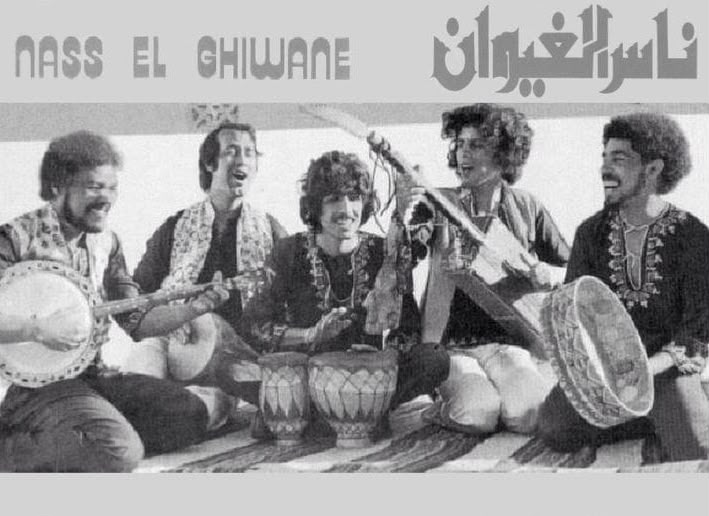
Rabat – Emerging from the marginalized, working-class area of Hay Mohammadi in Casablanca, Nass El Ghiwane rebelled against conventional styles and brought a unique touch that set them entirely apart.
Featuring five folk musicians belonging to the working class, Hamid Sayed, Larbi Batma, Boujemaa Hagour, Allal Yaala, and Abderahman Kirouche, Nass el Ghiwane captured political issues, social relations, and identity in a way that resonated, and still resonates, with people in Morocco and beyond.
A unique, eclectic style
Blending gnawa trance, malhoun, and regional folk, Nass el Ghiwane constituted a unique musical style that caters to all tastes.
Nass el Ghiwane covered a variety of aspects of daily life; they sang of love, poverty, politics, victory, and failure.
Adopting Moroccan Arabic and Moroccan proverbs was a political and artistic choice, for the musical landscape back then relied heavily on imported Egyptian and Lebanese styles.
What made them stand out was their selective eye. They were the first ones to introduce Moroccans to Western instruments like the modern bajo, a modern electric bass guitar. Their style, therefore, is built around the fusion of Moroccan linguistic and rhythmic traditions and Western instruments.
Moroccan Arabic to voice margins
Since the beginning of their career, Nass el Ghiwane has deployed a basic yet intriguing register. Drawing upon Moroccan oral heritage, such as proverbs in their songs, helped them refine their storytelling and connect deeply with people’s everyday experiences.
Established in the 1960s in one of the poorest neighborhoods in Casablanca, Nass el Ghiwane deployed music not only to entertain, but also to help people get a closer look at what life looks like for impoverished, forgotten groups.
Rather than singing for entertainment or gain, they sang to mirror raw, unfiltered truths about marginalized groups in poor neighborhoods, allowing their music to find its way to Maghrebi households.
A legacy persisting over years
Among their iconic hits are “Siniya”, “Allah ya moulana”, and “Fine ghadi bia khouya”, masterpieces that are still widely celebrated across generations.
Nass el Ghiwane is a flame that refuses to be extinguished; the group underwent constant changes in members, mainly after the death of Larbi Batma, and it also suffered multiple internal conflicts leading to the withdrawal of other members.
However, the group, led by Omar Sayed, is still performing and celebrating its rich, timeless repertoire around the globe.