

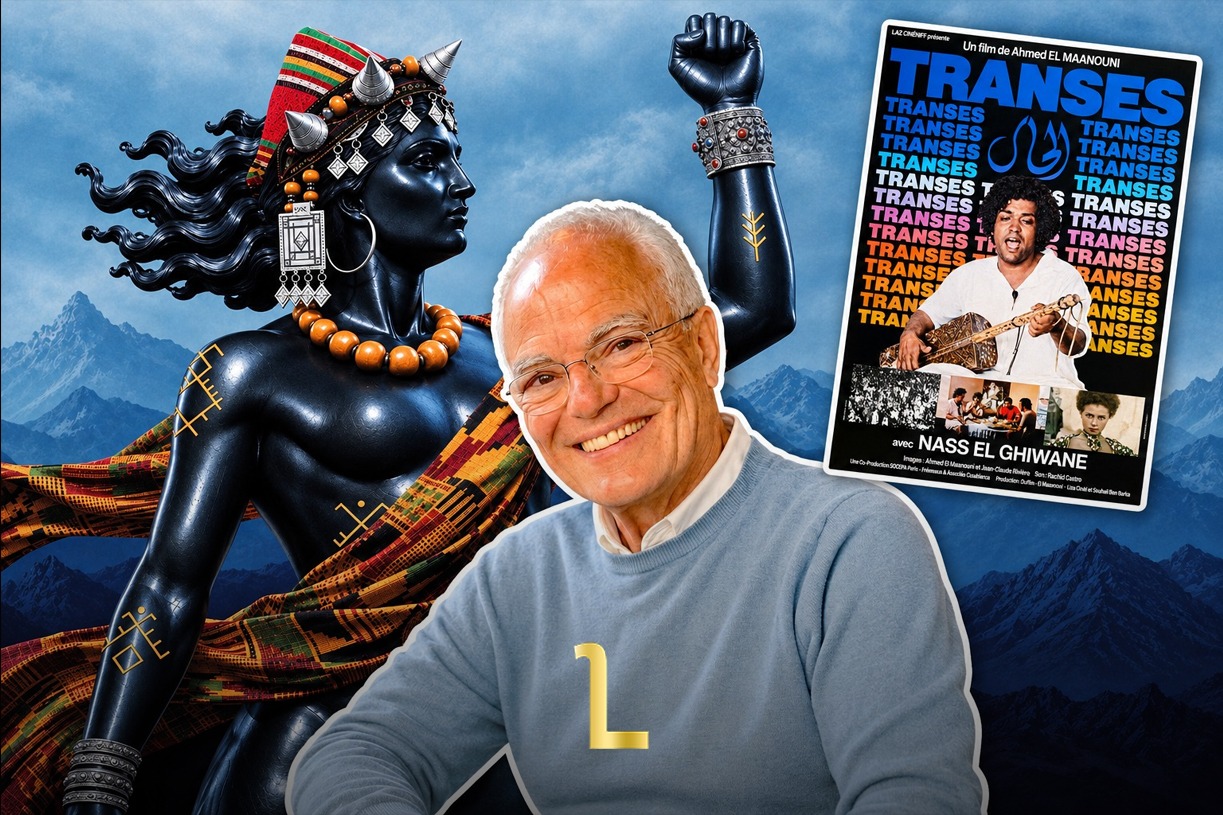
Fez — In 1981, Moroccan filmmaker Ahmed El Maanouni captured the music, poetry, and rebellious spirit of Nass El Ghiwane in a documentary that would become an international classic.
Forty-five years later, the Casablanca-born director is bringing “Trances” back to European audiences at the 21st AfryKamera African Film Festival in Warsaw, Poland.
The documentary will screen on November 27 at 6:45 p.m. at Kino Amondo, followed by a discussion with El Maanouni.
The event is part of the festival’s AfryClassic program, which revisits significant works of African cinema. This year’s edition, running from November 23 to 29, also places a special focus on Moroccan filmmaking.
For El Maanouni, the screening marks another chapter in a career that helped introduce Moroccan cinema to international audiences.
The film that captured Morocco’s musical soul
Released in 1981 under the original title “Al Hal,” “Trances” follows Nass El Ghiwane, the legendary Moroccan musical group whose songs became closely associated with the social and cultural atmosphere of the 1970s.
Blending poetry, traditional instruments, theatrical performance, and socially engaged lyrics, the musicians developed a distinctive sound rooted in Moroccan popular culture.
El Maanouni followed the group through performances in Morocco, Tunisia, and France, capturing their encounters with audiences alongside intimate conversations and scenes from Casablanca.
The documentary moves beyond the conventional concert film, exploring the relationship between music and the society that produced it.
Its significance eventually reached Martin Scorsese, who discovered the film while working on “The King of Comedy” in 1981.
Scorsese later described “Trances” as more than a portrait of Nass El Ghiwane. To him, it was also a portrait of Morocco and the world that shaped the band’s music.
In 2007, the documentary became the first restoration undertaken by The Film Foundation’s World Cinema Project.
The restored film was presented at Cannes Classics that year and subsequently entered the Criterion Collection, helping introduce it to new generations of cinema enthusiasts.
The filmmaker who brought Morocco to Cannes
El Maanouni’s international recognition began before “Trances.”
His debut feature, “Alyam Alyam” (1978), became the first Moroccan feature film selected for the Cannes Film Festival, screening in the Un Certain Regard section.
Set in rural Morocco, the film follows a young man hoping to leave for France in search of a better future.
Through his struggles and family relationships, El Maanouni examines migration, generational tensions, and the uncertainty facing young Moroccans.
The film also featured music by Nass El Ghiwane, establishing an artistic connection that would continue in “Trances.”
“Alyam Alyam” received several international distinctions, including the Grand Prize at the Mannheim Film Festival in 1978.
Like “Trances,” it was later restored with support from the World Cinema Project.
A career dedicated to Moroccan memory
Throughout his career, El Maanouni has moved between fiction and documentary, repeatedly exploring Morocco’s history, identity, and social transformations.
His 2007 feature “Burned Hearts” follows a young architect returning from Paris to Fez to confront painful childhood memories and unresolved family conflicts.
The film won the Grand Prize and Critics’ Award at Morocco’s National Film Festival and received recognition at numerous international festivals.
A decade later, El Maanouni directed “Fadma” (2017), a comedy exploring family relationships, identity, and social change. The film earned him the Best Director Award at the National Film Festival in Tangier.
His documentary work has also examined overlooked chapters of Moroccan history.
“The Moroccan Goumiers” (1992) revisited the experiences of Moroccan soldiers who fought in major twentieth-century conflicts.
“Morocco–France, A Shared History” (2006) examined the complexities of the colonial relationship, while “The Paths of Freedom” (2015) explored Mohammed V’s role in Morocco’s struggle for independence.
According to his latest filmography, El Maanouni is also developing projects about pioneering Moroccan aviator Touria Chaoui and artist Abdelkébir Rabi’.
Across these works, a recurring concern emerges: how cinema can preserve experiences that might otherwise disappear from collective memory.
Moroccan cinema reaches a new generation in Poland
El Maanouni’s participation in AfryKamera arrives as the festival introduces Polish audiences to different generations of Moroccan filmmakers.
The program also revisits the connections between Morocco and Poland through directors who studied at the Łódź Film School, including Mostafa Derkaoui.
Against this backdrop, “Trances” offers audiences an opportunity to encounter a defining chapter of Moroccan musical and cinematic history.
Its return to the screen also highlights the lasting significance of film preservation, which allows works created decades earlier to remain accessible.
For El Maanouni, whose career has consistently explored the connections between personal stories and national history, the Warsaw screening represents more than a retrospective.
It is another opportunity for Morocco’s voices, memories, and cultural heritage to reach audiences far beyond the country where they were first recorded.