

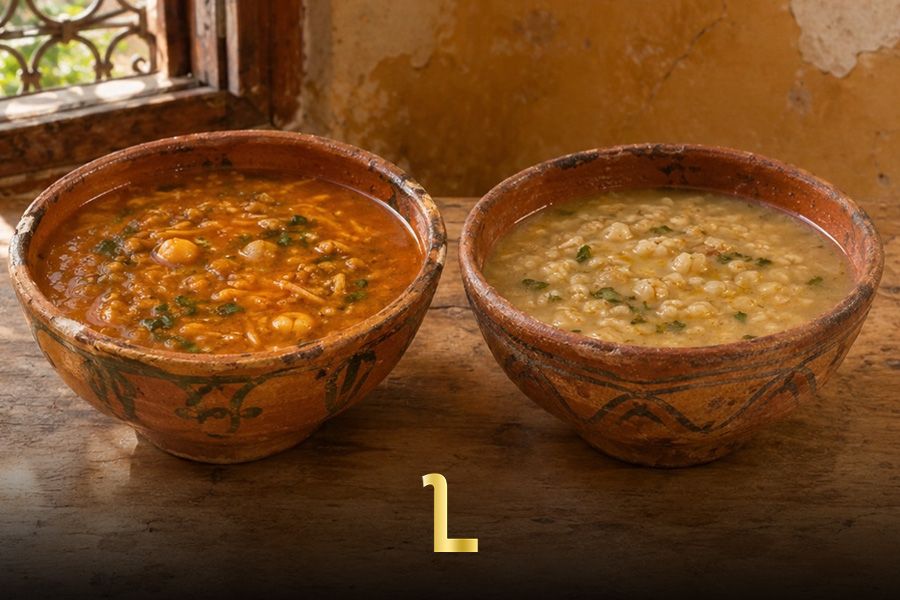
Fez — Imagine sitting down to a bowl of Moroccan harira without its familiar red color. No tomatoes, no tomato paste, and none of the rich acidity that defines the soup in so many Moroccan homes today.
Instead, the bowl might have contained a pale, creamy preparation made from flour, milk, and fat, perhaps enriched with grains or aromatic ingredients.
It is a striking possibility for a dish now so closely associated with tomatoes.
Yet tomatoes are relative newcomers to the Mediterranean culinary world.
Originally from the Americas, they arrived in Europe following transatlantic contact during the sixteenth century.
Botanical research documents references to tomatoes in Italy as early as 1544.
The precise chronology of their introduction into Moroccan kitchens is less certain.
So what might the soup have looked and tasted like before tomatoes became an established ingredient?
An older history of Moroccan soup
Harira’s origins remain difficult to establish precisely.
Its development reflects a long history of Amazigh, Arab, and Andalusian culinary influences, as well as regional differences in food preparation.
One important historical reference comes from the Moroccan scholar Al-Yusi, who lived during the seventeenth century.
In his study of Moroccan food traditions, historian Bernard Rosenberger examines an account in which Al-Yusi describes the food preferences of people from different regions.
A person from the Draa region, for instance, is associated with local dates and harira.
The reference establishes that harira was already recognized in Moroccan food culture by the late seventeenth century.
However, it does not provide a recipe or establish whether tomatoes were used.
To understand earlier preparations, researchers must look at the wider history of flour-based soups and porridges.
The secret was in the flour
Moroccan researcher Abdelhaï Diouri explored harira’s history in his study of Ramadan food traditions.
His research traces older preparations in which flour, milk, and fat played essential roles.
He also examines medieval recipes from the Islamic West, including those preserved in the thirteenth-century cookbook of Ibn Razin al-Tujibi.
These recipes describe related soups made with flour, bread, sourdough, or grains, sometimes accompanied by oil, eggs, chicken, and seasonings.
They are not necessarily identical to modern harira, but they reveal the culinary traditions from which later recipes could develop.
One technique remains particularly important: tadouira.
This involves gradually stirring flour diluted with water into a hot broth to create a smooth, thick consistency.
Diouri describes the technique as central to harira’s identity, even suggesting that its history may be closely connected to the evolution of the soup itself.
Without tomatoes, flour and other ingredients would have played a greater role in determining the dish’s texture and appearance.
What would it actually have tasted like?
A reconstructed pre-tomato harira might have been considerably milder than the version familiar today.
Depending on its ingredients, it could have had the creamy richness of milk, the comforting weight of cooked grains, or the savory depth of a meat-based broth.
Flour would have provided body rather than the pronounced acidity associated with tomatoes.
Historical soup traditions also incorporated ingredients such as coriander, ginger, cinnamon, onions, and garlic, suggesting that earlier preparations were not necessarily bland.
Some variations may have featured a slightly fermented character.
Diouri records an older practice associated with bufertuna, a name linked to harira in Fez and Rabat, in which the flour mixture was prepared using sourdough from the previous day’s bread.
This could have added another dimension to the soup’s flavor.
Still, there is no surviving evidence establishing one definitive pre-tomato Moroccan harira recipe.
Its color and taste would have depended on regional ingredients and individual cooking traditions.
How the tomato transformed harira
Over time, tomatoes became a defining ingredient in many Moroccan versions of harira.
They added color, acidity, and depth to a preparation already characterized by its nourishing ingredients and thick consistency.
Today, the soup commonly contains chickpeas, lentils, fresh herbs, spices, and flour, although recipes vary considerably between regions and families.
A study of Moroccan gastronomy published by the World Intellectual Property Organization details some of these differences, including the use of rice in Fez and vermicelli or cracked barley in Marrakech.
These variations reflect the adaptability of a dish that has never belonged to one fixed recipe.
Harira’s history is therefore more complex than the story of a traditional soup that simply acquired tomatoes.
It is the story of generations of Moroccan cooks adapting techniques, ingredients, and tastes while preserving the idea of a nourishing meal.
The familiar red harira remains one of Morocco’s most recognizable culinary traditions. But behind its modern appearance lies a much older history of flour, grains, broths, and the knowledge passed between kitchens.
What we know about that history suggests that harira’s identity was shaped by more than its color, long before the tomato came to dominate the bowl.