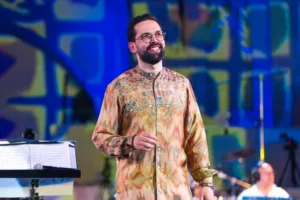
Fez — Moroccan singer Mohamed Rifi has released “Qalu Qalu,” a new duet with Egyptian mahraganat star Ortega, marking Rifi’s most visible comeback to mainstream Arabic pop in years.
The single arrived this week across streaming platforms alongside a punchy video built around fast cuts, bright color palettes, and street-styled choreography.
According to Egypt’s Youm7, the track was written by lyricist Mostafa Hadouta, composed by Tag, and arranged by Coolpix, and it leans into the fast “festival” sound popular with Cairo’s youth.
For Rifi, whose calling card has long been a more classical, big-voiced delivery, “Qalu Qalu” is a tactical pivot toward lighter, dance-friendly phrasing that plays to Ortega’s rapid rhythms and electronic textures.
The release is backed by Saudi producer Sultan Elshan, who promoted the project and teased the clip on his official pages before the full cut went live. That push, coupled with platform distribution through Universal Music MENA, positions the duet for broad regional reach beyond core fan bases in Morocco and Egypt.
Rifi’s return arrives more than a decade after he won The X Factor Arabia in 2013, a breakout that introduced his power-baritone to audiences across the Arab world. Industry watchers have since viewed the Casablanca native as a potential crossover voice; his decision to record in Egyptian dialect and to lean into mahraganat production suggests a deliberate bid to re-anchor his profile in the region’s largest music market.
Early listener reaction on social platforms has focused on the song’s hook and call-and-response structure—a staple of festival tracks designed for quick virality. The video amplifies that effect with fast edits and saturated tones, mirroring Ortega’s established visual language while giving Rifi space to shift registers and trade lines on the refrain.
Whether “Qalu Qalu” signals a full project or a series of collaborations, the single underlines how North African artists continue to blur borders between pop, shaabi, and mahraganat to capture younger audiences across the Maghreb and the Middle East. For Rifi, it is a reminder of the voice that won him a prime-time title and of a willingness to evolve to meet the moment.