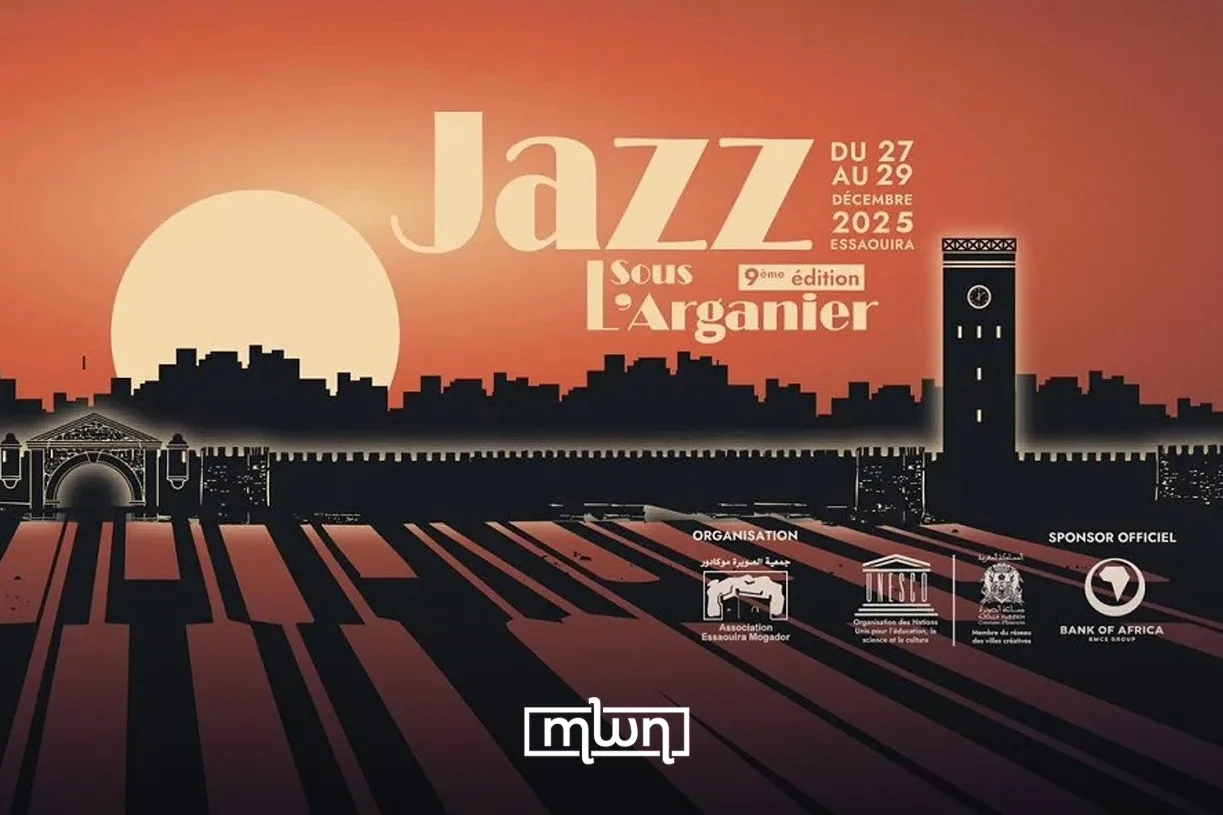
Fez — Essaouira will host the ninth edition of “Jazz Under the Argan Tree” from December 27 to 29, reaffirming the coastal city’s reputation as a winter crossroads for world music, improvisation, and artistic exchange. Organized by the Association Essaouira Mogador and directed by Moroccan musician Majjid Bekkas, the festival has become a defining fixture of the city’s cultural calendar.
As the year draws to a close, music once again takes over Essaouira’s emblematic spaces, transforming winter into a season of gathering and shared experience. Over three days, the festival will offer a broad panorama of European jazz open to influences from Africa, the Mediterranean, and beyond, echoing Essaouira’s long-standing identity as a city of musical dialogue and métissage.
A winter anchor in Essaouira’s cultural life
Since its early editions, Jazz Under the Argan Tree has established itself as a highlight of Essaouira’s artistic season, bringing together established musicians, emerging talents, and a loyal audience. Known internationally for its openness to experimentation, the festival naturally aligns with Essaouira’s role as a capital of world music and creative exchange.
Evening concerts will take place at Dar Souiri, while Bayt Dakira will host colloquia and concerts dedicated to Morocco’s southern provinces, marking the 50th anniversary of the Green March. A defining feature of the festival remains its late-night jam sessions, which extend each evening well past midnight and foster spontaneous encounters between local and international musicians.
From jazz fusion to Saharan heritage
The festival will open on Saturday, December 27, at Dar Souiri with the Mohamed Derouich Trio, a project built around guitar, saxophone, and drums. Drawing on contemporary jazz, traditional music, and multiple global influences, the trio blends Balkan energy, African rhythms, and Maghrebi colors through performances shaped in the moment by collective improvisation.
The same evening will feature the JET Fuel Trio, bringing together musicians from Denmark and The Gambia. Led by kora virtuoso Dawda Jobarteh alongside saxophonist Michael Blicher and drummer Stefan Pasborg, the group merges jazz improvisation with African roots before giving way to the festival’s first jam session at midnight.
Sunday, December 28, will introduce a reflective and territorial dimension. A morning colloquium at Bayt Dakira will explore shared history and future partnerships between Essaouira and the southern provinces, placing artistic creation within a broader dialogue on memory, transmission, and youth.
The afternoon will be devoted to Saharan music, with performances by the all-female group Bnat Aïchata from Guelmim, followed by the troupe of Mohamed Baïa from Laâyoune. In the evening, Dar Souiri will welcome the JD Allen Trio, led by American tenor saxophonist JD Allen, whose powerful playing draws on the lineage of John Coltrane while asserting a contemporary voice. The night will continue with the Andrés Coll Cosmic Trio, an exploratory project uniting marimba, violin, and percussion.
A closing night of shared creation
The final day, Monday, December 29, will open with the Mosaic Duo, pairing Swedish pianist Jacob Karlzon with Moroccan percussionist Rhani Krija in an intuitive piano-percussion dialogue. The evening will then bring together the Munsch Trio and Moroccan multi-instrumentalist Mourad Belouadi, following a recent artistic residency that expanded their electro-jazz soundscape.
The festival will close with a highly anticipated jazz-gnawa fusion creation, uniting international musicians with Maâlem Mohamed Boumezzough. Anchored by the guembri and jazz improvisation, the collective performance is set to embody the spirit of Jazz Under the Argan Tree: deeply rooted, open to the world, and driven by shared creation.
As Essaouira once again becomes a winter meeting point for artists and audiences, Jazz Under the Argan Tree continues to show how improvisation and cultural dialogue can turn the year’s end into a moment of renewal, connection, and collective listening.