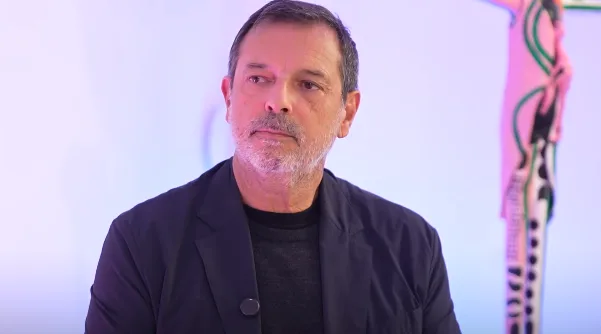
Fez — At a time when Morocco readily celebrates its material heritage, contemporary visual arts continue to occupy a marginal place in public discourse. These questions were at the center of a recent episode of “De choses et d’autres,” which hosted Moroccan gallerist and cultural actor Hassan Sefrioui for an in-depth discussion on the relationship between Moroccans and art today.
Among the earliest gallery owners to establish themselves in Casablanca, Sefrioui has spent more than two decades shaping and observing Morocco’s contemporary art scene. His career includes serving on numerous art competition juries and participating in the selection committee for Morocco’s representation at the Biennale de Venise, giving him both a critical and informed perspective on the sector’s evolution.
“De choses et d’autres,” which translates roughly to “Of things and other matters,” is a Moroccan cultural television program broadcast on Le Matin TV that centers on long-form conversations about art, culture, and society. Hosted by journalist Fadwa Misk, the show invites artists, intellectuals, and cultural figures to reflect on their work and on broader questions shaping Moroccan cultural life, offering viewers a thoughtful and accessible space for dialogue beyond daily news and entertainment.
The structuring of Morocco’s art ecosystem
According to Sefrioui, the past 20 years have marked a decisive turning point in the organization of art-related professions in Morocco. When he began, many of today’s key players did not yet exist.
Gradually, galleries opened in several cities, independent curators emerged, the role of art dealers stabilized, and the Ministry of Culture, through its Directorate of Arts, became more involved. Today, he argues, the foundations are in place for a durable and credible Moroccan art market.
Public access and the impact of digital platforms
Sefrioui identifies two major shifts in how the Moroccan public engages with contemporary art. The first came through initiatives by cities and regions to bring art into public spaces. Events such as Casablanca’s early-2000s festivals, the Marrakech Biennale, and cultural programs in Rabat offered free access to contemporary works, helping reach audiences far removed from traditional galleries.
The second shift followed the rise of social media and digital platforms, particularly in photography. These tools allowed artists to experiment with new formats and reach wider audiences. Today’s art public, he notes, is largely split between young students and emerging artists, and an older, more established group of collectors. The challenge now is engaging professionally active thirty-somethings who remain relatively distant from art.
Art, artisanat, and education
Addressing why Morocco valorizes artisanat more visibly than contemporary visual arts, Sefrioui emphasized the country’s historical links between art and craftsmanship. Since the 1960s Casablanca School, led by figures such as Farid Belkahia, Mohamed Melehi, and Mohamed Chabaa, modern art has drawn from familiar forms and signs rooted in artisan traditions.
For Sefrioui, education is central to democratizing art. Public festivals help reduce fear of contemporary art, while schools should provide all children with a basic cultural foundation, from zellige and ceramics to modern and contemporary practices. Artists, he adds, have long been carriers of social and political questions and can help develop critical thinking among younger generations.
Art as a tool for international presence
Sefrioui views artists as observers of society, comparing their role to that of anthropologists. For him, contemporary Moroccan works document their socio-political context, just as earlier generations did under different conditions. While art may not rival sports in popularity, it plays a key role in shaping Morocco’s international image.
Morocco’s upcoming participation at the Venice Biennale, where it will be represented by Amina Agueznay with curator Meriem Berrada, signals renewed political will. Despite challenges such as export restrictions on artworks, Sefrioui remains optimistic. Morocco remains unique in the Arab world for producing a new generation of artists every year, he noted.
For him, the priority is clearly to build a solid, credible environment that allows Moroccan artists not only to create, but to live with dignity from their work, ensuring that contemporary art becomes an integral part of Morocco’s cultural future.