Fez — Morocco’s national anthem, widely known as the “Cherifian Anthem,” is one of the country’s most enduring symbols of sovereignty and unity, combining a 20th-century royal melody with lyrics that emerged at a decisive sporting and political moment.
Unlike many anthems written at once, Morocco’s anthem took shape in stages. Its music predates its words by several decades, while its lyrics were only officially adopted in 1970, on the eve of Morocco’s historic debut at the FIFA World Cup.
A melody born under the Protectorate
The music of Morocco’s national anthem was composed in the early 20th century by Léo Morgan, during the period of the French Protectorate. The composition dates to the reign of Moulay Youssef and the tenure of Resident-General Hubert Lyautey.
At the time, the piece was not conceived as a national anthem in the modern sense. It functioned as a royal salute, performed to honor the Sultan during official ceremonies.
In the 1920s, the melody circulated under the name “Moulay Youssef” before becoming more widely known as the “Cherifian Anthem.” It remained strictly instrumental and symbolic of the Sultan’s authority rather than popular national identity.
Independence without lyrics
After Morocco regained independence in 1956, the melody continued to be used by the state, still without words.
For more than a decade, Morocco effectively had an anthem without lyrics, relying on the instrumental piece for official events and international representation.
This unusual situation changed at the end of the 1960s, not because of domestic pressure, but due to international protocol.
Why lyrics came in 1970
Morocco’s qualification for the 1970 FIFA World Cup marked a turning point. As the first Arab and African team to compete in that edition of the tournament, Morocco needed a full anthem — music and words — to be performed on the global stage.
The task of writing the lyrics was given to Ali Squalli Houssaini, a respected Moroccan poet and intellectual from Fez known for his classical Arabic style and nationalist themes. His verses were officially adopted in 1970, completing the anthem just in time for Morocco’s appearance in Mexico.
Words rooted in creed and sacrifice
Houssaini’s lyrics center on Morocco’s enduring national motto: “God, Homeland, King.” Rather than narrating a historical event, the text emphasizes loyalty, sacrifice, and continuity, framing Morocco as both a spiritual and physical homeland defended by its people.
The anthem’s imagery blends faith, land, and collective duty, reinforcing the idea that Moroccan identity rests on devotion and permanence rather than momentary triumph.
Musical composition and structure
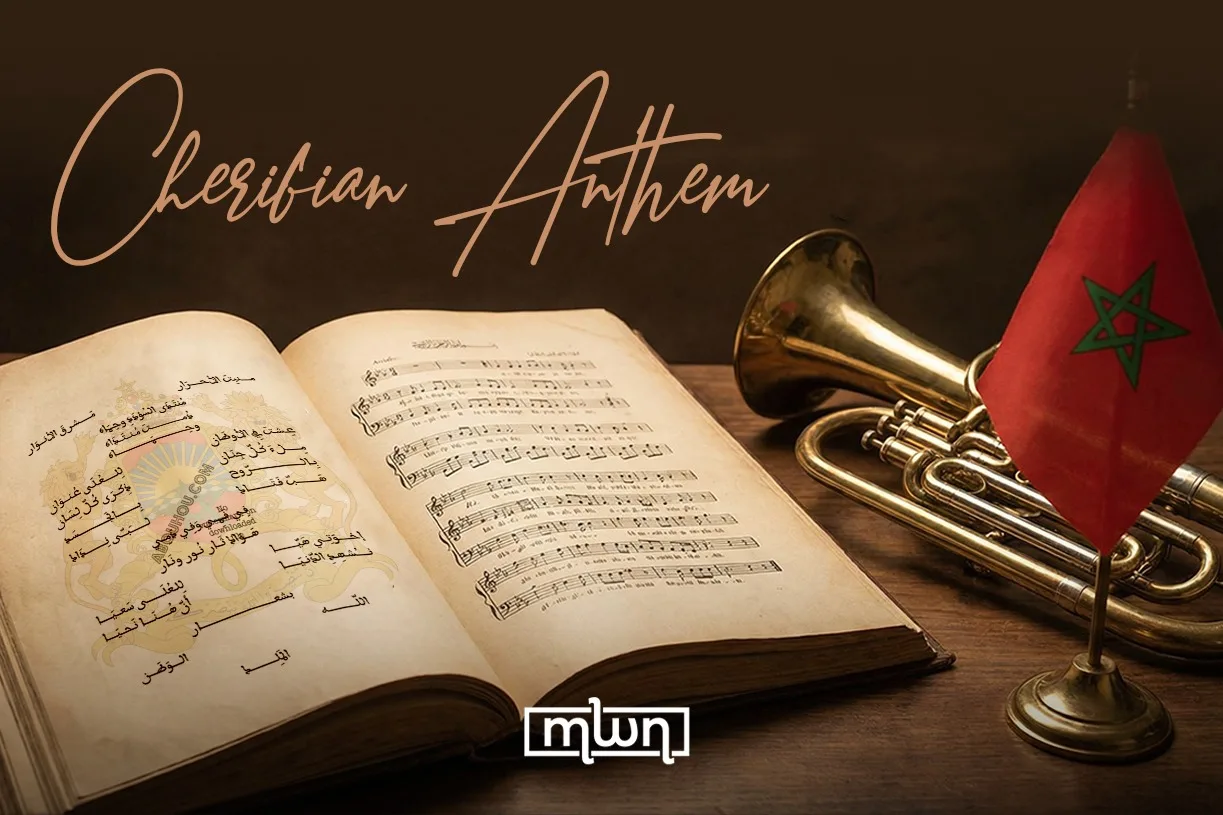
Musically, the anthem follows a stately march form, typically performed in F Minor. Its restrained pace allows for clear articulation of the lyrics while maintaining a dignified ceremonial tone.
Brass instruments dominate official renditions, emphasizing authority and unity rather than emotion or lyricism. This balance has helped the anthem remain adaptable — equally suited to royal ceremonies, school assemblies, and international sporting events.
English translation of the Moroccan national anthem
Root of the free,
Rising place of the Lights,
Forum of glory and its protector,
May you perpetuate as its forum and its protector.
May you live among the homelands
As an address for grandeur
Filling every garden
Conveyed by every tongue.
With the spirit,
With the body,
Your son has come
To answer your call.
In my mouth and in my blood,
Your love stirred up as light and fire.
Let us go, brothers!
Heading for grandeur,
Making the world witness
That we here perpetually live
With the motto:
God, Homeland, King.
A lasting national symbol
Since 1970, the anthem has accompanied Morocco at every major international sporting event, diplomatic ceremony, and national celebration. Its association with the World Cup has given it particular resonance in football culture, where it is often sung with visible emotion by players and fans alike.
The “Cherifian Anthem” functions as a compact expression of Moroccan identity, linking independence, monarchy, faith, and collective pride. Decades after its lyrics were first written, it continues to serve as a unifying voice, reminding Moroccans at home and abroad of the values that define the nation.