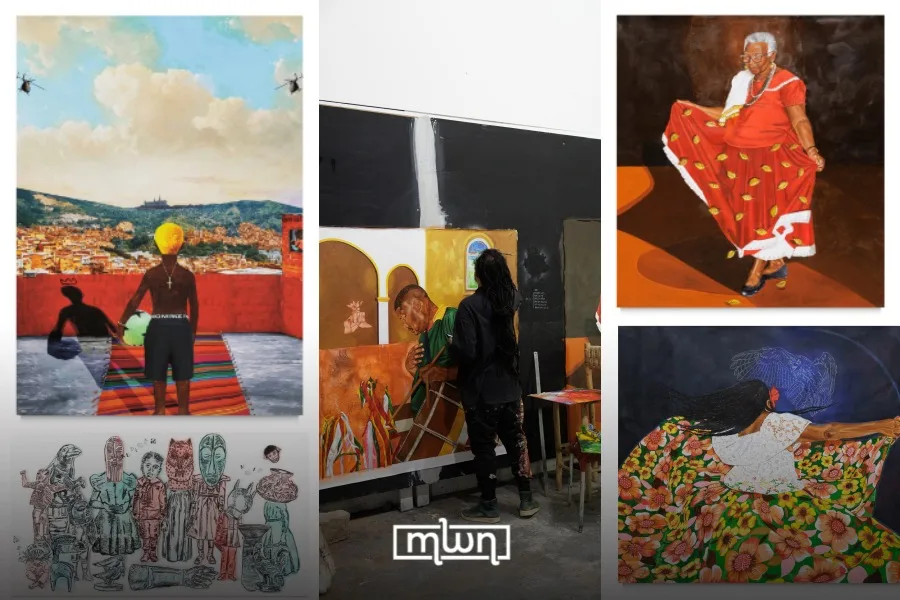
Fez — The Montresso Art Foundation is set to spotlight Brazil’s Afro-diasporic rhythms and visual cultures through “DIÁSPORA DO TAMBOR,” a new “IN-Discipline” edition running from February 7 to April 11 at the Espace d’art Montresso (Montresso Art Space) during the 1-54 Contemporary African Art Fair Marrakech.
The foundation asserts that “IN-Discipline” is a nomadic program combining artist residencies with public encounters, designed to foster dialogue within and about the African continent while giving voice each year to a distinct creative territory. The works developed through the residency are then unveiled in Marrakech within the foundation’s exhibition space as part of 1-54.
Curated by Brazilian journalist and cultural management specialist Oswaldo Carvalho, “DIÁSPORA DO TAMBOR” frames the drum as an “ancestral pulse” that crossed centuries and oceans — carried not by objects, but by memory.
The curatorial note argues that enslaved Africans, denied the right to bring instruments aboard slave ships, reconstructed their traditions in Brazil, where African rhythms intertwined with indigenous percussions and European music to shape new hybrid forms that later became tools of celebration and resistance.
A Brazil edition anchored in artists and ancestry
The exhibition brings together eight artists: Blackson Afonso, Hebert Amorim, biarritzzz, Bonikta, Cássio Markowski, No Martins, Alexis Peskine, and Mônica Ventura.
Their practices span painting, installation, collage, performance, and digital media, with several artists explicitly engaging Afro-Brazilian and indigenous traditions. The press materials highlight, among others, Hebert Amorim (also known as Artedeft) and his multimedia approach shaped by favela life and Black community listening, as well as Ventura’s recurring use of the cabaça (gourd) as a bridge between Africa and Brazil.
Alexis Peskine, presented as an artist of Russian and Afro-Brazilian heritage, is described as creating Afro-descendant spiritual embodiments charged with the energy of Minkisi — forms he builds through dimensional compositions marked by gold-leaf-clad nails driven into wood.
A public talk at La Mamounia
Ahead of the exhibition opening, the program also features a 1-54 Art Fair talk titled “Diáspora do tambor,” scheduled for February 6, at 12 p.m. at “La Mamounia” in Marrakech, moderated by Oswaldo Carvalho. Participating speakers include biarritzzz, Alexis Peskine, and Mônica Ventura.
The talk is structured in two parts: approximately 30 minutes of guided discussion followed by an open Q&A with the public. Its guiding questions focus on how a “pulsation” can travel across oceans, reinvent itself, and shape a nation’s imagination — while asking how artists reconfigure rhythm to confront history, persistent racism, and the evolving ties between Africa, Brazil, and Morocco.
The program’s opening is also set to include Ilú Obá de Min, an all-female collective from São Paulo described as a 400-member ensemble that has spent two decades honoring Afro-Brazilian culture through music and dance.
In Marrakech, “DIÁSPORA DO TAMBOR” positions Morocco not as a distant host, but as an active melting pot — where African, Afro-diasporic, and Atlantic histories can be revisited through art, and where rhythm becomes a shared language across continents.