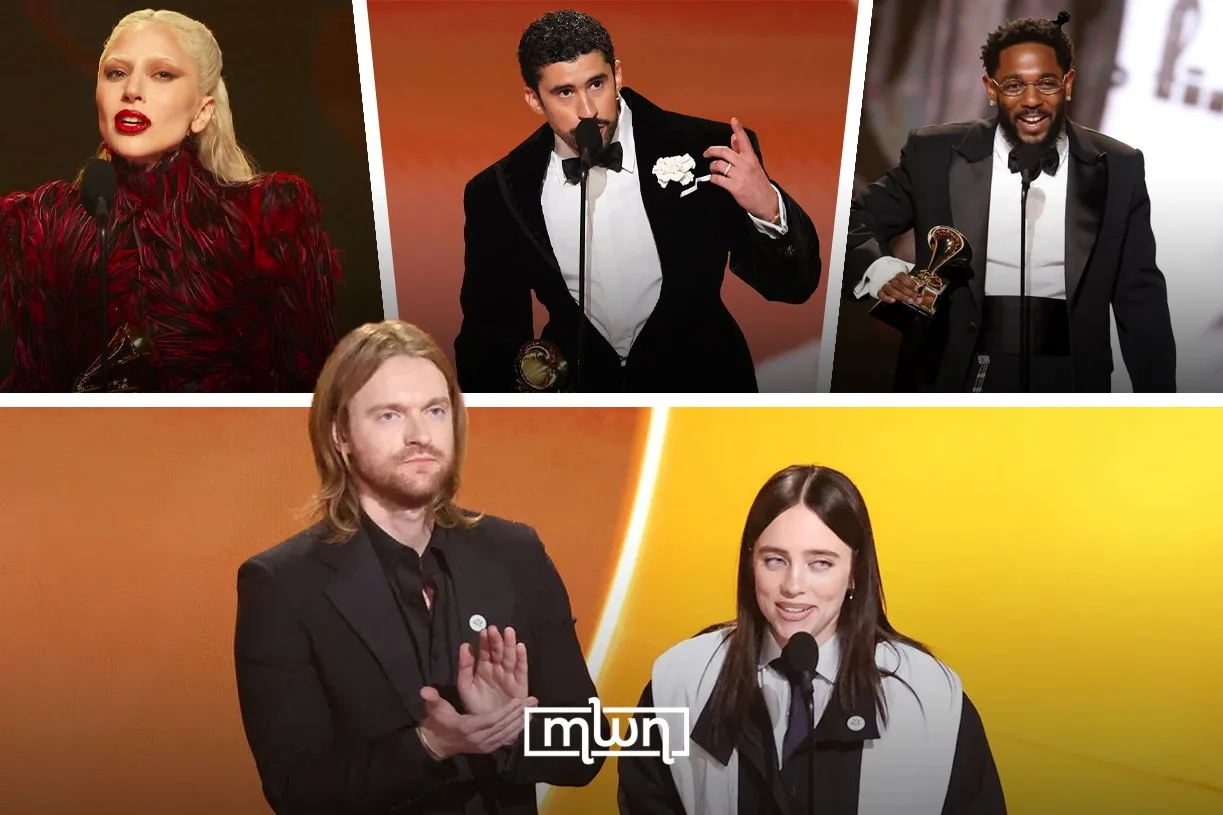
Fez — The 68th annual Grammys, held last night at the Crypto.com Arena was not only an awards ceremony but a cultural flashpoint, with Trevor Noah returning to host and several winners using their speeches to condemn US Immigration and Customs Enforcement (ICE) amid a wider wave of protests across the United States.
The night’s defining competitive headline belonged to Bad Bunny, whose “DeBÍ TiRAR MáS FOToS ” won Album of the Year, a result widely framed as a first for a Spanish-language record in the Grammys’ top category.
The biggest wins and the ‘Big Four’ story
Bad Bunny’s sweep extended beyond the top prize: he also took Best Música Urbana Album, cementing his dominance in the category.
In the other marquee awards, Billie Eilish won Song of the Year for “Wildflower,” while Best New Artist went to Olivia Dean. Record of the Year was awarded to “Luther,” credited to Kendrick Lamar with SZA.
Beyond the trophies themselves, the results reinforced two broader narratives: the Grammys’ continued internationalization at the very top of the ballot, and the staying power of artist-led genre ecosystems — rap, pop, and Latin — driving the evening’s most watched moments.
Pop, rap, and the night’s genre anchors
Pop awards saw Lady Gaga collect multiple wins, including Best Pop Vocal Album for “Mayhem” and Best Dance-Pop Recording for “Abracadabra,” keeping her in the ceremony’s central conversation even as the top prizes went elsewhere.
One of the night’s most discussed category surprises arrived in Best Pop Duo/Group Performance, which went to Ariana Grande and Cynthia Erivo for “Defying Gravity” from “Wicked,” an outcome amplified by the broader awards-season context around the film.
Rap awards were dominated by Kendrick Lamar, including Best Rap Album for “GNX,” Best Rap Song for “TV Off,” and the top-record victory for “Luther,” reinforcing his status as the evening’s most decorated force and making him break JayZ’s record as the rapper with the highest number of Grammys.
Rock, alternative, R&B, and global categories
Outside the pop-rap axis, the ceremony’s genre fields delivered notable wins that resonated with dedicated fan bases: Turnstile took Best Rock Album, while The Cure won Best Alternative Music Album for “Songs of a Lost World.”
In R&B, Leon Thomas won Best R&B Album for “Mutt,” and Kehlani won Best R&B Performance for “Folded,” highlighting a field where new-school crossover and classic vocal traditions both remained visible.
Global-facing categories also drew attention, including a high-profile win for Tyla in Best African Music Performance, as the Grammys continued to elevate non-U.S. scenes through headline-friendly recognitions.
For a complete, category-by-category record of winners across the full slate, the Recording Academy has published the official running list on its website.
‘ICE Out’ pins, speeches, and the politics inside the telecast
What separated this Grammys from many recent editions, however, was not only who won, but how openly the ceremony absorbed a nationwide political rupture.
Multiple celebrities arrived wearing “ICE Out” pins, turning a small accessory into a coordinated visual statement on the red carpet and inside the hall. Justin Bieber and Hailey Bieber took part of the small but powerful protest, alongside other performers and attendees.
Bad Bunny’s acceptance remarks, delivered partly in Spanish, explicitly referenced immigration enforcement and included the phrase “ICE out,” drawing immediate reaction across U.S. political media and social platforms.
Coverage linked the heightened mood to controversy surrounding two recent incidents in which ICE agents fatally shot Renee Good and Alex Patti in Minneapolis — events that has fueled competing public claims and intensified national debate.
Highlights beyond the trophies
Alongside political messaging, the show’s emotional pacing leaned on tributes and spectacle, including a widely noted In Memoriam segment led by Reba McEntire with Brandy Clark and Lukas Nelson.
The broader takeaway from Grammys 2026 is how little separation now exists between entertainment’s biggest stages and the political climate surrounding them. Even as the Recording Academy celebrated recordings released over the eligibility year, the ceremony doubled as a live referendum on belonging, identity, and who gets to be called “American” in a moment of national tension.