

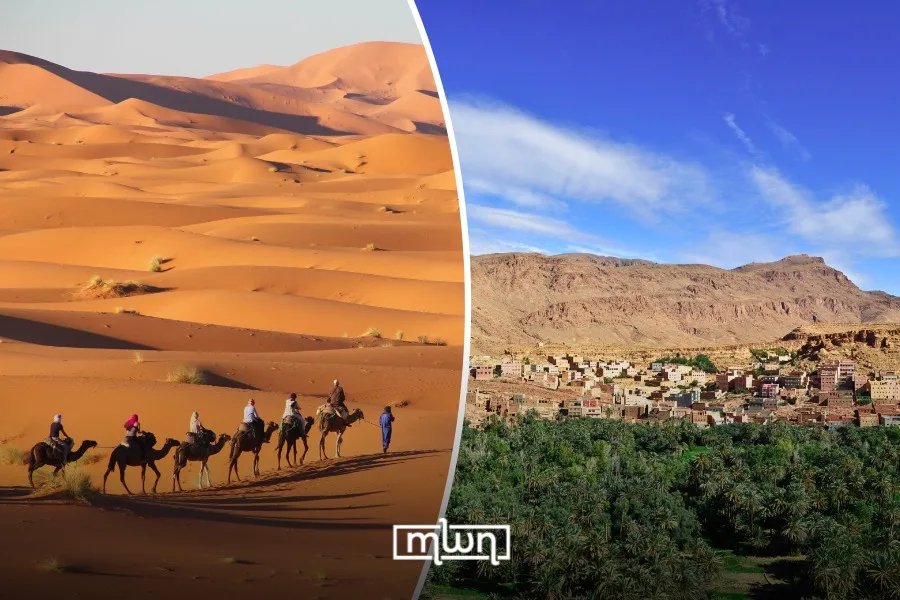
Fez — The Moroccan Sahara forms a large part of the country’s southern territory and represents one of its most distinctive geographic and cultural regions. Part of the wider Sahara Desert, this area includes sand dunes, rocky plateaus, dry valleys, and fertile oases that have supported human life for centuries.
In Morocco, the Sahara is not a single uniform landscape. It is a varied environment that extends from the southeastern borders near Algeria to the southern provinces. Its climate is arid, with low rainfall and wide temperature variations between day and night, conditions that have strongly influenced settlement patterns and economic activity.
Desert landscapes and dune systems
This vast desert includes well-known dune fields such as Erg Chebbi and Erg Chigaga. These areas are characterized by large wind-shaped dunes that can reach significant heights. Beyond the dunes, much of the Sahara consists of hamada, or rocky desert, as well as wide plains crossed by seasonal riverbeds.

These landscapes are sparsely populated but not empty. Nomadic and semi-nomadic communities have traditionally moved through these areas, adapting their routes to water availability and seasonal conditions. Additionally, tourist desert camps are a popular draw for travelers from around the world, and serve as a major source of capital for the industry in this region.
Oases and water management
Oases are central to life in the Moroccan Sahara. Valleys such as the Ziz Valley and historic regions like the Tafilalt Oasis rely on underground water sources and rivers descending from the Atlas Mountains.

Palm groves dominate these oases, with date production playing a key economic role. Traditional irrigation systems, including khettaras, have long allowed communities to distribute water efficiently in an environment where it remains scarce.
Settlement, trade, and culture
Historically, the Moroccan Sahara was integrated into trans-Saharan trade networks connecting North Africa with sub-Saharan Africa. Towns such as Rissani developed as commercial and religious centers along these routes.

The region’s population reflects a mix of Amazigh, Arab, and sub-Saharan influences. Architecture, particularly ksour and kasbahs built from earth, responds directly to desert conditions by providing insulation from heat and cold.
The Sahara today
Today, the Moroccan Sahara faces challenges linked to water scarcity, climate change, and economic transition. Tourism has grown in parts of the region, especially around dune areas and oases, while agriculture and pastoralism remain important for local communities.
The Sahara remains a fundamental part of Morocco’s geography and history. It is a living region shaped by environment, movement, and adaptation, continuing to play a significant role in the country’s present and future.