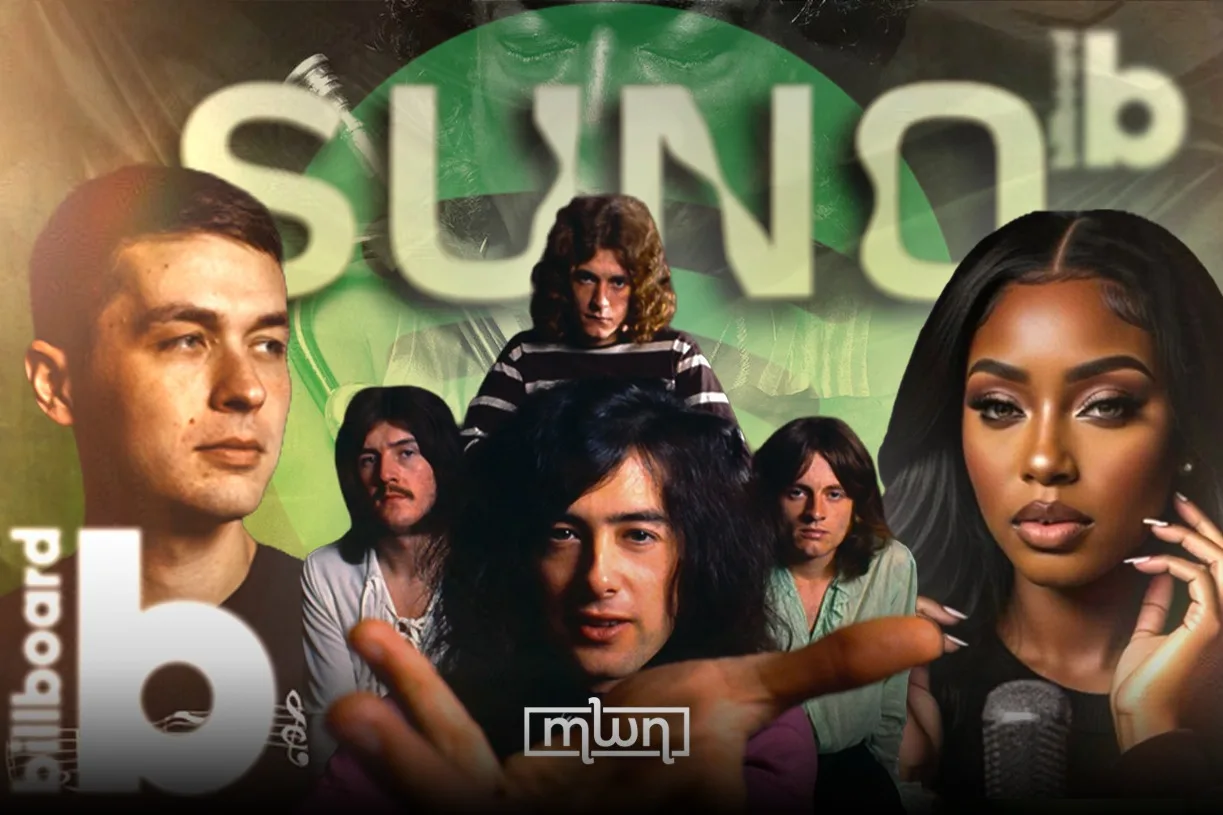
Fez — The music industry has survived radio, piracy, streaming, and TikTok. Now it faces a more existential disruption: artificial intelligence that can generate full songs in seconds. Among the most visible platforms driving this shift is Suno, an AI music generator that allows users to create complete tracks — lyrics, vocals, instrumentation, and production — from simple melodies and text prompts.
To some, Suno represents a democratizing breakthrough. To others, it signals the erosion of artistic labor and the dilution of cultural authenticity. The debate is no longer theoretical. AI-generated songs are already circulating on streaming platforms, going viral on social media, and competing for attention alongside human-made music.
Take Xania Monet for example. Created by Telisha “Nikki” Jones using Suno, this AI artist debuted across multiple charts, including Hot Gospel Songs, Hot R&B Songs, Adult R&B Airplay, and Emerging Artists, even securing a multimillion-dollar label deal.

The question is no longer whether AI can make music. It can. The question is what happens to music when anyone, musician or not, can produce it instantly.
Creation without craft?
Suno’s appeal lies in its accessibility. A user types a description (e.g., “melancholic Moroccan chaabi with modern trap beats”) and within moments receives a finished track, complete with vocals and arrangement. No studio, no instruments, no years of practice required.
This ease disrupts traditional hierarchies in music production. Historically, mastery required time: learning scales, training the voice, understanding rhythm, developing an ear for harmony. AI tools compress that process into seconds.
Supporters argue that this opens creative doors. Not everyone has access to instruments, formal training, or recording budgets. AI tools, they say, level the playing field.
Critics counter that leveling the field is not the same as cultivating skill. If music becomes prompt-based rather than practice-based, the value of discipline and lived experience risks fading into aesthetic simulation.
Expert’s opinion
Music YouTuber Adam Neely argues that the problem with tools like Suno is not that they make people interested in music; it’s the kind of interest they cultivate, and who benefits from it. In his latest video essay, he frames commercial generative AI as a shift away from learning, community, and craft toward consumption dressed up as creativity.

“Commercial generative AI is bad in ways which are different from other disruptive music technologies of the past,” he says, because “there is a sociopolitical agenda behind its adoption.”
Neely is careful to separate the technology from the business model and the power structure around it.
“I don’t have any beef with the technology of generative AI,” he says, adding that people “can do some really amazing things with it,” and that users are not “bad people.” But he rejects the familiar online framing of “pro-AI or anti-AI” as a distraction. “It’s a distraction from the real war,” he says. “The class war.”
His core critique is that commercial platforms risk turning music-making into a gamified, hyper-personalized product — fast, cheap, and isolating — rather than a social practice that builds skills and shared taste.
After surveying Suno users, he notes that many described the tool mainly in terms of convenience and speed, not musical discovery or growth. “In other words,” he concludes, “Suno lets you make the same music faster, cheaper, and lonelier.”
The ethics of influence
Perhaps the most controversial aspect of Suno is its ability to mimic style. AI systems are trained on vast datasets of existing music, absorbing patterns, structures, and vocal textures. The result can resemble specific genres, or even individual artists, without direct attribution.
This raises legal and moral questions. If an AI generates a song that sounds unmistakably like a particular artist, who owns that sound? Is style intellectual property? And what happens to artists whose lifework becomes training data?
Across the globe, musicians are pushing back. Lawsuits have already emerged against AI companies for allegedly using copyrighted material without permission. The issue is not just about royalties, but about identity.
Music is not merely pattern; it is biography. It carries accent, trauma, memory, and geography. When AI replicates style, it extracts surface elements while bypassing lived context.
Cultural authenticity at risk?
In countries like Morocco, where music is deeply tied to heritage, from Andalusi orchestras to chaabi, gnawa, and Amazigh traditions, the rise of AI music carries specific cultural stakes.
What happens when AI can generate a “Moroccan wedding song” without ever setting foot in a Moroccan wedding? When it simulates gnawa rhythms without understanding their spiritual roots?
The danger is not that AI will erase tradition overnight. The greater risk is gradual flattening: culture reduced to sonic motifs detached from history. A digital chaabi loop might sound convincing, but it lacks the communal energy of a live orchestra and the social rituals that give the genre meaning.
This is not nostalgia. It is about context. Music traditions are ecosystems. Remove them from their human networks, and they become aesthetic shells.
The economics of replacement
Beyond authenticity lies economics. If content creators can generate background music instantly, why hire composers? If record labels can experiment with AI-generated pop tracks at minimal cost, why invest in emerging artists?
Suno and similar platforms could shift industry incentives. Music may become more abundant but less valued. The paradox of digital culture persists: as supply explodes, individual worth declines.
For independent musicians already navigating streaming-era economics, AI introduces new competition, but not from other artists, but from algorithms.
At the same time, some producers see AI as a tool rather than a threat. Used thoughtfully, it can assist with drafts, inspiration, and experimentation.
The difference lies in whether AI supports human creativity or replaces it.
Who is the author?
Perhaps the deepest philosophical question concerns authorship. When a user prompts Suno to create a song, who is the artist? The person who wrote the prompt? The engineers who built the model? The dataset of musicians whose work trained it?
AI music blurs lines of credit and accountability. Art has long been a space where identity matters — where a voice carries the weight of its maker. When songs are generated without personal narrative, the emotional contract between artist and listener shifts.
Listeners may still feel moved by an AI-generated melody. But does knowing that no human lived the heartbreak behind it change the experience?
For some, yes. For others, the distinction is irrelevant. Music, they argue, is about sound, not biography.
Why imperfection matters in real music
One of the quiet casualties of AI-generated music is imperfection. Real music breathes. It speeds up slightly in moments of excitement. A voice cracks under emotion. A drummer drags behind the beat after a long night. These so-called “mistakes” are not flaws; they are fingerprints.
In traditional Moroccan chaabi, for example, a singer may stretch a phrase beyond strict tempo because the crowd demands it. In gnawa rituals, rhythm bends to spiritual intensity rather than metronomic precision. These micro-deviations are not technical failures; they are social signals. They tell us a human body is present.
AI music, by contrast, is almost unnervingly clean. It does not tire. It does not hesitate. It does not feel nerves before a high note. Its timing is mathematically stable, its pitch corrected by default, its phrasing optimized for symmetry. The result can sound polished — but polish is not personality.
Sloppiness, in the right context, is evidence of risk. And risk is what makes performance thrilling. When everything is algorithmically perfected, the danger disappears — and with it, some of the magic.
In that sense, the crack in the voice may be more authentic than the flawless note. Because it tells us someone was there.
When imperfection became immortal
Take classic rock, especially from the late 1960s and early 1970s, when recording meant magnetic tape, physical splicing, and often just four tracks. Studio time was expensive. Editing was manual. Musicians had to commit to performances rather than polish endlessly. Yet many of those recordings remain iconic precisely because of their imperfections.

Listen to “Whole Lotta Love” by “Led Zeppelin.” The drums are not quantized. The guitar bleeds. The mix surges and swells unpredictably. There is grit, air, and slight imbalance. It feels alive. Or take “Gimme Shelter” by The Rolling Stones — Merry Clayton’s voice famously cracks during her climactic vocal take. That crack was not corrected. It was kept. It became one of the most haunting moments in rock history.
Even The Beatles, working with limited multitrack equipment at Abbey Road, produced songs like “Twist and Shout,” recorded in a single exhausting session. John Lennon’s shredded vocal was the result of physical strain. Today it would likely be tuned or re-recorded. Instead, its rawness became part of its myth.
Compare that to AI-generated music, which can simulate distortion and humanized timing, but does so intentionally, algorithmically. The difference lies in origin. In a four-track era, imperfection was the cost of reality. Today, imperfection is often an effect applied after perfection.
Jazz and the energy of the unrepeatable
Jazz offers perhaps the clearest argument for imperfection as power. In jazz, the same song is never truly the same twice. A standard performed by Miles Davis in one concert would carry a different mood, tempo, and emotional weight the next night. Improvisation reshapes structure in real time. Musicians respond to each other’s breathing, phrasing, and risk-taking.

Listen to live versions of My Favorite Things by John Coltrane — the melody becomes a launchpad, expanding or contracting depending on the room, the audience, and the spiritual intensity of the moment. Notes bend. Rhythms stretch. Silence becomes as important as sound.
This elasticity cannot be fully scripted. Jazz thrives on unpredictability. The slight hesitation before a solo, the unexpected harmonic turn, the drummer pushing the tempo just a touch — these choices generate energy that feels alive precisely because it is not pre-programmed. In jazz, imperfection is not tolerated; it is embraced as opportunity.
The road ahead
Suno is not an isolated phenomenon. It is part of a broader technological wave transforming image, text, and sound production. Resistance alone will not halt its expansion.
The future likely lies in hybrid models. Artists who integrate AI tools while retaining creative control may define the next phase of music. Meanwhile, audiences will decide what they value: efficiency or authenticity, abundance or depth.
In Morocco and beyond, the challenge is not to reject innovation outright, but to ensure that technology does not hollow out culture. AI can generate music, but it cannot attend a wedding, sit in a studio until dawn, or inherit a grandmother’s lullaby.
Those human layers remain irreplaceable — for now.
Suno proves that machines can compose. What remains to be seen is whether they can mean.