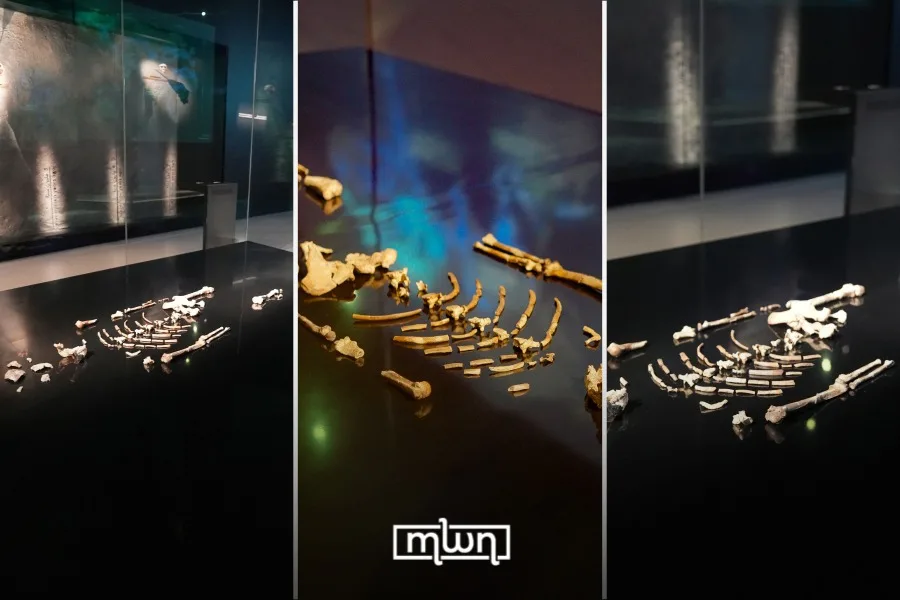
Casablanca – Abu Dhabi’s Natural History Museum is offering visitors more time to see Lucy, the 3.2-million-year-old Australopithecus afarensis fossil, now on display until March 23.
Featured in The Human Story gallery, the exhibit offers an encounter with a distant past while reflecting on evolution, survival, and the passage of time.
Lucy’s fossil was discovered in 1974 by American paleoanthropologist Donald Johanson and his team at the Hadar site in the Afar Triangle of Ethiopia.
Her skeleton preserves about 40% of the body, giving scientists a rare glimpse into how early humans moved, lived, and survived.
The nickname “Lucy” is a nod to the Beatles’ song “Lucy in the Sky with Diamonds,” which was playing during the team’s celebration the evening of her discovery.
What made this skeleton especially important was what her bones revealed about how early human relatives moved. Although her brain was small, similar in size to that of a chimpanzee, the shape of her pelvis and leg bones showed clear adaptations for walking upright on two legs.
Lucy’s discovery didn’t just expand scientific knowledge, it also sparked global fascination with human origins. It provided one of the first clear examples of how early humans combined humanlike and apelike traits, offering a window into life over three million years ago.
Visitors today can see the evidence firsthand: her arm, leg, and pelvic bones which reveal how she moved in that environment, while subtle features in her hands and feet show her ability to climb to heights.
This one of a kind opportunity allows people to connect with an ancient story, one that offers a bonding with past ancestors.
If you’re in Abu Dhabi, you can plan your visit, explore the museum, and book tickets at nhmad.ae.
Admission is free for visitors under 18 and over 60, while adult tickets are AED 70 (MAD 174)
Read also: Morocco’s Phosphates Yield a New Fossil Shark With Peculiar Teeth