

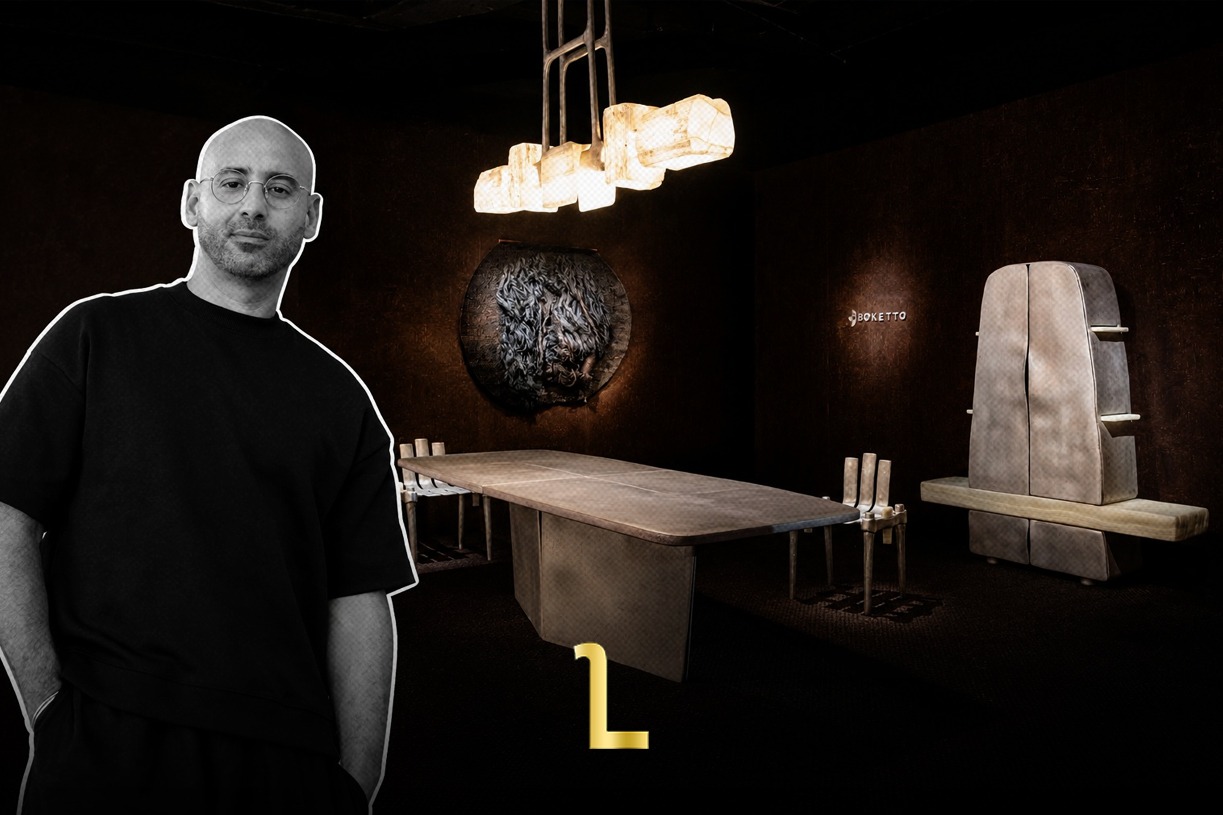
Fez — An oceanographic boundary is an unlikely starting point for a chair. For French-Moroccan designer Moulay Hafid Sdikiene, it provides a way to think about how different materials can occupy the same object.
His “Halocline” collection takes its name from a layer of water where salinity changes sharply. The designer translates that encounter into furniture and lighting, placing metal and stone together without disguising the distinction between them.
The Paris-based founder of Aulyom Studio presented work from the collection with Galerie Boketto at PAD London, held October 13–18.
His TOR chair also features in “THE EXHIBITION #4” at The Gallery in Beaulieu-sur-Mer, running through December 12. The venue documents its combination of recycled cast aluminum and jade green onyx.
Leaving the making visible
Boketto describes a production process that moves between digital precision and physical intervention.
Designs begin with digital modeling. Metal components undergo sand casting and extensive hand finishing, while onyx elements are machine-shaped before further sculpting and texturing.
Grinding, sanding, and welding leave controlled marks on the surfaces. These traces become part of the finished object.
The collection includes seating, a table, a cabinet, and lighting. Across those forms, Sdikiene repeatedly returns to the junction: the place where separate components meet and the object reveals its construction.
In the HALO ceiling light, illumination passes through the material, making the relationship between stone, metal, and light central to the design.
A decade learning through making
Before developing his own studio, Sdikiene spent nearly ten years working within designer Éric Schmitt’s practice, according to his gallery biography.
That experience helped shape an approach in which an object’s construction matters as much as its silhouette. His work spans furniture, lighting, and sculptural objects, with particular attention to assemblies and surfaces.
He was also a finalist for the Arab World Institute’s design prize in 2025.
With “Halocline,” the meeting of materials becomes the subject itself. Stone remains visibly stone, metal retains its texture, and the seam between them gives the object its character.