

Fez — Tunisian artist Walid Ardhaoui will present “The Lives We Imagine” at Loft Art Gallery in Casablanca, bringing together paintings that explore the distance between people’s everyday realities and their dreams.
Opening on Wednesday, November 4, the solo exhibition will run through November 27, offering audiences an encounter with Ardhaoui’s distinctive approach to contemporary portraiture.
His compositions combine meticulously detailed human figures with spontaneous drawings inspired by childhood, placing two seemingly opposing visual languages within the same artwork.
The resulting images explore identity, migration, social inequality, and the aspirations of people whose experiences often remain outside public attention.
Born in Kairouan, Tunisia, in 1978, Ardhaoui lives and works in Tunis, where his artistic practice focuses on individuals navigating difficult social and economic circumstances.
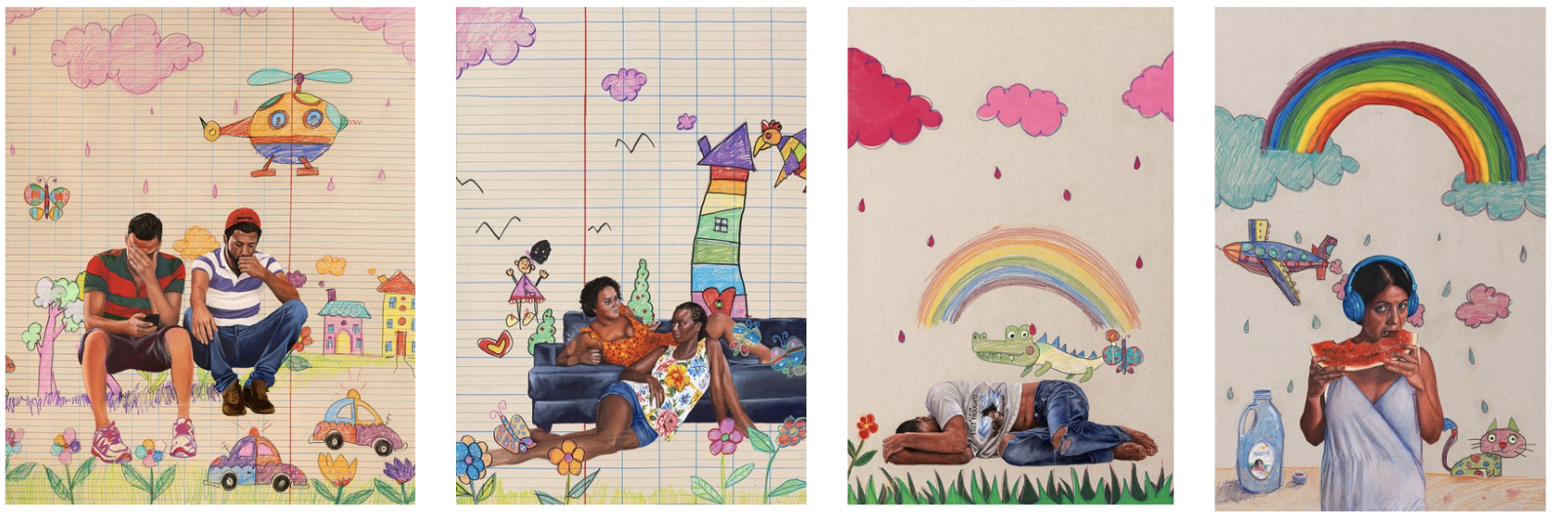
Through portraits of unemployed young people, migrants, and people experiencing homelessness, he examines how personal dreams persist even when circumstances make them difficult to achieve.
Between childhood dreams and adult realities
One of the defining characteristics of Ardhaoui’s work is the contrast between the precision of his portraits and the apparent simplicity of the drawings surrounding them.
Using oil and acrylic paint, he renders human figures with remarkable attention to facial expressions, clothing, and physical details.
These realistic representations coexist with colorful illustrations resembling children’s drawings, including imaginary scenes, playful shapes, and symbols of personal aspirations.
The contrast creates a visual tension between the world people inhabit and the possibilities they continue to imagine.
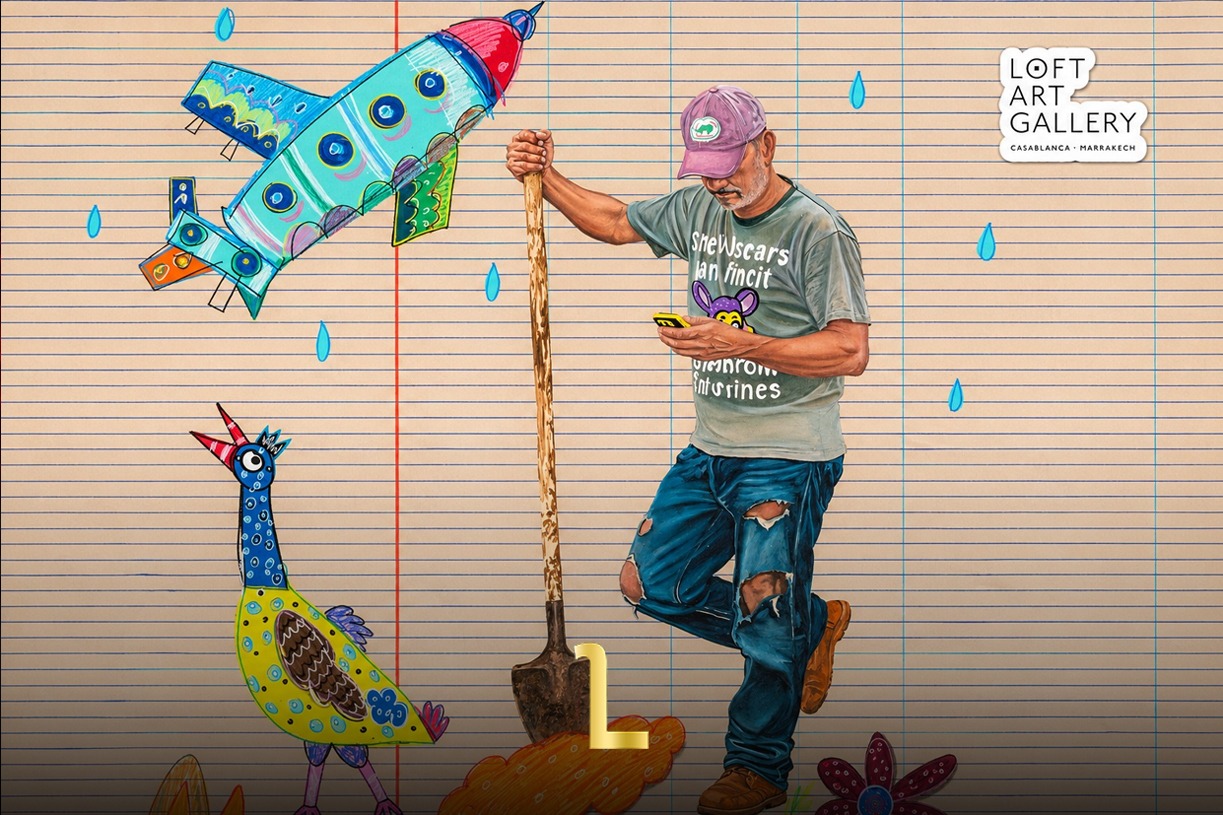
In one artwork reproduced in the exhibition’s announcement, a realistically rendered man stands against a background resembling lined notebook paper.
Around him appear a colorful rocket, a giraffe, flowers, and other playful drawings, introducing an imaginative dimension to an otherwise familiar scene.
The composition brings the ordinary and the extraordinary into the same space, allowing childhood imagery to interrupt the seriousness of adult life.
According to the gallery, this approach reflects Ardhaoui’s interest in the fragile boundary between lived experience and imagination.
The drawings do not merely decorate the portraits. They introduce another perspective on the people depicted, suggesting dreams and emotions that cannot be understood through appearances alone.
Giving visibility to overlooked lives
Ardhaoui’s interest in social marginalization developed through observing people whose everyday struggles rarely become the subject of artistic attention.
His work frequently portrays individuals experiencing unemployment, economic uncertainty, displacement, and the pressures associated with contemporary consumer culture.
Rather than presenting these circumstances exclusively through suffering, he introduces color, humor, and imagination to emphasize the complexity of individual experiences.
The people depicted become more than representatives of social problems, emerging as individuals with personal histories and aspirations.
In a 2024 interview with Canvas magazine, Ardhaoui recalled painting a homeless friend in Morocco who became emotional upon seeing his portrait at an exhibition.
The experience demonstrated how artistic representation could offer recognition to someone who had rarely felt valued or visible.
Ardhaoui also discussed the relationship between migration and imagination, particularly among young people whose expectations of life abroad are shaped by media and popular culture.
His paintings examine the difference between those expectations and the complicated realities facing people who pursue opportunities beyond their home countries.
Yet his approach avoids reducing his subjects to their hardships.
Instead, his combination of realism and childlike imagery invites viewers to consider the hopes and personal identities that exist alongside difficult circumstances.
Drawing beyond the rules
Childhood occupies a central place in Ardhaoui’s artistic philosophy, particularly the freedom children demonstrate when creating without worrying about conventional artistic standards.
His colorful drawings deliberately depart from academic expectations of proportion, perspective, and composition.
Many appear against backgrounds resembling school notebook pages, whose familiar lines introduce another layer of meaning.
In his earlier interview, Ardhaoui explained that the restrictions of school notebooks had frustrated him during childhood.
He remembered being expected to remain within prescribed margins, an experience that later influenced his desire to draw freely across those boundaries.
His deliberately unpolished illustrations therefore represent more than a stylistic choice.
They also express a refusal to accept rigid limitations on creativity and imagination.
Ardhaoui sometimes works from children’s drawings and experiments with his own drawing techniques to recover a less controlled approach to artistic expression.
He has described using his non-dominant hand or drawing without looking directly at the canvas to challenge the precision developed through professional training.
These techniques create a deliberate contrast with the concentration required to produce his hyperrealistic portraits.
While the portraits demand patience and technical control, the surrounding drawings explore the freedom of creating without predetermined outcomes.
Together, the two approaches reflect his interest in the relationship between experience and innocence, suggesting that adulthood does not necessarily erase the imagination developed during childhood.
A Tunisian perspective in Casablanca
Ardhaoui graduated in interior architecture from the Higher Institute of Fine Arts in Tunis in 2006 before developing his career in painting and drawing.
His previous exhibitions include “Al Mahjouz” in Tunisia in 2016, “Isthme” in Carthage in 2017, and “Thresholds” in Jeddah in 2019.
He has also participated in international events, including the 1-54 Contemporary African Art Fair in London in 2019 and the Investec Cape Town Art Fair in 2020.
His work has entered collections including the Kamel Lazaar Foundation and the Museum of African Contemporary Art Al Maaden (MACAAL) in Marrakech.
The Casablanca exhibition continues his connection with Morocco’s artistic scene, where his work has previously appeared in group exhibitions.
In September 2026, Loft Art Gallery included Ardhaoui in “Hamasāt al-Fajr,” the collective exhibition inaugurating its new Casablanca space.
Founded in 2009 and led by Yasmine and Mohamed Berrada, the gallery has developed a program connecting Moroccan artists with contemporary voices across Africa and the Arab world.
For Yasmine Berrada, co-founder of Loft Art Gallery, Ardhaoui’s work offers an opportunity to recognize people whose personal stories rarely receive attention.
She said his portraits bring visibility to overlooked individuals while highlighting the “dreams, hopes and aspirations that connect us all.”
Berrada also emphasized the importance of presenting artists whose work encourages dialogue about identity, migration, and belonging.
Visitors can discover more about Ardhaoui through the gallery’s official website.
Imagining lives beyond their circumstances
“The Lives We Imagine” brings together themes that resonate across North Africa, where migration, economic insecurity, and questions of social belonging shape many personal experiences.
Ardhaoui’s paintings approach these realities without suggesting that an individual’s circumstances define the limits of their identity.
The contrast between realistic portraits and imaginative drawings encourages viewers to recognize the difference between what can be observed and what remains hidden within someone’s aspirations.
In doing so, the exhibition also challenges conventional expectations of portraiture, presenting the imagination as an important part of understanding the people represented.
The exhibition offers an opportunity to encounter a Tunisian artistic perspective that connects personal experience with wider social questions.
Ultimately, Ardhaoui’s work suggests that the lives people imagine deserve attention alongside the lives they are currently living, particularly when their dreams remain their most enduring source of possibility.