

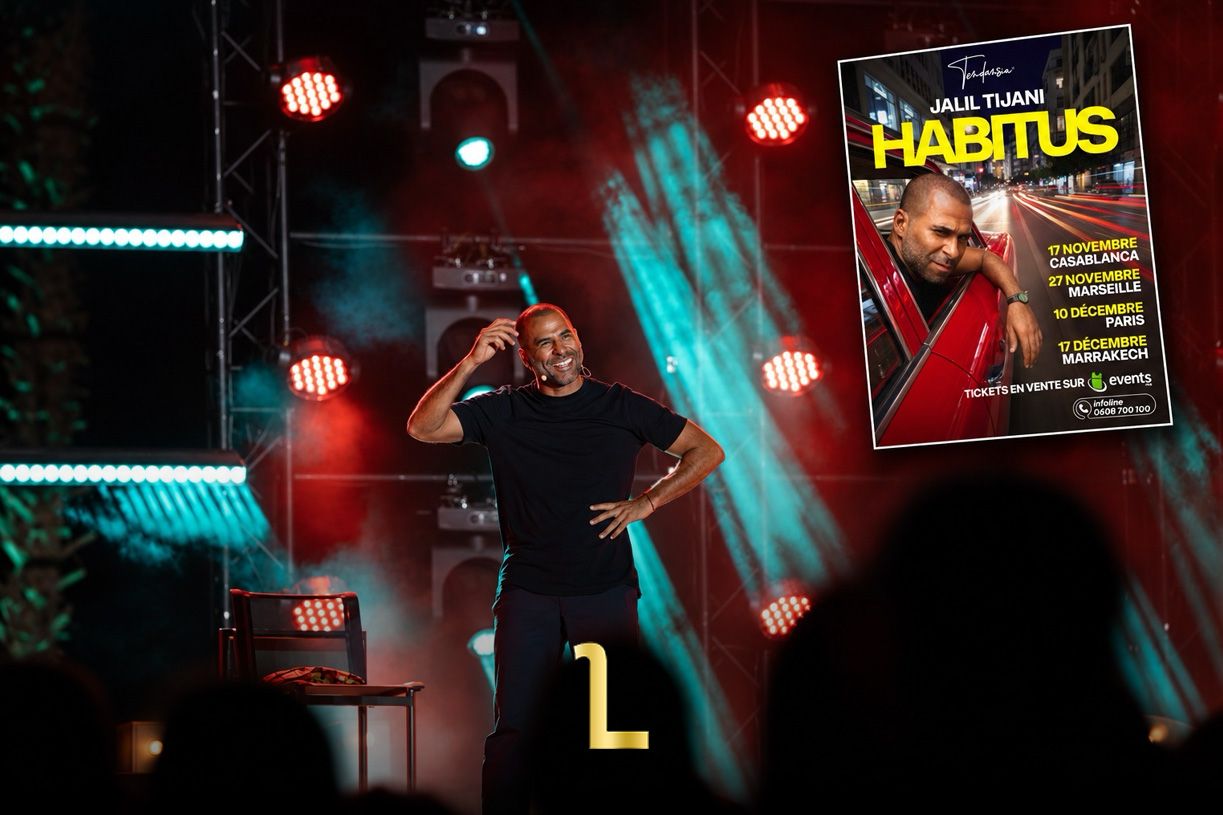
Fez — Moroccan comedian Jalil Tijani is continuing his “Habitus” tour with performances scheduled in Casablanca, Paris, Marseille, and Marrakech following a sold-out opening in the French capital.
The comedian introduced his second one-man show in Paris on October 8, marking the beginning of a new chapter in his career.
Produced by Tendansia, “Habitus” explores the habits, social expectations, and inherited behaviors that influence how people think, act, and understand themselves.
Through observational humor, personal anecdotes, and a collection of recognizable characters, Tijani examines the contradictions hidden within ordinary situations.
The tour will resume on November 17 at Casablanca’s Studio des Arts Vivants (Performing Arts Studio), before continuing to France and returning to Morocco in December.
Finding humor in the habits we inherit
The title “Habitus” comes from sociology, where the concept describes how people’s environments and experiences shape their attitudes, preferences, and everyday behavior.
Tijani approaches the subject through comedy, turning familiar routines and unconscious habits into opportunities for laughter and reflection.
His performance examines the behaviors people inherit from their upbringing, the expectations they absorb, and the assumptions they rarely stop to question.
Rather than presenting these ideas through academic explanations, he transforms them into humorous situations drawn from personal experience and everyday observations.
The show combines expressive characters with moments of self-deprecation, encouraging audiences to recognize themselves in the contradictions unfolding on stage.
According to the production team, the performance balances accessible comedy with questions about the invisible influences shaping individual personalities.
Its humor often emerges from ordinary gestures and social codes that become absurd when examined from a different perspective.
Performed in French and Moroccan Arabic, “Habitus” also reflects the cultural experiences of audiences familiar with moving between languages and social environments.
A comedian shaped by several cultures
Tijani’s interest in cultural differences reflects a personal journey that began long before his professional career in comedy.
Born in The Hague, Netherlands, he spent part of his childhood in Canada before moving to Rabat at the age of 10.
Growing up across different countries exposed him to contrasting customs, languages, and expectations, experiences that continue to influence his comedic writing.
He later moved to Paris, where he studied acting for three years at the École du Jeu (School of Play).
That theatrical training helped develop his approach to characterization, physical expression, and the construction of scenes built around recognizable personalities.
In 2015, he returned to Morocco to pursue his artistic career, gradually establishing a distinctive style of observational comedy.
His earlier show, “Jeux de société” (“Social Games”), explored social behavior and the contradictions of contemporary Moroccan life.
With “Habitus,” the focus becomes more personal, examining how individuals reproduce the habits and values that surround them.
The change allows Tijani to approach familiar social questions through the experiences that shaped his own identity.
From a sold-out Paris debut to four new performances
The October 8 premiere in Paris attracted a full audience, according to Tendansia, whose announcement highlighted the comedian’s connection with Morocco’s diaspora.
For Moroccans living abroad, Tijani’s humor draws on shared cultural references that can acquire different meanings outside their country of origin.
His performances turn these experiences into moments of recognition, allowing audiences to laugh at situations they may have previously considered uniquely personal.
Following the Paris debut, the tour continues with four announced performances across Morocco and France.
The first takes place on Tuesday, November 17, at the Studio des Arts Vivants in Casablanca, beginning at 8:30 p.m.
Tickets range from MAD 300 to MAD 500 ($30.5 to $60), depending on seating category, and audiences can book through Events.ma.
The production team has also announced a return to Paris on November 26 at La Scène Parisienne (The Parisian Stage).
However, that specific date was not independently confirmed on the venue’s publicly available ticketing page as of November 3.
Audiences can consult the theater’s official website for updated performance information.
The comedian will then perform in Marseille on November 27 at Le Vig’s, with the show scheduled to begin at 9:30 p.m.
The Marseille date also appears in the city’s published cultural events calendar.
The tour’s final currently announced stop will take place on December 17 at Meydene in Marrakech, beginning at 8:30 p.m.
Tickets for Marrakech range from MAD 250 to MAD 400 ($25 to and $41) are available to purchase online.
Tendansia has indicated that additional performances are expected in 2027, both in Morocco and internationally, although further dates have not yet been announced.
When comedy becomes a mirror
Beyond its tour schedule, “Habitus” reflects a broader interest in comedy that examines the relationship between personal identity and collective experience.
Tijani’s performances draw attention to the small behaviors people repeat without noticing, revealing how cultural expectations can become deeply ingrained.
The subject resonates particularly with audiences navigating multiple cultural environments, where familiar habits can become more visible through comparison.
By exaggerating ordinary situations, he invites audiences to reconsider what they have learned to accept as natural or inevitable.
His return to Moroccan stages also follows a successful encounter with diaspora audiences, extending the conversation between those living at home and abroad.
Through “Habitus,” Tijani suggests that some of the most revealing questions about identity begin with the simplest observation of everyday life.
The result is a comedy show that seeks not only to entertain audiences, but also to encourage them to recognize the invisible habits shaping their own experiences.