

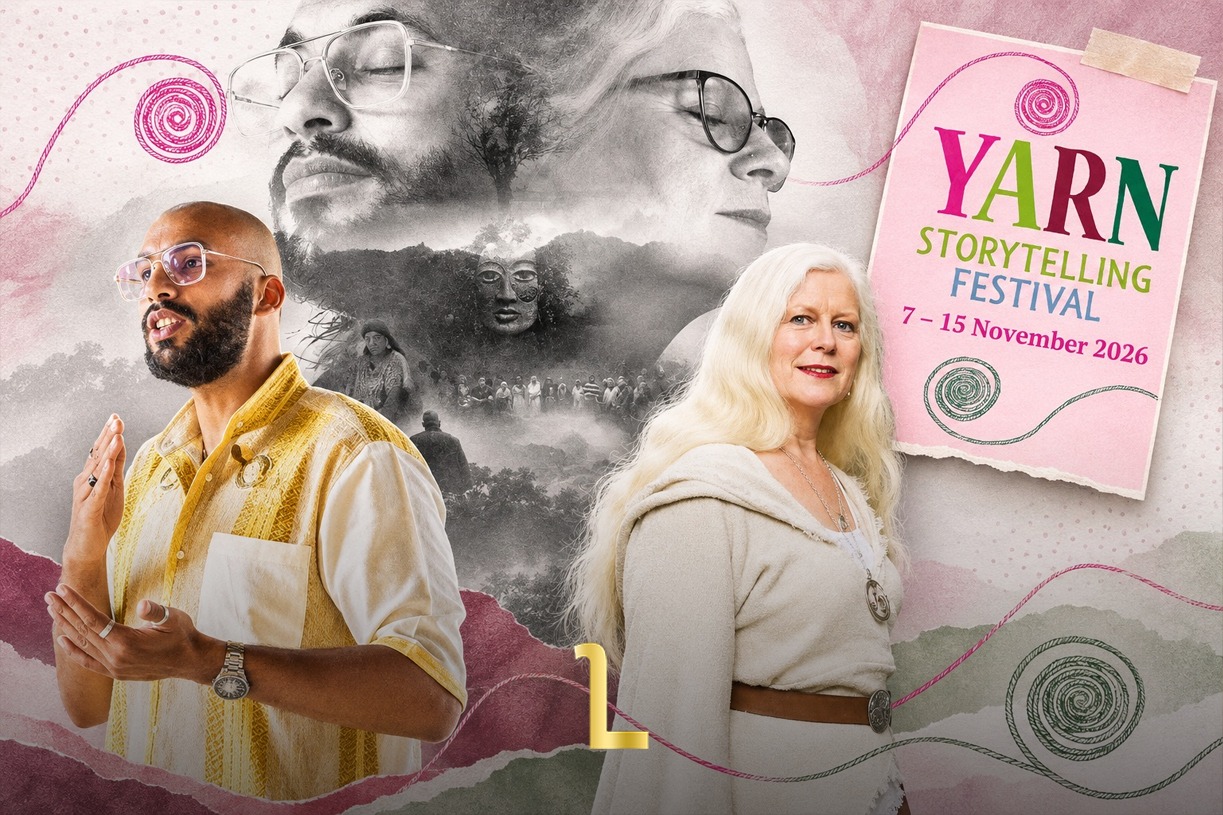
Fez – When Eimear Burke tells an Irish story, she sometimes brings along a silver branch hung with bells.
In one of her favorite tales, a branch like it lures a king into a bargain he comes to regret. In Burke’s hands, the bells do something gentler. She rings them to take her listeners with her as the story crosses into the Otherworld.
Zouhair Khaznaoui learned his craft in Marrakech, where a storyteller can make a stage out of the circle of people who stop to listen.
When he met Burke at the Marrakech International Storytelling Festival, she had come as an invited performer. By the time they met again in Ireland, he had a question he wanted to pursue with her. What might someone familiar with Moroccan accounts of jinn hear in an Irish story about the Aos Sí, the otherworldly beings of Irish folklore?
That encounter grew into “Invisible Threads,” a 55-minute documentary conceived and narrated by Khaznaoui. The film follows two years of research and artistic exchange between Morocco and Ireland. It will have its world premiere on November 15 at the YARN Storytelling Festival in Bray, on Ireland’s east coast.
The storyteller who stayed in Marrakech
In 2016, Khaznaoui was studying English literature at Cadi Ayyad University while learning an older way of telling stories from Haj Ahmed Ezzarghani. A year later, he was sharing Moroccan tales through the Clock Storytelling programme.
He went on to co-found the Marrakech International Storytelling Festival, bringing performers from abroad into the city where he had learned to hold a crowd himself.
Marrakech remained, as he told “The Heart of Storytelling” in October, “my stage, my laboratory, and my muse.” One thing that interested him about Ireland was how much of a country’s history a visitor could miss even after learning its dates, wars, and rulers.
A family might remember a remedy, a musician might carry a prayer in a melody, or someone might still know the path to a sacred spring. Who would think to put any of that on a map?
The druid with the silver branch
Burke has her own way of answering that question. She likes to take listeners to an Irish site and tell a tale there, so that when the landscape enters the story, the audience can look up and see it. Sometimes she sings or plays the harp. In Kilkenny, she and her late husband, Howard Campbell, founded a druid grove at their home. She also works as a counseling psychologist and a celebrant, accompanying families through occasions ranging from baby namings to funerals.
The silver branch offers a glimpse of how she works. In the tale of Cormac Mac Airt, the king first falls under its enchantment and makes a poor bargain.
Later, as Burke recounts, the same branch becomes a source of healing and delight. Its meaning changes as Cormac does. A listener who remembers only that it was magical has missed much of what happened to the man who held it.
What travels with a story
During visits to both countries, Khaznaoui and Burke explored beliefs about healing, prophecy, and encounters with the unseen. Their Moroccan research included the chouafa, a woman people consult for divination.
In Ireland, they considered the Aos Sí and the landscapes associated with them. Across both visits, one of Khaznaoui’s questions concerned the people who turn to these traditions in the first place: “How does a community care for someone who is suffering?”
Khaznaoui wanted a collaborator who might disagree with him. He had grown up Muslim in Marrakech and trained as a hakawati, a teller of tales. Burke came to the work from another generation, with experience in Irish ceremony, music, and psychology.
“I did not want to work with someone who would simply confirm my ideas,” he writes in his reflection on the film.
On November 15, both storytellers will be at Mermaid Arts Centre in Bray for the 7:30 p.m. premiere. A conversation with the audience and a book presentation will follow. After two years of asking questions in each other’s countries, Khaznaoui and Burke will take some from the room.