

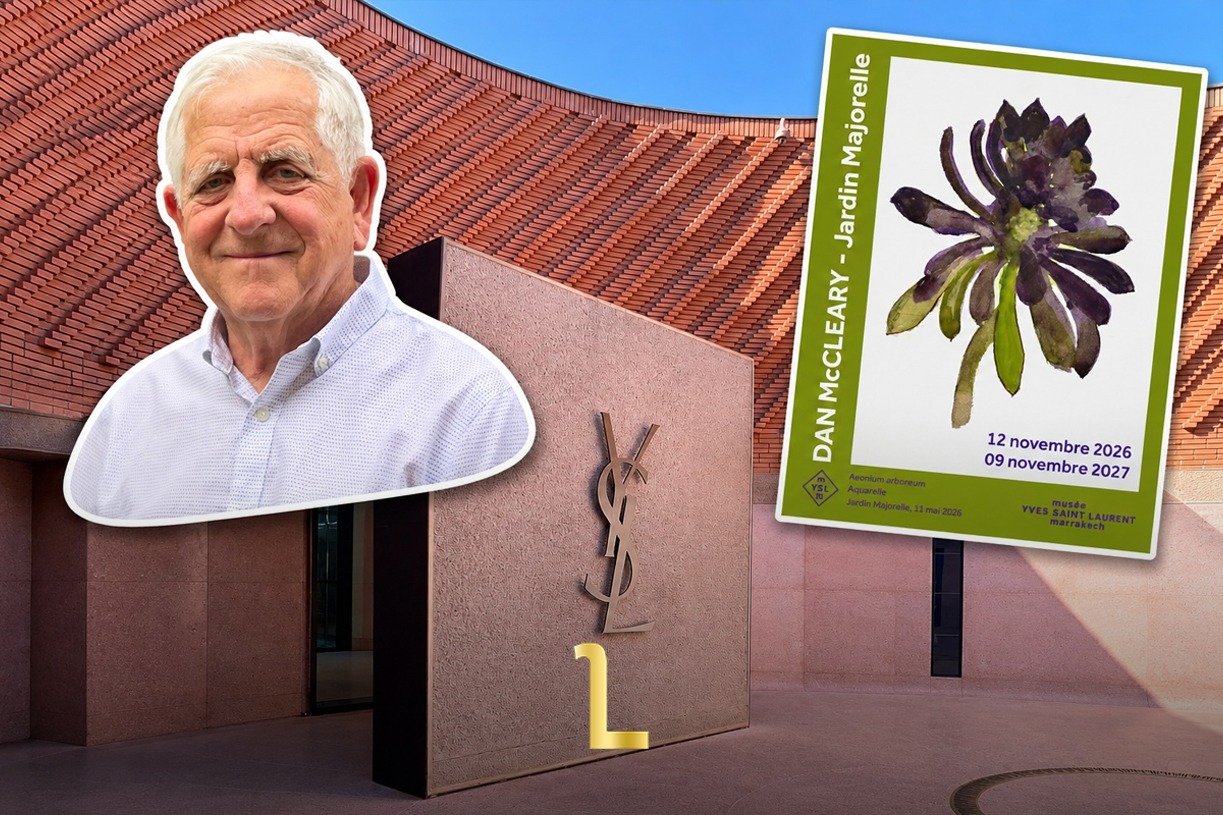
Fez — For American painter Dan McCleary, the plants of Marrakech’s Jardin Majorelle became more than botanical subjects. Over several months, they gradually transformed into figures inhabiting a world between observation and imagination.
His exhibition, “Dan McCleary – Jardin Majorelle,” opened on November 12 at the Musée Yves Saint Laurent Marrakech, presenting works created during two residencies at the celebrated garden in spring and autumn 2026.
Running until November 9, 2027, the exhibition brings together drawings, watercolors, and oil paintings produced entirely on-site.
Presented in the museum’s photography gallery, the exhibition follows McCleary’s transition from precise botanical illustration to a more intuitive and imaginative interpretation of the natural world.
When plants replace people
Born in 1952, McCleary is a Los Angeles-based figurative painter known for depicting ordinary people in everyday settings.
His paintings often portray solitary figures in offices, restaurants, and hair salons, capturing quiet moments of contemporary life.
His works are held in major American collections, including the Metropolitan Museum of Art, Los Angeles County Museum of Art, Hammer Museum, and Harvard Art Museums.
At Jardin Majorelle, however, the artist encountered an entirely different kind of subject.
Instead of human figures, the garden’s plants became the focus of his attention.
During his residencies, McCleary followed a disciplined routine. Six days a week, he walked to an open-air studio nestled among the garden’s vegetation, working until early afternoon.
He frequently collaborated with Ismail Bourzik, the garden’s Head of Gardens and Landscaped Spaces, who helped him select plants and introduced him to their scientific names.
For an artist accustomed to teaching young people in Los Angeles, the experience offered an unexpected reversal of roles.
In Marrakech, McCleary became the student, learning directly from someone whose knowledge came from years of working with the garden’s living collection.
From scientific precision to dreams
McCleary’s earliest watercolors closely followed the conventions of traditional botanical illustration.
They emphasized accuracy, careful observation, and the distinctive structures of individual plants.
As the residency progressed, his approach gradually changed.
The plants began to take on a more imaginative presence, moving beyond their scientific characteristics to become subjects of personal artistic interpretation.
“The plants thus became messengers from a realm as wondrous as it is inaccessible,” McCleary wrote in a statement accompanying the exhibition, describing what he calls the dream of Jardin Majorelle.
The exhibition traces this transformation through works that reveal how sustained observation can develop into an entirely different visual language.
Discovering Marrakech beyond the garden
McCleary’s creative experience was also shaped by the city surrounding his temporary studio.
Before beginning work, he often wandered through Marrakech’s medina without a particular destination.
He paused to admire the geometric patterns of zellige tiles and the architectural details of traditional riad courtyards.
Within Jardin Majorelle, he experienced another side of Marrakech.
After visitors departed in the evening, the garden became quieter, filled with birdsong, the sounds of frogs, and the distant noise of the city.
McCleary continued sketching cacti and succulents along its pathways until nightfall.
These moments of solitude offered opportunities to observe the garden beyond its familiar identity as one of Marrakech’s most visited cultural attractions.
The exhibition also establishes a connection between the Musée Yves Saint Laurent Marrakech and its famous neighbor, acquired by Yves Saint Laurent and Pierre Bergé in 1980.