

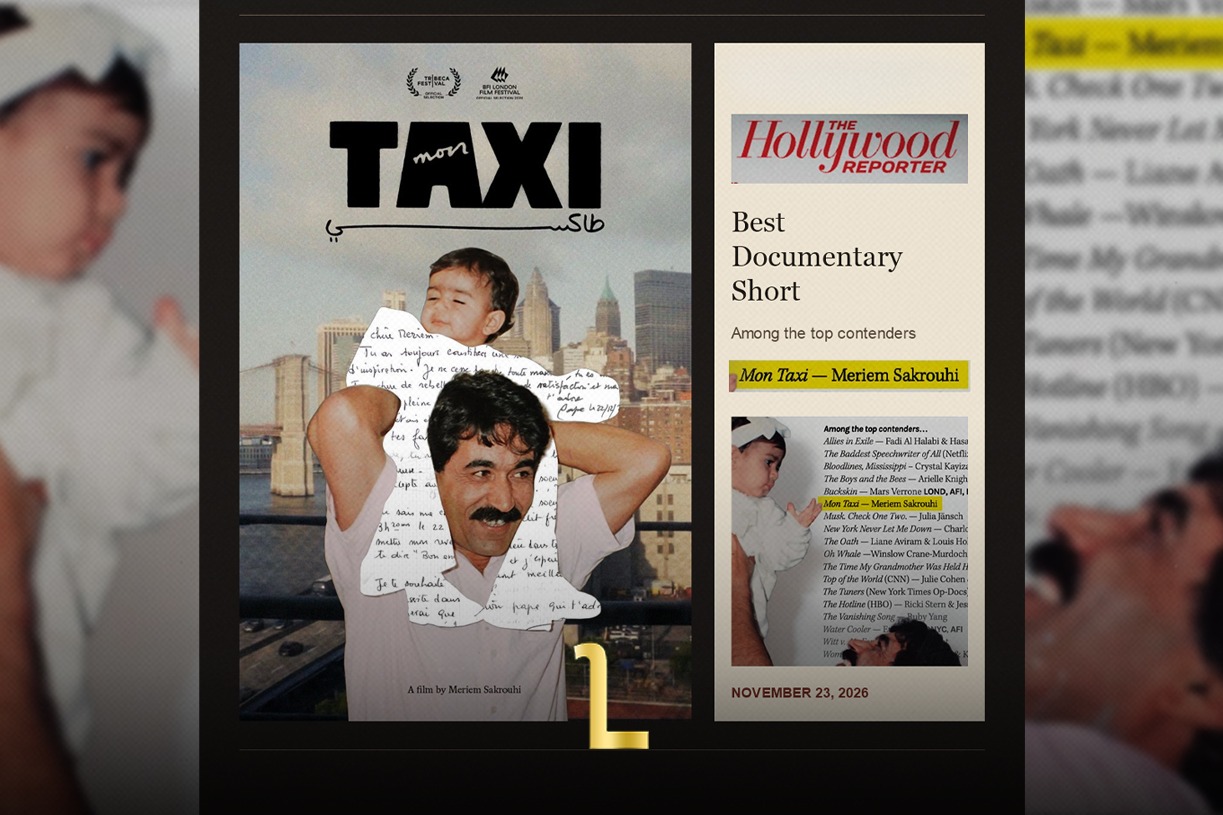
Casablanca – The short documentary “Mon Taxi” by Moroccan filmmaker Meriem Sakrouhi has made its way into The Hollywood Reporter’s Oscar predictions, appearing in the Best Documentary Short category.
“Mon Taxi” made its world premiere at the Tribeca Film Festival last June. Since then, it has screened at several other festivals, including the HollyShorts Film Festival, the Calgary International Film Festival, and the Hamptons International Film Festival and BFI London Film Festival in October.
More recently, “Mon Taxi” screened during the 30th Arab Film Festival’s “Emerging Voices” program at AMC Kabuki in San Francisco on November 6. It also featured in the 31st Rabat International Auteur Film Festival on November 11, as part of a short-film program at ISMAC.
View this post on Instagram
What’s the story?
Sakrouhi built the eight-minute film around her memories and daily rituals with her late father. When she lived in New York and he was in Casablanca, the two used to talk on the phone while she walked through the city’s streets.
He jokingly called himself her “free taxi,” as he accompanied her on her walks and guided her home over the phone. That little joke eventually gave the film its title.
Even after his passing, their conversations did not really stop.
Sakrouhi kept sending him voicemails about her life, until she decided to turn 11 of those recordings into a short documentary. Alongside the voice messages, the film features footage of New York streets, including places they explored together on foot.
In a way, “Mon Taxi” also became a way for Sakrouhi to turn her grief into something she could hold on to, keeping their conversations and everyday moments alive through film.
From keeping it to herself to Oscar predictions
“Mon Taxi” has now moved beyond festival screenings and into Oscar-season conversations. But perhaps what makes this recognition particularly meaningful is that Sakrouhi never initially intended to release the film.
In a previous interview with Lifestyle Magazine, Sakrouhi shared that she first made it for herself, using the recordings to process her grief and feelings she could not yet understand.
That changed when someone who had also lost their father watched an early version of the film and told her it made them feel less alone. That reaction made Sakrouhi reconsider keeping the film to herself and encouraged her to share it with a wider audience.
What started as a personal way to deal with loss has since reached festival audiences across different countries and is now appearing in The Hollywood Reporter’s Oscar predictions.
The story began with one daughter trying to stay close to her father, and it has ultimately found a way to connect with people who have their own stories of loss. And perhaps that is what makes the film’s journey special and uniquely relatable.