

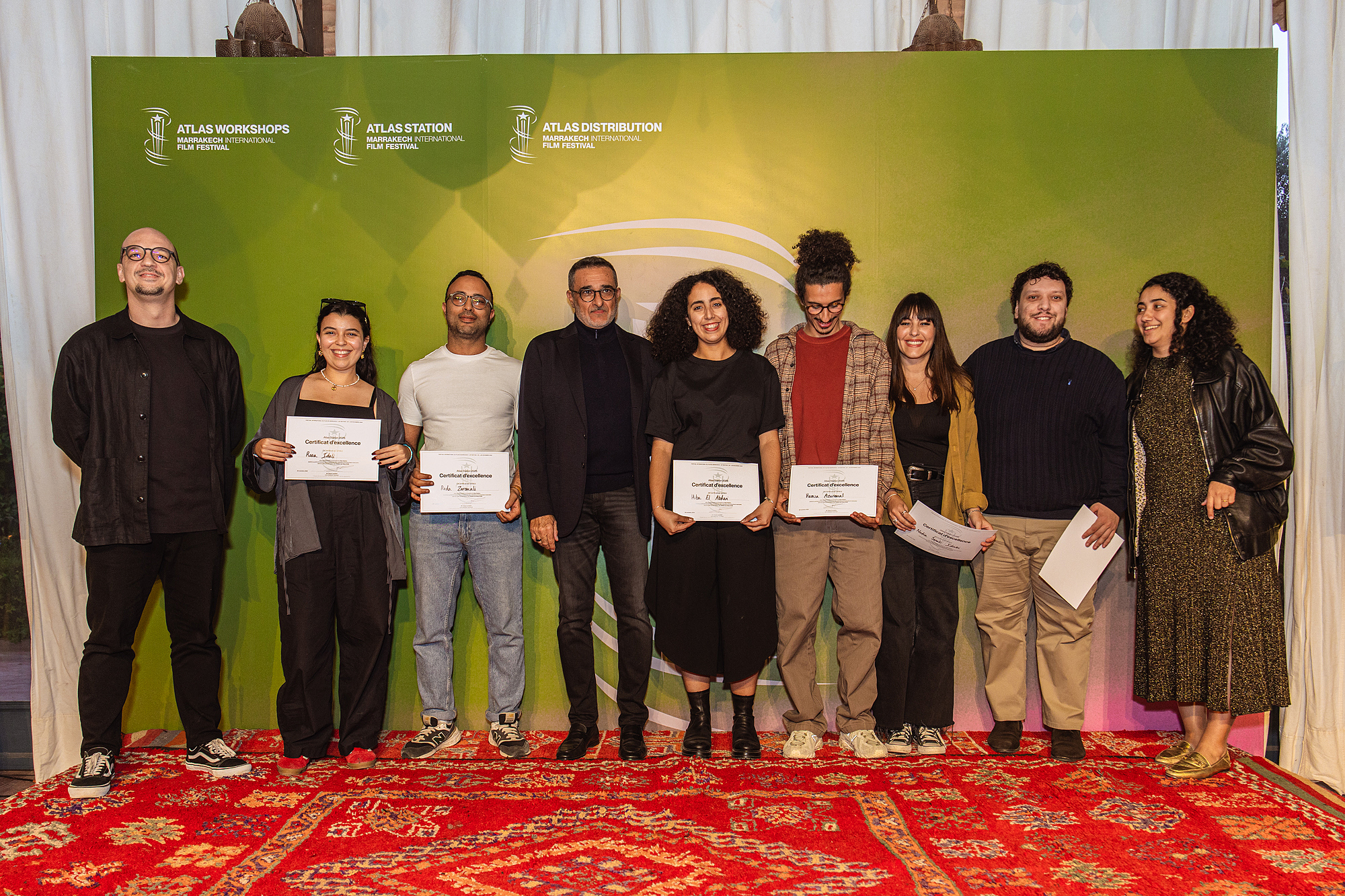
Marrakech – Behind every film that reaches an international festival lies a journey of development, financing, collaboration, and persistence. For emerging Moroccan, Arab, and African filmmakers, Marrakech’s Atlas Workshops have become an important part of that journey.
The ninth edition of the professional program concluded today, November 26, awarding approximately MAD 1.37 million (€125,000; $137,188) to ten film projects. Two Moroccan productions were among the winners, highlighting the country’s growing presence in regional and international cinema.
Held from November 22 to 26 as part of the 23rd Marrakech International Film Festival, the workshops welcomed 350 international professionals and presented 30 projects and films from 14 countries.
Moroccan Filmmakers Among This Year’s Winners
Moroccan director Yasmine Benkiran received the second Atlas Development Prize, worth approximately MAD 164,600 (€15,000; $16,463), for “Waltz of the Savages.” The project is produced by Edyta Janczak-Hiriart and Moroccan filmmaker and producer Saïd Hamich Benlarbi.
Fellow Moroccan filmmaker Madane El Ghazouani received the Atlas Close-Ups Prize, worth approximately MAD 54,900 (€5,000; $5,488), for “The Cemetery’s Birds,” produced by Faycal El Kadiri.
Their recognition comes as the Atlas Workshops continue to strengthen their role in supporting filmmakers who might otherwise struggle to access international production networks.
From Marrakech to the World’s Biggest Film Festivals
Speaking to Lifestyle Magazine during the festival, Mélita Toscan du Plantier, director and advisor to the president of the Marrakech International Film Festival Foundation, reflected on the program’s growing importance.

“There are a few workshops in the world, but they really want to come to Marrakech now,” she said, referring to the increasing number of young filmmakers seeking opportunities through the initiative.
Toscan du Plantier emphasized the expertise that participants encounter through the workshops, particularly the contributions of international professionals invited to mentor emerging directors and producers.
“I think it’s very important to discover young filmmakers,” she said.
As an example, she recalled Moroccan filmmaker Asmae El Moudir, whose internationally acclaimed documentary “The Mother of All Lies” benefited from the Atlas Workshops during both its development and post-production stages.
El Moudir’s film subsequently reached Cannes, where it received the directing prize in the Un Certain Regard section, and won the Sydney Film Prize in Australia.
For Toscan du Plantier, stories like El Moudir’s demonstrate how the workshops can help filmmakers move from early creative ideas to international recognition.
“It’s magic what’s happening with Ateliers de l’Atlas, especially for the Moroccans,” she said, pointing to the discovery of young Moroccan directors, producers, and women filmmakers.
“That’s something that we are very proud of,” she added.
Ten Projects Recognized Across Africa and the Arab World
This year’s awards also recognized filmmakers from across the region.
Lebanese director Jessy Moussallem secured the top Atlas Post-Production Prize, worth approximately MAD 329,300 (€30,000; $32,925), for “Faux Bijoux,” produced by Olivier Muller.
Palestinian filmmaker Laila Abbas won the first Atlas Development Prize, worth approximately MAD 274,400 (€25,000; $27,438), for “America Is Behind the Door,” produced by Giovanni Pompili.
Egyptian filmmaker Ahmed Fawzi-Saleh and Jordanian-Palestinian director Bassel Ghandour each received a joint second post-production prize for “Hamlet from the Slums” and “Occupational Hazards,” respectively.
Tunisian director Fatma Riahi received the third post-production prize for “My Father Killed Bourguiba.”
Other development prizes went to Cabo Verde’s Yuri Carlos Ceuninck for “Eko Gongon,” Senegal’s Awa Moctar Gueye for “Safara,” and Syrian filmmaker Dyaa Naim for “Chronicles from an Unannounced Death.”
Record Meetings and New Opportunities for Emerging Talent
Beyond the awards, the ninth edition set a new record for professional networking.
Its Co-Production Market organized 575 individual meetings, the highest number since the program launched in 2018. Participants also benefited from more than 235 working sessions, including 100 individual consultations with international specialists.
Forty mentors, experts, and consultants provided guidance across approximately 20 areas of filmmaking, from screenwriting and cinematography to financing, editing, music, and distribution.
The program also expanded its support for Moroccan filmmakers through Atlas Station, which welcomed eight emerging producers and five short film projects in post-production.
Brazilian filmmaker Kleber Mendonça Filho, patron of this year’s workshops, described the experience as an opportunity to discover the cinema of tomorrow.
“I have spent the last few days accessing a brand new archive of future films,” he said, calling his time in Marrakech a nurturing experience.
Since their establishment in 2018, the Atlas Workshops have supported 284 projects and films, including 135 Moroccan productions.
Those figures reflect an initiative that has developed into more than a training or networking program. For filmmakers at the beginning of their careers, the workshops offer access to people, resources, and opportunities that can help bring ambitious projects to the screen.
As Toscan du Plantier’s reflections suggest, the program’s significance lies not only in the films that eventually reach international festivals, but also in the new generation of Moroccan, Arab, and African storytellers gaining the opportunity to make them.