Scientists Crack the Code Behind the World’s Oldest Synthetic Blue
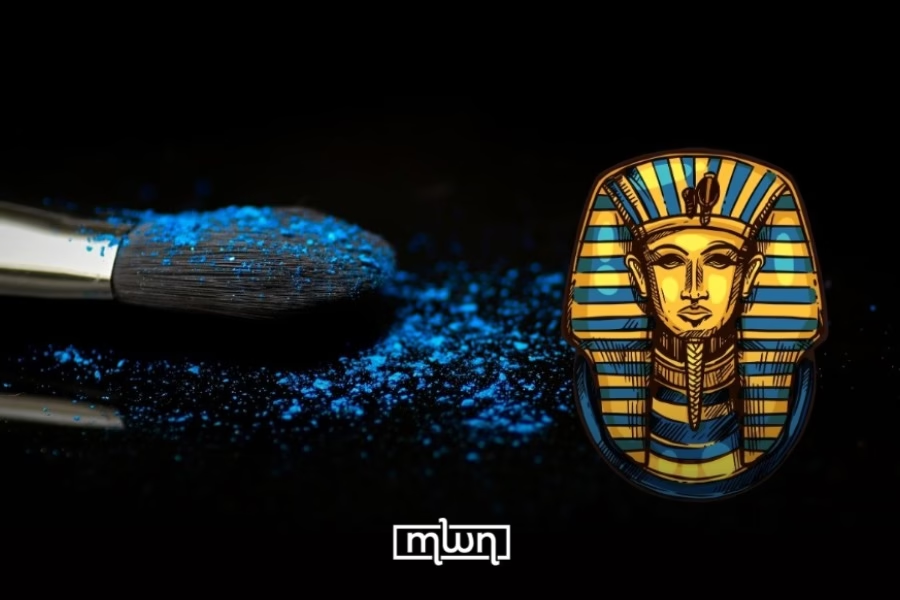
Ancient Egypt’s boldest color has just been brought back to life Fez– When we think of ancient Egypt’s genius, we usually jump straight to mummies, pyramids, and the whole “defying time” business. But there’s another masterpiece that often gets overlooked: “Egyptian blue,” a vivid, shimmering pigment that just happens to be the oldest synthetic color known to humankind. Yes, they made their own paint… thousands of years before oil paints were a thing. Fast forward to 2025, and a team of researchers from Washington State University, along with collaborators from the Carnegie Museum of Natural History and the Smithsonian, have managed to do something pretty spectacular: they’ve recreated this ancient color from scratch using modern science. And no, it wasn’t as simple as mixing blue food coloring into playdough. So, what’s the big deal with Egyptian blue? For starters, it’s not just a color, it’s a scientific puzzle, an artistic statement, and a materials engineering marvel all rolled into one. At the heart of this shade is a rare compound called “cuprorivaite”, a turquoise-leaning mineral that forms when you heat a precise mix of silica, copper oxide, and calcium carbonate at temperatures reaching 1000°C. The Egyptians pulled this off without labs or thermocouples, just fire, intuition, and a bit of magic. The recent study, published in “Heritage Science”, took that recipe and modernized it. The researchers tested 12 different versions using ultra-pure materials, think clean silica (a fancy way to say sand), natron (basically Egyptian baking soda), and copper sources. They experimented with heating times and temperatures, observing how each tiny tweak changed the outcome. It turns out even slight differences in cooling speed or ingredient ratios affected whether you got a deep ocean blue, a dusty teal, or something closer to moss. The team didn’t stop there. They compared their lab-made pigments with actual samples from two ancient Egyptian statues, one from the reign of Akhenaten (14th century BCE), and another from the Ptolemaic era. Using high-powered tools like electron microscopes and X-ray diffraction, they found a striking match. The structure of the blue crystals, the way the light reflected off the pigment, all of it mirrored the real deal. That’s not just color-matching; that’s forensic archaeology meets material science. The coolest part? This isn’t just a “wow, neat history” moment. Egyptian blue emits infrared light, which means it could be used in cutting-edge tech, from anti-counterfeiting inks to medical imaging. Shrink its particles down to the nanoscale, and it becomes even more efficient. Imagine a color invented to paint a falcon god’s crown, now helping detect fingerprints or improving cancer scans. Ancient Egypt, meet modern innovation. And if all that feels a little too high-tech, here’s something simpler: this rediscovered pigment could one day end up in luxury textiles. Imagine wearing a scarf dyed with a color formula that dates back to the Pharaohs, one that never fades, never dulls, and comes with a story longer than most civilizations. Today, these re-created pigments are on display at the Carnegie Museum in Pittsburgh, nestled inside a gallery devoted to ancient Egypt. But they’re more than museum pieces, they’re proof that even secrets buried for millennia can be brought back to life, with a little curiosity, a lot of collaboration, and just the right amount of fire. Read also: Saudi Arabia Is Building a New SuperCity With an F1 Track
Professor Mohamed Hilout and the Astrolabe’s Quiet Revolution
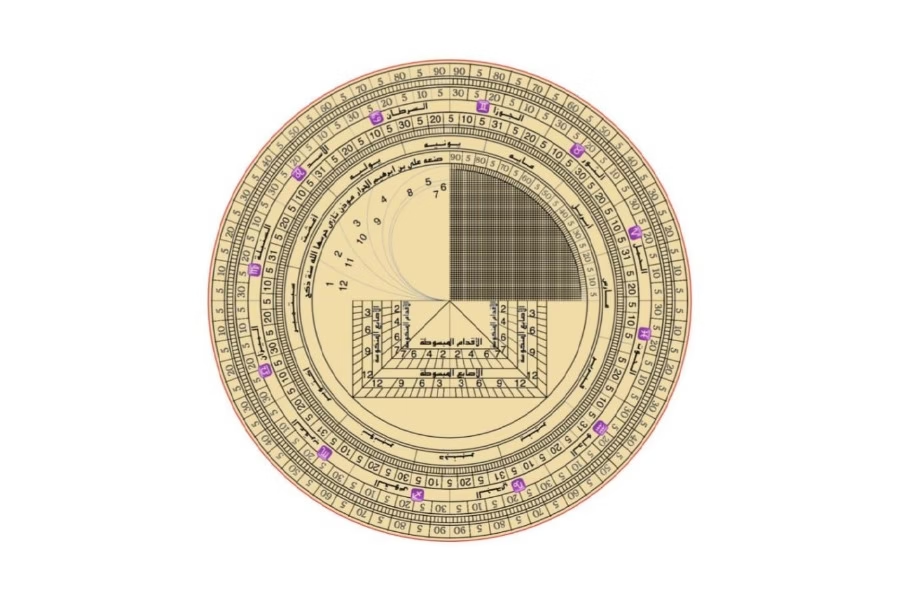
In rediscovering an ancient astrolabe, Mohamed Hilout found a way to connect modern minds to medieval skies. Fez– In the quiet arc of Morocco’s scientific memory, few names have traveled as far as that of Mohamed Pascal Hilout. Born in 1952 near Taza, a city that once stood at the crossroads of Arab, Amazigh, and Andalusian knowledge, Hilout grew up speaking multiple languages without fully realizing their intellectual power. “All Moroccans are polyglots by default,” he said in an interview with Morocco World News. As a boy, he learned French and Darija. As a teenager in Fez, he added German to his list. Then, like many gifted students of his generation, he left the country, pursuing studies in Germany under a university scholarship. Hilout’s early career unfolded far from the humanities. He worked in computing and transport systems for France’s national railways. But his mind, shaped by a fascination with logic and form, never left the questions of time, space, and structure. It was only in 1995, well into his professional life, that a meeting with an amateur astronomy association triggered a deeper transformation. The sky, it turned out, still held unfinished business. That interest turned into a project that would consume decades. What began as casual observation evolved into serious research. He found himself returning not just to stars and planets, but to the instruments that had once helped humanity locate itself in the universe. Chief among them: the astrolabe. Once a prized possession of scholars, navigators, and rulers, the astrolabe offered a window into the scientific imagination of ancient civilizations, Babylonians, Greeks, Persians, Arabs, Andalusians, and North Africans. Hilout approached the astrolabe as a systems analyst might approach a machine. He began reconstructing their logic using software he developed himself, digitally modeling these complex instruments, then engraving them with a laser cutter to create precise replicas. By combining programming and historical research, he found a way to translate centuries-old geometry into a language he could manipulate. His work gave shape not just to the object itself, but to the worldviews encoded within it. “I’m not a craftsman or a physicist,” he says. “I’m someone who builds bridges between ideas.” One such object would change everything. In 2022, Hilout’s attention was drawn to a 14th-century universal astrolabe, crafted in Taza by a maker named Ali ben Brahim al-Harrar. Forgotten for centuries, it had survived in the collections of Oxford’s History of Science Museum. For Hilout, the discovery was less about pride than continuity: proof that the city of his birth had once contributed to the global development of astronomical science. This instrument became the centerpiece of his 2024 book, “Astrolabes Through Historical Texts and Artefacts”, written in Arabic and aimed at a new generation of Arab readers. In it, Hilout does something rare, he introduces, for the first time in Arabic, the earliest known technical description of a classical astrolabe, written by the Alexandrian scholar John Philoponus in the sixth century. He supports it with illustrations generated through his own software and devotes an entire chapter to the rediscovered Taza astrolabe, complete with historical analysis and technical diagrams. He followed this work with a second book in early 2025, a translation and study of kitab fi alhaya”, the 12th-century Andalusian treatise by Nur al-Din al-Bitruji. In it, Hilout builds a pedagogical narrative tracing the evolution of cosmological thinking from Pythagoras and Plato to Ibn al-Shatir and al-Qushji. Alongside the book, he launched an online educational platform, providing a detailed visual archive of astronomical knowledge across Greco-Arabic, Persian, and Ottoman traditions. But Hilout’s project is not confined to philology or restoration. At its core lies a critical argument about the trajectory of scientific history. He contends that Aristotelian cosmology, with its fixed spheres and geocentric worldview, dominated not because it was the most accurate model, but because it served religious and political purposes across empires. “Aristotle’s model was beautiful, but it became a golden cage,” he says. “It trapped scientific thought in a closed system.” This framework, he believes, stifled the development of physics and rational mechanics for centuries in both East and West. Lost in this eclipse were earlier, more dynamic hypotheses, like the Pythagorean view of Earth’s rotation or Archimedes’ vision of mechanical laws, ideas that could have led to scientific revolutions far earlier than the Renaissance. It is not enough, in his view, to celebrate Islamic astronomy for its technical achievements. The real task lies in re-examining the philosophical choices that shaped scientific inquiry. Why, he asks, did so many civilizations adopt models that were elegant, but fundamentally flawed? Why were dynamic systems resisted in favor of idealized geometries? These are the questions he wants to see addressed in curricula across Morocco and the wider Arab world. His critique extends to contemporary pedagogy. Despite Morocco’s long and rich scientific past, Hilout sees little evidence of serious engagement with its complexities. University-level teaching, he says, still relies on outdated assumptions that fail to explore the historical alternatives to Aristotelian thought. “We teach astronomy without context,” he says. “We show the stars but not the ideas behind how we understand them.” Yet Hilout does not advocate nostalgia. For him, the astrolabe is not a relic, but a teaching tool. Constructing one, he believes, is an excellent way to teach students practical geometry, astronomy, and intellectual history simultaneously. He envisions a classroom where students learn to build astrolabes not to mystify the past, but to understand it as a living intellectual system. Even so, the astrolabe retains a kind of aura. Its Kufic inscriptions, abstract beauty, and mathematical elegance set it apart from the cold utility of modern tools. Unlike smartphones, which are ubiquitous and quickly obsolete, astrolabes were rare and refined, objects of ceremony and authority, used by caliphs, scholars, and navigators alike. Their appeal was not only scientific, but symbolic. Though some today try to link the astrolabe with astrology, Hilout makes a careful distinction. He does not dismiss the fact that astrology played a role across
Did You Know? Earth Has a Heartbeat and Scientists Are Still Figuring It Out

What if Earth isn’t just alive with life, but alive itself? Fez – We tend to think of Earth as solid, stable, and predictable, until it reminds us it’s anything but. Spinning through space at breakneck speed, our planet isn’t just floating aimlessly in the dark. It’s alive with movement, rhythm, and strange patterns that scientists are still trying to decode. One of those patterns? A mysterious tremor, pulsing deep within the Earth every 26 seconds. It’s so subtle you won’t feel it under your feet, but it’s been picked up by seismic sensors around the world since at least the 1960s. No one really knows where it comes from, or why it’s so regular. Some researchers think it might be tied to ocean waves hitting the coast of the Gulf of Guinea. Others suspect it’s something deeper, more geological. Either way, it’s weirdly precise. A literal tick of the planet. But that’s just one piece of the story. Because recently, the idea of Earth having a “heartbeat” got a whole new, and strangely beautiful, interpretation. A video posted by the X account “Heritage Matters” run by a self-described “history nerd and magician”, has been making the rounds. It uses satellite data that tracks global photosynthesis (yes, plants breathing) to create a time-lapse animation of Earth’s living surface. The result? A pulsing, almost breathing motion that mirrors the natural ebb and flow of plant life throughout the year. Add in the sound of wind and a slow, steady heartbeat, and suddenly Earth doesn’t feel like a rock, it feels like an organism. Now, is this scientifically Earth’s literal heartbeat? No. But as a metaphor, it’s hard to beat. Every tree that grows, every leaf that photosynthesizes, every wave that crashes, it all adds up to a planet that’s in constant motion. Breathing in, breathing out. The blend of science and poetic interpretation is where this gets interesting. Satellite data is real. Plant rhythms are measurable. And our collective reaction to it; fascination, awe, even emotion, says a lot about how disconnected we sometimes are from the natural systems that keep everything alive. Earth isn’t just our home. It’s doing something all the time. And sometimes, if we really pay attention, it almost feels like it’s speaking to us. Read also: Moroccan Artist Younes Megri Returns to Cinema with ‘Shadows of Caravaggio’
Understanding the Science of Love: It’s More Brain Than Heart

Ever wondered if love is more science than sentiment? Turns out, it’s both. Fez– Love is often seen as a feeling that blooms in the heart, but in reality, it’s the brain that does most of the heavy lifting. Hormonal releases and brain chemicals are triggered, making love more of a brain game than a simple emotional experience. Dopamine, serotonin, and oxytocin are some of the key neurotransmitters involved, fueling pleasure, satisfaction, and, well, the warm fuzzies we all crave. When you feel good about someone, your brain takes notes and encourages you to seek that feeling again. But love isn’t just one feeling, it’s a mix of overlapping components that work together to shape how we connect with others. These include: Infatuation or attraction, sexual desire and attachment. Though these components play a significant role in love, they aren’t necessarily phases you go through. They’re just different aspects of how love can manifest. Attachment, for example, can grow out of a deep friendship, and that can lead to a romantic relationship. In those cases, the safety and trust you build with someone might come before the attraction or sexual desire. Here’s where it gets interesting: while hormones and neurotransmitters are busy doing their thing, you still hold the reins when it comes to how you feel. Love isn’t just a series of chemical reactions, it’s also about choice. We can help ourselves recognize when we’re in the honeymoon phase, it’s important to be aware of moments when we might be overlooking red flags. On the flip side, if you’re hyper-focused on picking apart someone’s flaws, it could make it harder for your brain’s reward system to kick in. Hormones like dopamine and oxytocin can certainly shape your behavior, but your actions aren’t automatic. It’s important to check in with yourself and take a moment to understand what’s happening inside. Taking a step back and reflecting on your feelings can help you navigate the complex and beautiful process of love with a clearer perspective. So, while love might be sparked in your brain, how you choose to respond is still very much in your control. Read also: Why Nature Has Its Own Internet And We’ve Been Ignoring It
Reading These Books Puts You in the Top 5% of Intellectual Minds
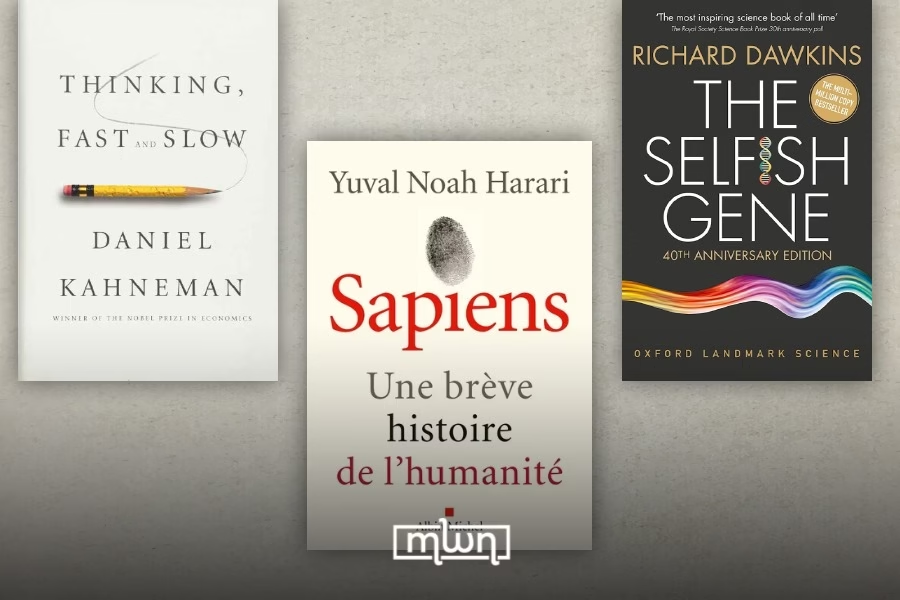
Step up your intellectual game with these must-read books that challenge everything you thought you knew. Fez– Some books do more than just tell a story, they shape the way we think, challenge the very fabric of our beliefs, and take our intellectual capacities to the next level. The following books aren’t just for casual reading; they’re for those who want to elevate their minds, sharpen their critical thinking, and dive deep into some of the most profound questions humanity has ever asked. If you truly want to join the intellectual elite, this list is where you start. “Gödel, Escher, Bach: An Eternal Golden Braid” by Douglas Hofstadter If you think math, music, and art have little in common, think again. In this Pulitzer Prize-winning gem, Hofstadter uncovers the hidden connections between these seemingly disparate fields, all while exploring the nature of consciousness, logic, and self-reference. This isn’t just a book, it’s a mind-bending exploration into the very fabric of reality, showing how the mind’s patterns shape our understanding of the world. Whether you’re into philosophy, mathematics, or just curious about the nature of human thought, this book is a must-read. “Sapiens: A Brief History of Humankind” by Yuval Noah Harari Ready to see history in an entirely new light? Harari’s groundbreaking book takes you on a journey through the evolution of humankind, blending anthropology, biology, and history into a seamless narrative that explores how Homo sapiens rose to dominate the planet. It’s not just a history book; it’s a rethinking of how cultures, economies, and technologies have shaped our present and will continue to shape our future. If you’ve ever wanted to understand the true forces that have shaped civilization, Harari’s work will blow your mind. “Thinking, Fast and Slow” by Daniel Kahneman Ever wonder why we make irrational decisions? Nobel laureate Daniel Kahneman unpacks the two systems of thought that drive human decision-making: the fast, intuitive side and the slower, more deliberate one. Through fascinating research and experiments, he reveals how our cognitive biases influence everything from risk assessment to personal opinions. This book isn’t just about thinking better; it’s about understanding how and why we think the way we do. A game-changer for anyone serious about mastering critical thinking. “The Selfish Gene” by Richard Dawkins Dawkins’ revolutionary perspective on evolution isn’t just about survival of the fittest, it’s about survival at the genetic level. In “The Selfish Gene”, Dawkins introduces the concept of “memes”, ideas that evolve and spread just like genes. This book challenges conventional views on altruism and cooperation, offering a fresh lens through which to view human behavior and biology. Whether you’re a biology buff or just interested in how culture evolves, Dawkins provides a radical look at the forces that govern life. “The Republic” by Plato Plato’s “The Republic” is a timeless philosophical work that dives deep into questions about justice, governance, and the nature of the ideal state. Through his Socratic dialogues, Plato examines the very essence of virtue, power, and societal structures. One of the book’s most famous sections, the “Allegory of the Cave”, invites readers to rethink their perceptions of reality, urging them to escape the “shadows” of conventional wisdom. If you’re interested in exploring ethics, politics, or the philosophical foundations of society, this book is a must-read. These five books are intellectual tools that push the boundaries of human thought and elevate anyone’s intellectual pursuits. Ready to take your mind to the next level? Start reading. Read also: Al-Idrisi and His Quest to Draw the World’s First Accurate Map
Al-Idrisi and His Quest to Draw the World’s First Accurate Map
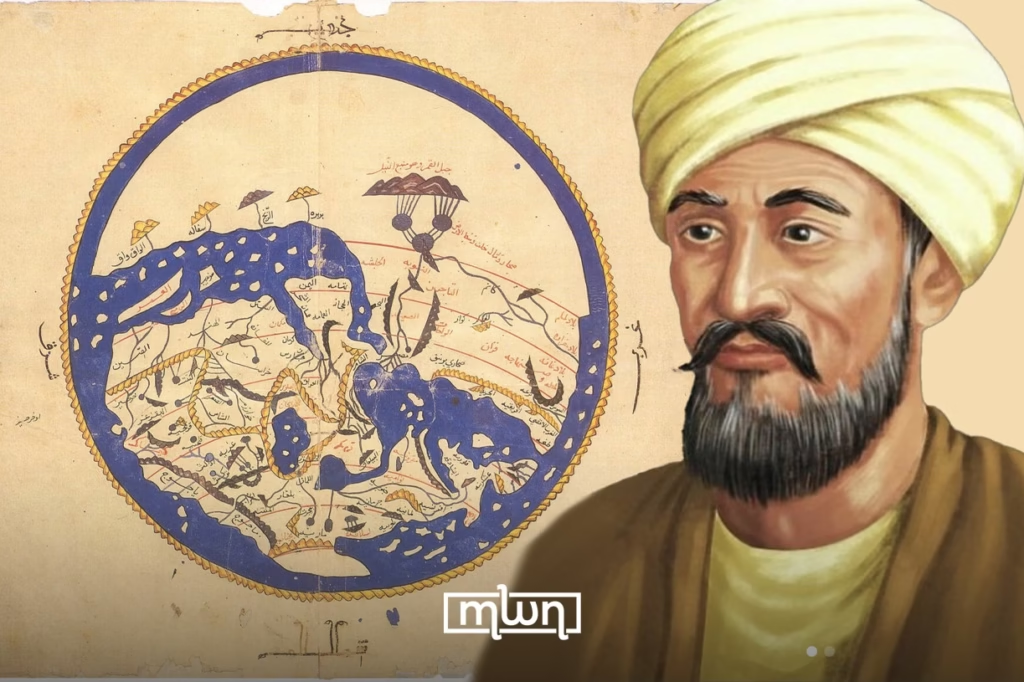
Long before GPS, one man’s journey shaped how we see the world. Fez – Before Google Maps made it possible to explore the world from our phones, cartography was an art that required bravery, intelligence, and an insatiable thirst for knowledge. And guess what? The first truly accurate world map wasn’t created in modern times, it was drawn way back in 1154 AD by the brilliant Moroccan geographer Al-Idrisi. But how did he manage such a feat? There are three different accounts of how Al-Idrisi crafted his legendary map, each more intriguing than the last. The First Theory: A king’s commission Al-Idrisi, a geographer and traveler from the Moroccan city of Ceuta, found himself in the court of King Roger II of Sicily. The king, fascinated by knowledge and exploration, commissioned him to create the most advanced world map of his time. To achieve this, Al-Idrisi spent nearly a decade gathering data, sending out explorers, and compiling information from travelers, merchants, and previous geographical works. The result? A silver globe depicting the world and a massive 70-section map that provided an astonishingly accurate view of the known world, so precise that parts of it remained useful even centuries later. The Second Theory: 15 years of exploration Some believe Al-Idrisi didn’t just rely on reports, he set out on an epic journey himself. According to this version, he traveled for 15 years, exploring distant lands, documenting landscapes, and verifying geographical details firsthand. His journey allegedly started in 1138 and concluded in 1153 when he arrived in Palermo, Sicily, with a map so groundbreaking that it challenged previous understandings of world geography. Interestingly, his map placed south at the top, a common feature in medieval Islamic cartography but one that confuses modern viewers. The Third Theory: A team of 12 experts The final theory suggests that Al-Idrisi didn’t work alone. King Roger II, passionate about science and culture, provided him with a dream team, 12 experts specializing in navigation, mathematics, and cartography. Together, they analyzed travelers’ accounts, interviewed sailors, and even sent out ships to explore uncharted territories. One report claims that explorers returned describing a mysterious land where the sun barely rose and snow covered everything, likely Iceland or Greenland. These discoveries further enriched the accuracy of Al-Idrisi’s map, making it a masterpiece of medieval geography. Who was Al-Idrisi? Al-Idrisi was not just a mapmaker, he was a scholar, scientist, and philosopher. Born into a noble lineage tracing back to the Prophet Muhammad, he excelled in various fields, from astronomy to medicine. His work, particularly his book Nuzhat al-Mushtaq fi Ikhtiraq al-Afaq (The Book of Roger), remained a cornerstone of geographical knowledge for centuries, influencing European explorers during the Age of Discovery. While we may never know exactly which of these theories is the most accurate, one thing is certain: Al-Idrisi’s contributions to cartography changed how we see the world, literally. Read also: The Oldest Ceratopsid Fossil Ever Discovered in Morocco’s Boulemane
What Can Space Do to Your Body
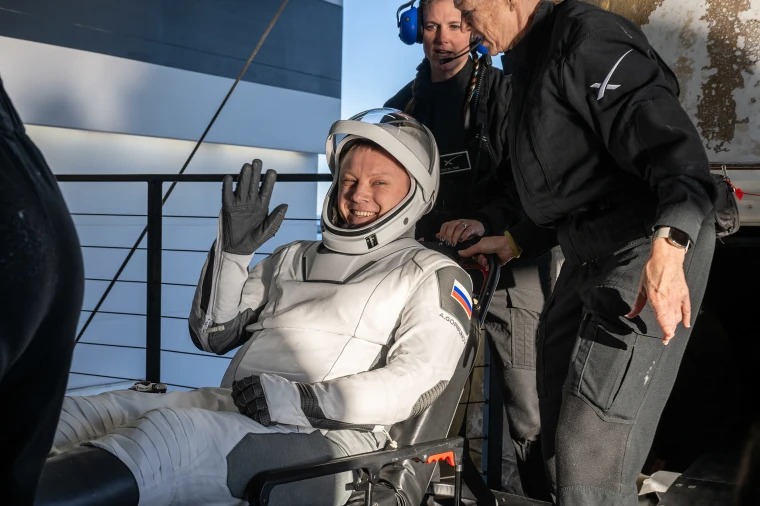
Nine months in space sounds cool until your body forgets how to work. Spending time in space sounds like the ultimate dream: floating weightless, gazing at Earth from above, and living like a sci-fi hero. But what happens when the dream ends, and reality, otherwise known as gravity, comes crashing back? Astronauts Suni Williams and Butch Wilmore know this better than anyone and recently told their story to the BBC. What was supposed to be a quick eight-day mission aboard the International Space Station (ISS) turned into an unexpected nine-month stay. Now that they’re back on solid ground, their toughest mission begins: getting their bodies to work properly again. Ask any astronaut, and they’ll tell you: zero gravity feels amazing at first. “It feels like a holiday,” says Tim Peake to BBC, who spent time on the ISS in 2015. With no gravity pulling you down, your heart, muscles, and bones get a break. Moving is effortless. It’s like lounging in bed for weeks, but that’s also the problem. On Earth, even standing still takes effort. Gravity forces your muscles and bones to work constantly, keeping you upright. In space, everything is weightless, so your body gets lazy fast. Without resistance, muscles shrink. The heart weakens because it doesn’t have to pump against gravity. Bones become fragile, breaking down faster than they rebuild. “Every month, about 1% of their bone and muscle withers away, it’s accelerated aging,” explains Prof. Damian Bailey, a human physiology expert at the University of South Wales. What happens when astronauts return? After months of weightlessness, even simple things like walking become a challenge. When Suni and Butch’s capsule landed, they needed help just to stand. Their bodies weren’t used to supporting their own weight. To prevent complete muscle loss, astronauts exercise for two hours every day in space, using treadmills, stationary bikes, and resistance machines. But even that isn’t enough to stop the damage. Now, back on Earth, they’ll need months of intense rehab to rebuild their strength. Muscles recover relatively quickly, but bones? That’s another story. “It could take a couple of years for their bone mass to come back,” says Dr. Helen Sharman, the first British person in space. And even then, it might never fully return to normal. Bones and muscles aren’t the only things that take a hit. Space changes the entire body, right down to the bacteria in our gut. Even fluids in the body behave differently. With no gravity pulling them down, they shift upward, making astronauts’ faces look puffy. It might seem harmless, but that swelling affects the brain and eyes, sometimes leading to permanent vision problems. And then there’s balance, another system that gravity controls. In space, there’s no up, down, or sideways. The body’s sense of direction goes haywire. “That initial phase of dizziness, regaining balance, and being able to walk properly again, that’s about two or three days,” Peake explains. “And those days can be brutal.” Space may be the final frontier, but the human body is still playing catch-up. Even with years of training and recovery plans, astronauts return home changed. Some effects fade, others linger forever. For Suni and Butch, the adventure isn’t over, it’s just moved to the gym. And while they won’t be floating through their workouts anymore, getting back to normal might just be their hardest mission yet. Read also: What Marvel Movies Teach Us About Tech, Innovation, and Hustling Hard
‘El Da7ee7’ Joins Spacetoon for a New Adventure!

The science wiz El Da7ee7 and Spacetoon? Now that’s a crossover we didn’t see coming! Fez– If you grew up glued to Spacetoon, get ready for a blast from the past, but this time, with a scientific twist! The iconic Arabic kids’ channel just announced an exciting new collaboration with none other than Ahmed El Ghandour, aka El Da7ee7. Yes, you read that right! The science storytelling wizard is joining Spacetoon’s family with a brand-new show. The program, titled “The Last Da7ee7 on Earth,” is set to target kids and young viewers, blending entertainment with knowledge in the signature El Da7ee7 style. While the exact release date remains under wraps, the buzz is already off the charts. Spacetoon’s 25th birthday gift to us To make things even more dramatic (because, why not?), Spacetoon dropped a teaser post on Instagram featuring a promotional image of the show. The caption? A poetic tribute to El Da7ee7’s genius: “A brilliant mind has joined Spacetoon’s family on its 25th anniversary… A personality that redefined explanation… Now, he’s gearing up for a new adventure.” Cue the nostalgia-induced excitement! Fans of El Da7ee7, known for his unique mix of wit, science, and rapid-fire explanations, couldn’t contain their enthusiasm. Some even declared that this would be their official return ticket to Spacetoon, because let’s be honest, who wouldn’t want to relive their childhood while also learning mind-blowing facts? This collaboration isn’t just about a cool new show, it’s a statement. Spacetoon, which shaped the childhood of an entire generation, is clearly evolving to stay relevant for both kids and the now-grown fans who once obsessed over its animated classics. By bringing in a powerhouse like El Da7ee7, the channel is expanding its content to appeal to a wider audience, including young adults and nostalgic millennials. With Spacetoon taking a step into educational content for a broader age group, this could be the start of something huge. Will this fusion of nostalgia and science spark a new wave of learning entertainment? One thing’s for sure, this show is not just another TV program; it’s a cultural moment in the making. Read also: Adrien Brody’s Tangier Adventure
Why Moroccan Parents Say Don’t Jinx It And Science Says They Might Be Right

Moroccan parents swear by the phrase “Don’t jinx it,” and science surprisingly backs up their superstition. Fez– If you’ve ever excitedly shared good news with a Moroccan parent, you’ve probably heard the warning: “Don’t jinx it!” This belief in the power of words and thoughts to influence reality isn’t just a cultural quirk, it has deep roots in both tradition and psychology. But could science actually back up this superstition? Surprisingly, yes. The evil eye The fear of “l’ayn” (the evil eye) exists across many cultures, from the Mediterranean to the Middle East. In Morocco, people believe that excessive praise or open discussion of good fortune can attract envy, leading to misfortune. This explains why phrases like “Allah ybarek” (May God bless it) or “Mashallah” (God willed it) are commonly used to deflect bad energy. This belief may stem from our evolutionary instincts. Humans are wired to be wary of jealousy because it can disrupt social harmony. In ancient communities, being envied could mean losing resources or social standing, so people developed protective rituals, like avoiding talking about success or wearing protective charms, to safeguard themselves. The science of jinxing: is it real? The belief in jinxing is linked to cognitive biases like confirmation bias and the self-fulfilling prophecy. When people think they’re jinxed, they become anxious, which can negatively affect their performance. When people believe they are “cursed” or “jinxed,” their stress levels rise, leading to poor decision-making and decreased confidence. Interestingly, people believing in luck (the opposite of a jinx) performed better on tasks, thanks to increased self-confidence. On the flip side, people who thought they were jinxed became more nervous and performed worse. Why do Moroccan parents insist on it? Moroccan parents aren’t just trying to ruin your excitement, they’re actually applying a mix of cultural wisdom and psychology. Avoiding premature celebration reduces the risk of disappointment and helps keep expectations realistic. In a way, their warnings serve as a mental safeguard against overconfidence and emotional distress if things don’t go as planned. While there’s no scientific proof that simply talking about good fortune can bring bad luck, there is strong evidence that believing in a jinx can impact your mindset and actions. So, the next time your Moroccan parents tell you not to jinx something, you might want to listen — if only to keep your own nerves in check! Read also: Are Moroccan Dads the Funniest Unintended Comedians?
A Quantum Breakthrough: Scientists Turn Light Into a Supersolid

Researchers achieve a historic feat in condensed matter physics, opening new frontiers in quantum science. Fez — In a groundbreaking scientific achievement, researchers have successfully transformed light into a supersolid, a bizarre state of matter that behaves as both a solid and a fluid. This discovery, conducted by scientists at Italy’s National Research Council (CNR), marks a major step forward in understanding quantum mechanics and its potential applications in advanced technology. Supersolids are materials that exhibit the structural properties of solids while flowing without resistance, much like a superfluid. Until now, such states of matter had only been observed in ultracold atomic gases under extreme laboratory conditions. However, this latest research introduces a novel approach. Instead of using ultracold atoms, scientists directed laser light onto a semiconductor material, aluminum gallium arsenide, that was engineered with a precise ridge pattern. This interaction produced polariton quasiparticles, which ultimately arranged themselves into a supersolid state. As reported in New Scientist, Dimitrios Trypogeorgos, one of the lead researchers, described the breakthrough with excitement: “We actually made light into a solid. That’s pretty awesome.” The achievement builds on earlier work by CNR scientist Daniele Sanvitto, who demonstrated more than a decade ago that light could behave like a fluid. This new research takes it a step further, proving that light can also form a stable supersolid structure. However, creating the supersolid was only half the challenge. The team needed to gather concrete evidence that their new material displayed both solid-like rigidity and fluid-like zero viscosity. Their experimental validation sets a precedent in condensed matter physics, expanding the possibilities for manipulating light in quantum systems. Physicists like Alberto Bramati from Sorbonne University in France see this study as a significant contribution to understanding quantum phase transitions, the process by which materials change states at a quantum level. While the experiment successfully demonstrated the formation of a supersolid, further research is required to analyze its full range of properties. Scientists believe this discovery could lead to innovative applications in quantum computing, optical technologies, and next-generation materials science. Trypogeorgos expressed optimism about future studies, suggesting that light-based supersolids may be easier to control than those formed from ultracold atoms, potentially leading to unexpected breakthroughs in quantum physics. As research progresses, this milestone serves as a reminder that the quantum world continues to reveal new surprises, reshaping our understanding of reality at the most fundamental level. Read also: Ftour Solidaire: How One Meal Brought Hope to Hundreds of Children