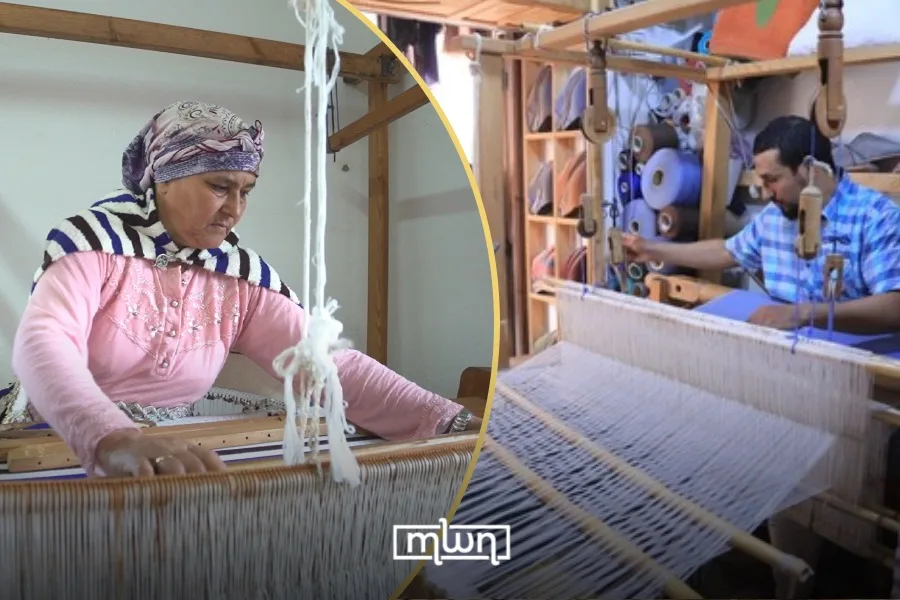
What looks like simple cloth is in fact a living record of Moroccan skill and patience.
Fez– In northern Morocco, the rhythmic clatter of wooden looms still fills small workshops, where the age-old craft of “drazza” weaving continues to defy time and fashion.
Known for producing vibrant hand-woven fabrics used in jellabas, cloaks, headscarves, and household textiles, this tradition has survived for centuries but now faces the pressures of modern manufacturing and shifting consumer tastes.
The “drazza” is far more than fabric. It is a labor-intensive process that relies on human skill, patience, and artistic intuition rather than industrial machinery.
Creating one piece of cloth involves multiple stages: preparing threads of equal length, weaving them on a traditional wooden loom, cutting the material, then reweaving and stitching to shape the final garment.
Each step is carefully timed, and most pieces require the cooperation of two or more artisans to achieve the desired quality and texture.
A handmade jellaba alone can take four hours or more to produce. Roughly half that time is spent spinning and weaving the threads, and the other half goes into sewing and finishing.
This deliberate pace gives every item its character, soft yet durable, warm yet breathable, unmistakably rooted in Moroccan heritage.
Colors are just as significant as technique. In the northern cities, deep reds and crisp whites dominate, while shades of blue remain especially popular among local women.
These hues are not chosen at random; they form a visual signature of the region, instantly recognizable in markets and festivals.
The range of “drazza” products is broad: jellabas for men and women, woolen cloaks for cold winters, lightweight scarves and aprons for summer, and the “sebniya”, a traditional women’s head covering.
Seasonal production has always been part of the craft’s rhythm, lighter fabrics in the warmer months, heavier garments for colder weather, ensuring that every piece meets both cultural expectations and practical needs.
Beyond color and texture, true craftsmanship is revealed in the sound of the loom.
Skilled weavers can tell the quality of a piece simply by listening to the even, balanced rhythm of the threads being worked.
Perfect tension, straight lines, and seamless color blending are essential markers of authentic “drazza”.
This centuries-old craft has roots stretching back more than 500 years, arriving with the Andalusian refugees who settled in northern Morocco.
For generations, families passed the knowledge from parents to children, maintaining a living link between the present and Morocco’s Moorish past.
In many households, older women still wrap themselves in the region’s distinctive handwoven scarves year-round, while men wear thick local cloaks during the cold season.
Yet, like many traditional industries, “drazza” weaving faces serious challenges.
Imported garments and machine-made fabrics have flooded the market, often cheaper and quicker to produce.
Younger generations, attracted to modern styles and faster income, are less inclined to learn the painstaking methods of their elders.
To survive, the craft must adapt, not by abandoning its identity, but by meeting today’s consumers where they are.
Some workshops present their work directly to visitors, demonstrating how fabrics are woven by hand to help buyers appreciate the time and effort involved.
Others utilize online platforms to reach distant markets, offering garments that blend classic patterns with contemporary tailoring.
There are even initiatives to use modern equipment inspired by traditional designs, creating garments that keep the recognizable “drazza” aesthetic while appealing to new tastes.
Still, the essence of this craft lies in its human touch. Every thread reflects hours of dedication, every stripe or check tells a story of Moroccan resilience.
The survival of “drazza” weaving will depend on balancing heritage with innovation, preserving its authenticity while allowing space for evolution.
If this delicate equilibrium is found, the wooden looms of northern Morocco will continue to hum for generations to come, keeping one of the country’s richest textile traditions alive.