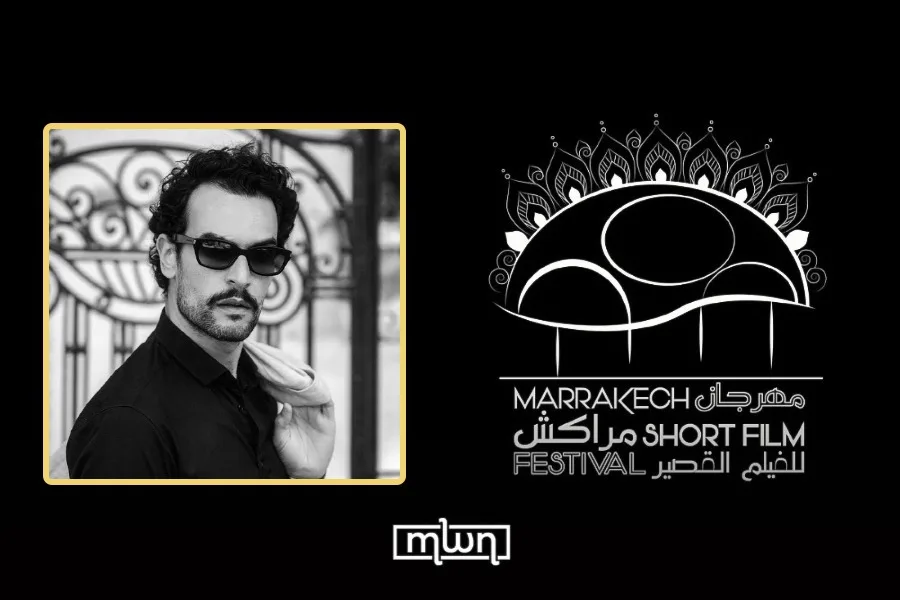
Fez — For Moroccan actor and filmmaker Ayoub Layoussifi, cinema has always been a calling that arrived naturally, weaving together childhood memories, youthful discoveries, and professional rigor.
His participation in this year’s Marrakech Short Film Festival (MSFF) is both a return to roots and a testament to how Moroccan cinema is carving a place in the world.
From VHS tapes to Paris classrooms
Layoussifi traces his love of cinema to his youth in Casablanca. “My father was a member of a video club (…). Every Friday or Saturday, we went and chose two films: an action film and a mainstream film. We must have also seen Hitchcock, Clint Eastwood, cowboys, Bruce Lee, ‘Home Alone,’” he recalled. “I think all that came back at some point.”
In 2002, Layoussifi moved to France for studies. “I did a maths sup, maths spé, preparatory classes for engineering schools. I did computer science, bachelor, master. And then during computer science studies, I created an association with friends who talked about cinema and theater,” he explained.
Those conversations about making-ofs, actors, and directors deepened his fascination. “We were always discussing how Al Pacino prepared, how the casting of ‘The Godfather’ happened, how Herzog worked with Klaus Kinski. All those people inspired me as an actor, as a filmmaker.”
By 2006, Layoussifi enrolled in cinema studies at Paris University. He earned a professional master’s in directing and creation and trained as an actor at the Actor’s Studio. In 2011, Morocco called him back, and he began to work between France and Morocco.
Cinema as education and inspiration
For Layoussifi, cinema is crucial for young people. “Watching films, being inspired, working their imagination… getting out of Netflix, trying to go to the cinema, auteur cinema, South Korean, Iranian, Moroccan, Italian cinema,” he said. “Cinema is very important for young people. You must develop an artistic eye, a critical eye around everything that is artistic.”
He emphasized that cinema education should begin early. “We see a painting, we can analyze it; we see a film, we can analyze it. Education in cinema is very important, or through cinema is very important.”
Stories rooted in memory and Morocco
Both personal memories and anecdotes from a Moroccan friend inspired the story for his latest project. “I would have loved, being very little, to go much more into cinema halls, to discover the films that I had discovered on videocassette,” he said. “We had the chance to have a father who had invested in this VHS player at the time. So that inspired me.”
He also wanted to anchor the narrative in Morocco’s everyday life. “I got a little inspired to write that, and then also to translate the film, and to be as close as possible to everyday Moroccan families.”
Aïta, tradition, and modernity
One of the central inspirations of his film is aïta, the ancestral Moroccan poetic art. “We are going to talk about the chikhates, who are artists for us, women artists who perform for us,” Layoussifi said. He recalled being fascinated by their voices and lyrics. “We have always been attracted to them, intrigued by that power of voice, by those texts sometimes that we didn’t understand.”
Anchoring the story in the 1990s, a period when aïta’s popularity was waning under the influence of Western sounds, Layoussifi sought to depict a generational dialogue between tradition and modernity. “It’s a young girl of 17 years old in the 90s. Maybe she wants to continue that art and even renovate it, bring something new, and perpetuate the tradition,” he explained. “It’s society, those who fight against tradition and others who fight for modernity. That’s what animated us in this story.”
Challenges and authenticity
For Layoussifi, the main challenges were linked to research, music, and authenticity. “It was above all the lyrics. And so we made the choice not to translate the lyrics of the aïta. Because if we translated them, for us, we would contextualize them. The real value was also the challenge,” he said. Financing the film and recreating the 1990s setting also required perseverance. “If you don’t do research when you write a film or you want to direct it, then you do nothing. To tell it in an authentic way, it was above all to tell reality.”
Learning from great directors
Layoussifi has worked with world-renowned directors such as Werner Herzog and Michael Bay. “It was an honor to have worked with them, because overnight, it’s a dream,” he said. “They brought me rigor, they brought me seriousness. Werner, I watched how he directed us as actors. All in simplicity, in the little word that unlocks the thing. While Michael Bay will go to other things, he is more into action. But really, it brings me rigor, it brings me seriousness. I take my work seriously.”
He also credits Moroccan directors across generations for shaping his vision. “Frankly, there is a young generation that comes to complete the work that was already laid by an older generation. For me, it’s continuity: complete and continue this work, while proposing something new.”
The future of Moroccan cinema
For Layoussifi, Morocco is on the right track but needs more support for distribution and financing. “Maybe it needs many more windows, many more financing windows, much more distribution internationally,” he said. “Like that, the film, from writing, we know that it will have a life. Because it is well surrounded, because of distribution.”
He sees progress already underway. “There are things that are being done that have been laid today. Moroccan cinema is thriving today and proposes solutions, collaborations, and agreements with France and other countries. So we are on a good path. It may need a little time to arrive at a global fulfillment. But in any case, the path is launched. And we are on that path. And we should just continue fully so that our Moroccan cinema shines more and more than it does today.”
Looking to Marrakech
Layoussifi and his collaborator Zahoua await MSFF with enthusiasm. “We are very happy, delighted with our participation in the Marrakech Short Film Festival. We await it with impatience because we know that it’s a very important festival and that it could bring us a lot of very positive things,” he said.
For Layoussifi, MSFF is not only a chance to showcase his film but also a space for Moroccan cinema to reflect, grow, and connect with the world.