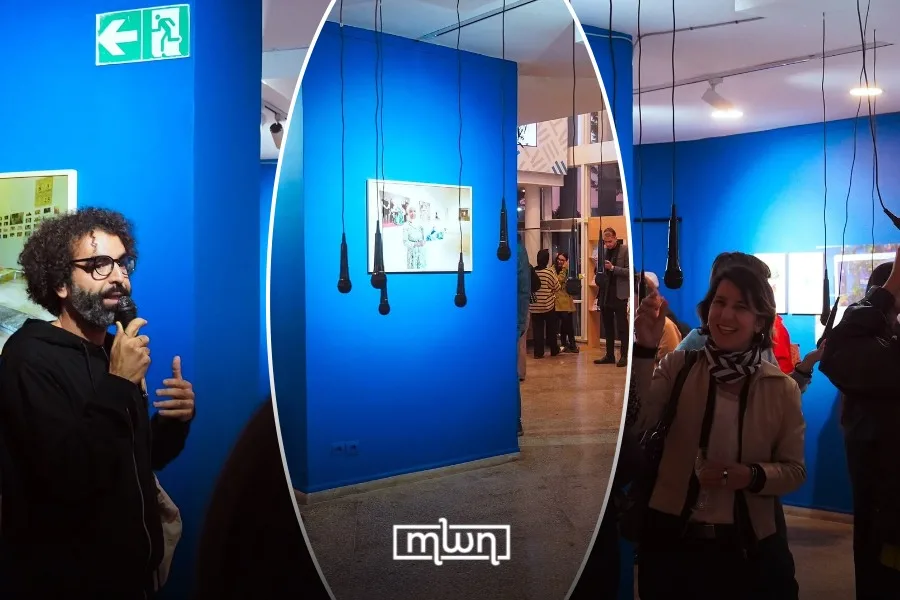
Fez — The “Entre nos mains” (“In our hands”) exhibition is now on view in Casablanca, where Moroccan artist Badr El Hammami is presenting an immersive installation that turns listening into a form of encounter.
Staged at “Galerie 121” inside the “Institut français de Casablanca” (French Institute of Casablanca), the show started running from December 5 and will be over on January 31 with free entry for the public.
At the heart of the installation are 15 suspended microphones, transformed into transmitters of narratives, songs, and fragments of collective remembrance.
Rather than amplifying a single voice, the work is designed to reward proximity: the closer visitors move, the more they uncover a layered soundscape of personal stories, traditional chants, and everyday recollections.
The exhibition is accompanied by a photographic component that extends the work’s central idea: memory does not exist only in words, but also in faces, gestures, and the quiet traces people leave behind.
Together, image and sound create what the organizers describe as a sensitive crossing of memories where individual experience becomes part of a larger, shared archive.
Listening as a way of moving through memory
What makes “Entre nos mains” distinctive is its restraint. The voices are described as discreet and almost whispered, producing an atmosphere closer to intimacy than spectacle.
In this setting, visitors are not passive spectators; they become explorers, moving through hidden sonic “universes” that reveal themselves gradually.
An artist shaped by borders, movement, and collaboration
El Hammami, born in Morocco in 1979 and now based in Marseille, has built a practice that repeatedly returns to questions of otherness, migration, borders, and memory. He is trained at the “École nationale supérieure d’arts de Paris-Cergy” (National School of Arts Paris-Cergy) and the “École régionale des beaux-arts de Valence” (Valence Regional School of Fine Arts).
His work has been shown in major international contexts, including at Madrid’s Reina Sofía Museum and France’s “Musée national de l’Histoire de l’Immigration” (National Museum of the History of Immigration), as well as in global art platforms like “MANIFESTA 13” and the “Rencontres de Bamako.”
In Casablanca, that trajectory feels especially resonant. A city shaped by internal movement and international circulation, it offers a fitting stage for an installation that asks how voices travel, how stories settle, and how communities remember.
As Morocco’s contemporary art scene continues to broaden — embracing sound, performance, and participatory forms — projects like “Entre nos mains” suggest a cultural shift toward listening as a civic act: a reminder that the most enduring archives are often carried not in institutions, but in people.