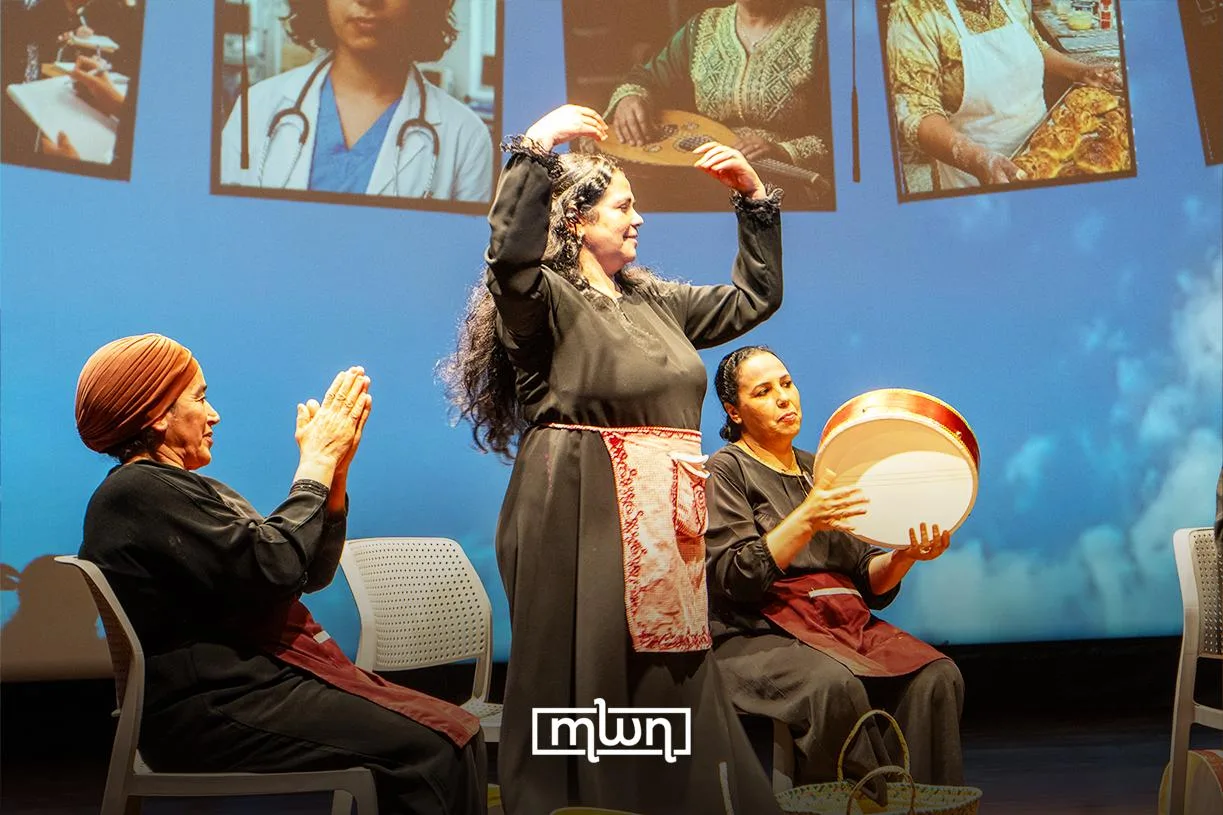
Rabat — The women who help keep the halls, classrooms, and offices of Morocco’s Higher Institute of Dramatic Art and Cultural Animation (ISADAC) running every day stepped into an unfamiliar role this weekend: theater performers.
Presented at Théâtre Lab in Rabat, the project “Théâtronissa” brought together ISADAC cleaning staff, students, and faculty members in an ambitious initiative that transformed personal stories into a theatrical performance centered on dignity, inclusion, and human connection.
For ISADAC Director Latefa Ahrrare, the project represents the very essence of inclusive art.
“We are truly happy to have achieved such a meaningful accomplishment with the cleaning staff of ISADAC,” Ahrrare said. “They are always present alongside the teaching staff, the students, and the administration.”
She emphasized that the project created a rare opportunity for the women to share their stories publicly.
“What is beautiful is that we gave them a space to speak, to open up, and to tell their stories,” she said. “At the same time, it is a way of including them and making them part of the experience.”
Ahrrare described the initiative as a valuable learning experience not only for the participants but also for the students who spent months working alongside them.
“This is inclusive art,” she said. “The cultural animation students and scenography students, together with their professor, Ayoub Aït Bihi, achieved something remarkable.”
Developed by fourth-year students in Cultural Animation and Scenography under the supervision of producer, director, and cultural production professor Ayoub Aït Bihi, the project sought to place women often overlooked in institutional life at the center of artistic creation.
“The idea behind this project was to work with women from the community, with a strong human and social purpose,” Ait Bihi told MWN Lifestyle.
“This is how the idea of ‘Théâtronissa’ was born.”
The initiative began with a series of workshops that lasted between five and six months.
Led by ISADAC students, the sessions focused on theatrical expression, storytelling, movement, and collective creation.
Over time, the women shared their experiences, personal journeys, and daily realities, providing the foundation for the final production.
“These workshops lasted for five to six months and were led by the institute’s students, who worked with the women on a daily basis,” Ait Bihi explained.
“As the project evolved, we eventually reached the stage of creating, for the first time, a theatrical workshop and performance.”
For many of the participants, it was their first experience standing before an audience.
“These women stepped onto a stage for the very first time and presented their first theatrical production,” he said.
“These are the cleaning staff who work at this institute.”
Beyond its artistic dimension, the project also aimed to challenge traditional boundaries within educational institutions by creating meaningful encounters between students and workers whose contributions often remain invisible.