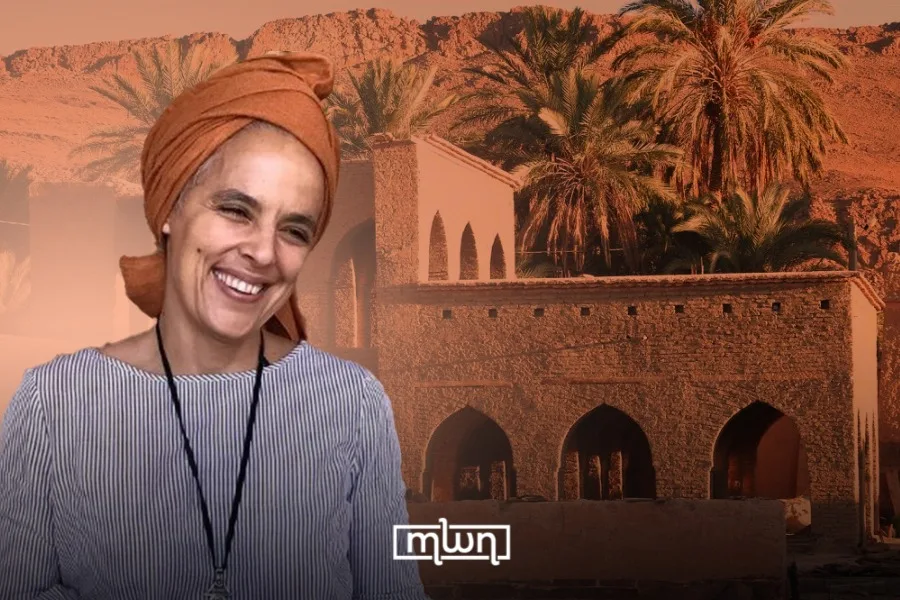
Fez — Salima Naji has built a career at the intersection of architecture, heritage conservation, and social anthropology, largely outside Morocco’s dominant urban development circuits.
Her architecture rejects spectacle in favor of continuity, grounding contemporary design in local materials, collective memory, and the people who inhabit her buildings.
Trained at the Paris–La Villette School of Architecture and holding a doctorate in social anthropology from the École des Hautes Études en Sciences Sociales, she has spent nearly two decades working primarily in southern Morocco, where climate, seismic risk, and limited resources shape both design and daily life.
She founded her architectural practice in 2004 with a focus on constructive alternatives rooted in local realities. Since 2008, she has been based in Morocco’s south, privileging earth, stone, and biosourced materials, while working closely with local artisans and communities.
A method rooted in place rather than form
Naji’s work is often described less as a visual “signature” than as a method. Rather than imposing new forms, she works with what territories already know how to build, repair, and maintain. According to Archnet, her projects consistently adapt vernacular Moroccan construction techniques — clay, stone, wood, palm fibers — to contemporary needs, with sustainability and skills transmission at their core.
This approach has led observers to describe her practice as an “architecture of memory,” where restoration is not about freezing sites in time, but keeping them functional and socially legible. Conservation, in this sense, becomes an active process tied to everyday use.
International recognition in 2025
In late 2025, Naji received the 2025 International Prize for Women Architects, awarded through the “Prix des Femmes Architectes” program by the Association pour la Recherche sur la Ville et l’Habitat. The International Union of Architects cited her “deeply engaged” approach, combining respect for heritage and territory with contemporary, sustainable innovation.
Projects cited around the award include the Citadel of Agadir Oufella, the Maternité de Tissint, the Centre d’Interprétation du Patrimoine in Tiznit, and community-oriented spaces such as women’s houses and artisan centers. The jury also pointed to restorations like Villa Carl Ficke and the colonial souk of Tablaba.
Repairing collective life, not monuments
Several recurring projects illustrate Naji’s broader philosophy. Her intervention at the Agadir Oufella citadel emphasizes locally sourced materials and vernacular anti-seismic techniques inspired by the Atlas Mountains. The rehabilitation of the Souk Tablaba in Taghjijt treats the marketplace as social infrastructure rather than a static monument.
Equally significant are her projects in Tissint, where women’s facilities and a maternity center apply the same material intelligence often reserved for historic sites. Heritage, in her practice, extends to dignity in public services.
Across southern Morocco, Naji has also led participatory restorations of ksours and communal granaries, working with local craftspeople to maintain fragile collective architectures in regions facing economic and environmental pressure.
Research as practice
Naji’s dual training in architecture and anthropology shapes how she approaches design. Projects begin with existing social arrangements, local knowledge, and lived constraints rather than abstract concepts. She has also authored several books documenting vernacular architecture and heritage rescue in southern Morocco, reinforcing the link between building and research.
Her work suggests that architecture can serve as a form of cultural continuity. By repairing rather than replacing, and by building with communities rather than over them, Salima Naji’s practice reframes heritage as something lived — not displayed — and positions Morocco’s local knowledge as a source of contemporary relevance rather than nostalgia.