Fez — Spain’s leading newspaper El País has dedicated a long-form travel report to Morocco’s Draa Valley, presenting the region as one of North Africa’s most striking desert corridors, stretching from the High Atlas Mountains to the edge of the Sahara.
Written by journalist Analía Iglesias for El Viajero, the newspaper’s travel section, the piece describes the valley as a route where desert, oasis, and human settlement coexist, challenging the idea of the Sahara as an empty or lifeless space. According to the report, the best period to explore the region runs from October to May, when temperatures are more moderate and desert travel is most accessible.
From the High Atlas to the Sahara
The article traces a typical journey beginning in Marrakech, crossing the High Atlas via the Tizi n’Tichka pass before descending into southern Morocco. Along the way, it highlights historic sites such as Aït Ben Haddou, the UNESCO-listed fortified village near Ouarzazate, and the kasbah of Telouet, once the residence of the Glaoui family.
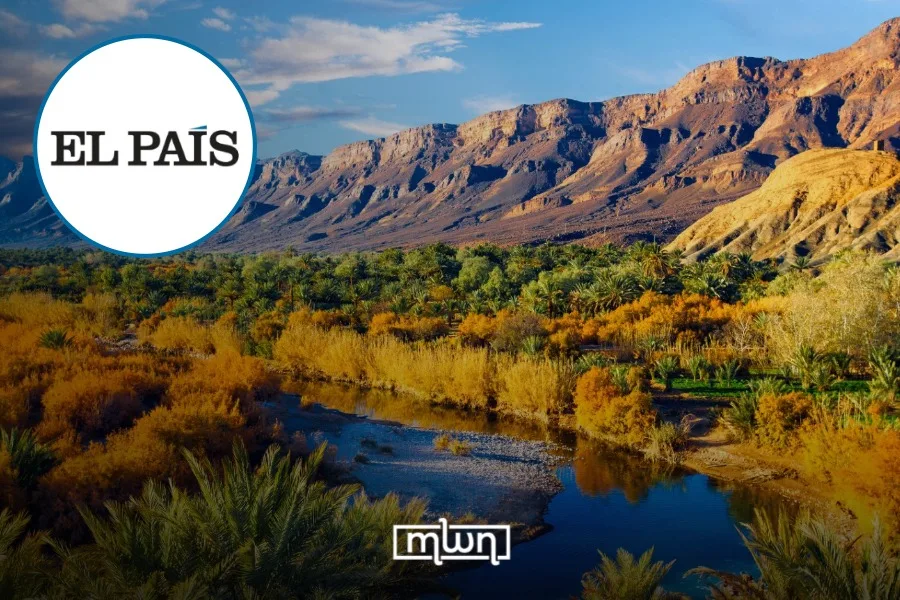
El País notes that the transition from mountain landscapes to palm-filled valleys marks the opening of the Draa, Morocco’s longest river, which runs for approximately 1,100 kilometers. While the river no longer flows year-round, residents interviewed for the report attribute its reduced water levels to prolonged drought and intensive agricultural practices.
Here is the visual contrast of almond trees in bloom, dense date palm groves, and reddish desert soil, particularly around Agdz and Zagora, where the valley’s agricultural heritage remains visible.
Oasis life, music, and heritage
Beyond landscapes, the article focuses on the cultural life of the region. Iglesias describes traditional music practiced in oasis communities, including styles performed by local brotherhoods using percussion, metal castanets, and string instruments. These musical traditions, often performed during gatherings and festivals, are presented as central to understanding desert society.
The report also highlights the village of Tamegroute, known for its centuries-old Quranic library and distinctive green-glazed pottery, which continues to be produced using traditional methods.
Living desert, not empty land
As the journey continues south toward M’Hamid El Ghizlane and the Chegaga dunes, El País portrays the desert not as a void, but as an ecosystem. The article notes efforts to reintroduce wildlife species such as gazelles, ostriches, and antelopes, as well as the continued presence of nomadic traditions.
Sleeping in desert camps, walking through the last palm groves of the Draa, and observing the night sky are described as key elements of the experience, reinforcing the idea of the Sahara as a place shaped by human adaptation and environmental balance.
In framing the Draa Valley as both a cultural corridor and a fragile ecological zone, the El País report situates southern Morocco within broader conversations about sustainability, heritage preservation, and responsible travel — presenting the desert not as an end point, but as a living continuation of Morocco’s historical routes.