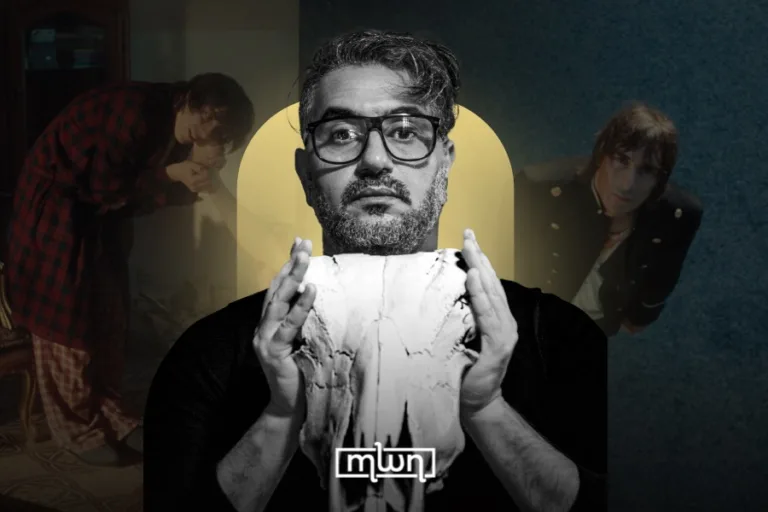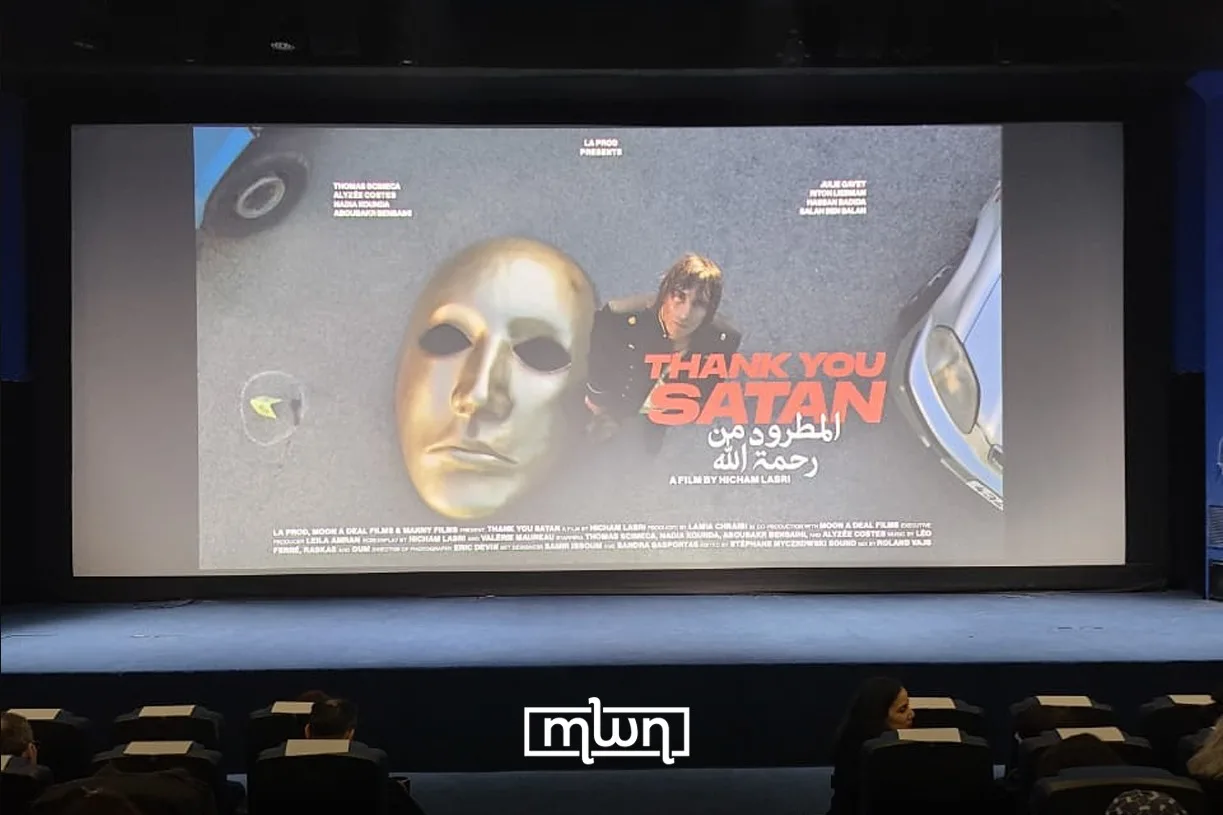
Casablanca – The avant-premiere of Hicham Lasri’s “Thank You Satan” took place yesterday at the Cinémathèque du Maroc in Rabat ahead of its official release on April 8.
Through this dark comedy, Lasri explores themes of violence, identity, and the mechanisms that drive individuals toward extremism.
The story revolves around a French writer who’s facing financial instability. With a pregnant wife and living conditions unfit for a newborn, he finds himself drawn into a disturbing path. The only solution left? Issuing a fatwa (religious ruling that offers monetary reward for killing someone accused of blasphemy) against another writer for a bounty.
He is not Muslim nor is he ideologically driven; yet he chooses to resort to violence. This raises unsettling questions about how and why such decisions are made.
Lasri emphasized that violence is not tied to religion, but rather rooted in human behavior and circumstance.
“We try to push to realize that violence comes from us because we are accused. Never because it’s a religion, never because we have the choice, never because everything is fine, it comes from us. Anyone can be a terrorist when they have no choice,” he explained.
In the film, the protagonist adopts Islam not out of belief, but as a performative step in his descent, pointing to the film’s argument that violence is constructed rather than inherited.
By showing a non-believer converting before acting violently, the film challenges the common assumption that extremism stems from faith itself, rather than from human circumstances and choices.
Western narratives on Muslims
It also pushes back against dominant western narratives that often portray Muslims through the lens of violence, instead suggesting that those narratives are reductive, and that the roots of violence lie far beyond religion.
“I have always been very attentive to the clichés about us,” Lasri told Morocco World News (MWN) Lifestyle.
“People who come to our territory and tell stories about us without us being able to control the narrative, without being able to spread, create a dialogue between the West that sees us in a certain way and we who see the west in a certain way, without necessarily being conflictual.”
“I think that sometimes,” the Morocca filmmaker elaborated, “there is bad faith, but also sometimes there is clumsiness. So what was interesting was to tell a story that made it possible to understand that it is a dialogue.”
No room for passive viewing
From the outset, Lasri makes it clear that “Thank You Satan” is not meant for passive viewing. Rather than delivering easy answers, the film invites audiences to engage actively with its ideas, taking the time to reflect before jumping into conclusions.
“I prefer to have an audience that is able to let themselves be transported by a film, even when they disagree with the themes we approach, that they make the effort to go to the end of the journey before having a synthesis, before making a decision on whether they like it or not, whether they question it on something important or not, or whether it adds something to their identity,” he further explained.
For international audiences in particular, the film’s reception appears to be shaped by both fascination and a sense of disturbance, as its ambiguity resists clear interpretation.
“An international audience is surprised by the eloquence of the film but also disturbed because it’s ambiguous. It’s a film that doesn’t give an answer. There’s no good, no bad.”
Ambiguity is not a limitation
For Lasri, however, this ambiguity – and even the risk of being misunderstood – is not a limitation, but a deliberate choice rooted in his broader philosophy of cinema. Rather than simplifying his work to meet audience expectations, he prioritizes sincerity and artistic integrity.
“I am never afraid that the film is misunderstood or misinterpreted because I start from the principle that it is only a matter of time. My philosophy in life is to be honest, it is to be sincere, it is to be pure and to share with people the result of my creation in all its complexity, but at the same time in all its simplicity,” Lasri said to MWN Lifestyle.
“My intention is never to say that it has to be simpler, that it has to be more readable, that it has to be comical, that it has to be dramatic, etc. I don’t think that way. I think in terms of cinematographic writing.”
Early controversy before the release
Even before its screening, “Thank You Satan” sparked debate, raising questions around freedom of expression and early criticism formed without a full view of the work. The situation has even taken a legal turn, based on the title and teaser alone.
“The complaint was deferred in an emergency, and then, in fact, we have not yet received a paper or anything at the hearing. But we know that it is an ongoing affair. I spoke with my lawyers to find out how we can defend ourselves,” Lasri told MWN Lifestyle regarding the case.