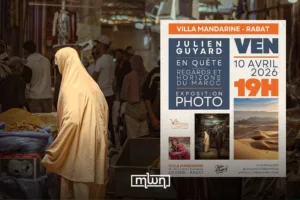
Fez — Rabat is set to welcome “En quête” (on a quest), a new photography exhibition by Julien Guyard opening on Friday, April 10 at Villa Mandarine in Rabat.
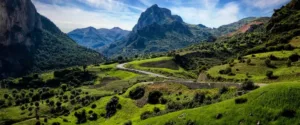
The show brings together a selection of images developed over more than two decades of the photographer’s life and work in Morocco, combining wide landscapes with portraits in a body of work rooted in patience, observation, and light.
Guyard, who has lived in Morocco for over 20 years, presents the exhibition as the result of a long process rather than a one-time project. Reports on the show describe “En quête” as a visual journey built over time, shaped by the places he has crossed, the people he has encountered, and the accumulated observations that have informed his photographic eye.
Rather than relying on dramatic staging, the work appears to focus on precise moments where composition, presence, and light fall into balance. That slower method is central to the exhibition’s identity. Coverage ahead of the opening describes Guyard’s practice as one based on repetition, waiting, and intuition, with each photograph adding to a broader, coherent series rather than standing as an isolated image.
A long-form photographic relationship with Morocco
What gives “En quête” its weight is not only the duration of the project, but also its attachment to Moroccan territory. The exhibition is anchored in a prolonged engagement with the country, treating Morocco not as a backdrop but as a lived landscape. In that sense, the show appears less interested in spectacle than in depth, offering viewers images shaped by time rather than speed.
The opening is scheduled for April 10, with invitations shared online indicating a 7 p.m. start at Villa Mandarine in Rabat. Social posts linked to the event describe the exhibition under the fuller title “En quête — Regards et Horizons du Maroc,” reinforcing its focus on both people and place.
Light, landscape, and the slow image
The language surrounding the exhibition repeatedly returns to light, suggesting that Guyard treats it as more than a technical condition. It becomes the thread connecting portraits to horizons, silence to scale, and fleeting moments to a much longer visual search.
For Rabat’s cultural scene, “En quête” adds another photography event grounded in lived experience rather than instant production. The exhibition offers the public a glimpse into a body of work shaped over years, and into a way of photographing Morocco that values endurance, precision, and attention over urgency.