Lugano — Working out alone has long been treated as the default starting point, but for many, it can become repetitive, tedious, and isolating.
Over time, this can lead to a decrease in motivation and enjoyment, ultimately resulting in inconsistency.
For beginners, the challenge is even greater, starting alone can feel intimidating, not knowing where to begin, what exercises to do, or whether they are being performed correctly.
Group fitness settings such as running clubs, yoga classes, and community workouts offer an alternative that can reshape how people begin and sustain fitness routines.
In these shared environments, the focus shifts away from performance and toward participation, where the expectation is not perfection, but presence.
This subtle change plays a significant role in making fitness more accessible to those who might otherwise struggle to start.
Consistency and Routine
Participants often describe how solo workouts rely heavily on self-discipline, and while this is a valuable skill to develop, it can fluctuate over time, making consistency difficult to maintain.
In a group setting, however, showing up becomes easier, as scheduled sessions such as indoor spin or Zumba classes, introduce a sense of accountability and structure that removes the constant need for self-motivation.
When outdoor exercise becomes less appealing due to heat, these environments provide a reliable alternative that helps maintain routine and consistency.
The dynamic also reshapes how beginners experience the workout itself, as in a spin class, for example, participants follow the same rhythm while adjusting intensity individually, allowing beginners to take part without pressure and making it easier to stay consistent regardless of seasonal conditions.
Social Connection
The social dimension adds another layer, as conversations before and after sessions, familiar faces, and repeated interactions gradually create a sense of belonging that extends beyond the workout itself.
In team-based activities such as football or basketball, connection often develops naturally through shared goals, cooperation, and collective effort, allowing participants to engage with one another without the pressure of forced interaction.
The World Health Organization found that physical activity contributes to social integration and self-esteem, reinforcing the role that shared environments can play in supporting social connectivity.
What begins as a fitness activity often evolves into a social routine, with participants returning not only for the exercise but for the familiarity and continuity that these group settings provide, as regular meetups encourage people to linger, talk, and build relationships over time.
Mental Wellbeing
Group fitness plays a significant role in supporting mental wellbeing, as exercising in a shared environment not only enhances mood but also reinforces those effects through connection, structure, and a sense of collective participation.
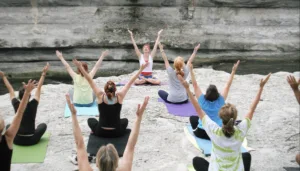
Activities such as group yoga classes combine movement with controlled breathing and guided focus, creating an environment that encourages individuals to slow down, become more aware of their bodies, and engage in the present moment, all of which contribute to reduced stress levels and improved mental clarity.
Practicing alongside others can also deepen this effect, as the shared rhythm of movement and stillness fosters a calming atmosphere that makes it easier to remain engaged and less focused on self-judgment.
Beyond the physical benefits, group-based practices like yoga can support emotional regulation by providing a consistent space for release and reflection, where participants are able to disconnect from daily pressures while still feeling part of a collective experience.
This sense of shared presence can reduce feelings of isolation and create a subtle but meaningful form of support, even without direct interaction.
This aligns with findings from the World Health Organization, which notes that regular physical activity improves mood, reduces symptoms of anxiety and depression, and supports overall wellbeing, particularly when it encourages social interaction and routine.