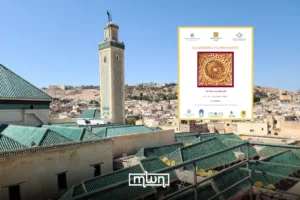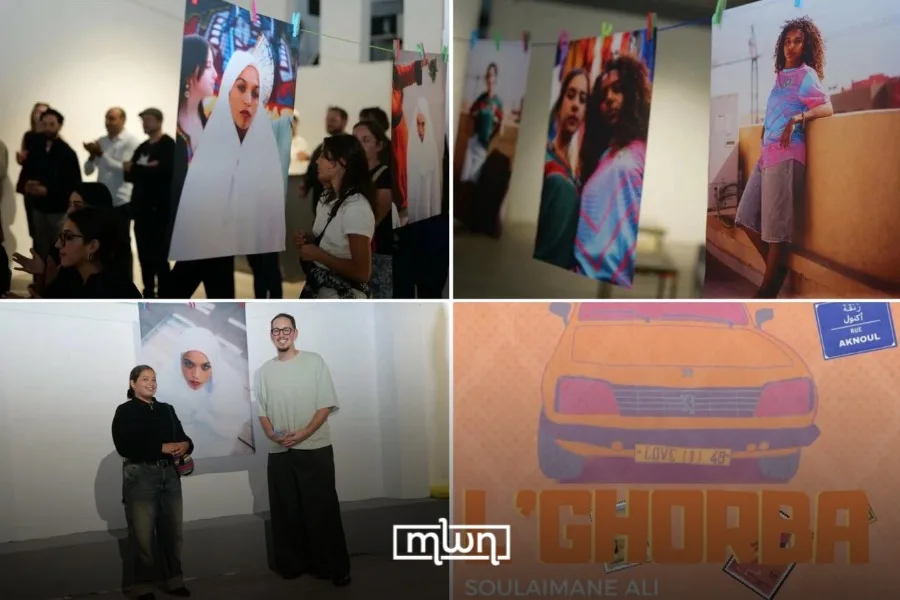
Fez — Tatmin Gallery is hosting “L’Ghorba” through December 7, presenting Soulaimane Ali’s sustained look at life lived between two shores.
In Moroccan Arabic, “ghorba” evokes the ache, freedom, and longing of being away from home. Ali leans into that double meaning, asking what we carry, what we shed, and how public space reveals both.
Organized around four photographic series — “Lbnaat” (“Girls/daughters”), “Lkoura li 3tat sawtha,” (“The Ball That Makes Its Voice Heard”), “Moroccan Men in Black,” and “Mgharbas in the City” — the exhibition moves from tightly framed portraits to broader urban tableaux.
The sequencing is deliberate. Faces come first, then bodies in motion, then the street, where language, fashion, and gesture signal belonging and distance at once. The mood shifts between tenderness and grit, but the throughline is clear: exile is not only departure, it is also a way of seeing.
Four series, one conversation
“Lbnaat” centers young women who author their own presence. They confront the lens, negotiate the city, and rewrite the gaze that usually defines them. “Lkoura li 3tat sawtha” tracks football as common ground, a shared language that threads neighborhoods in Tangier, Brussels, or Antwerp. The images catch brief alliances: a pass, a laugh, a huddle before dispersal.
“Moroccan Men in Black” studies the codes of masculine dress and self-presentation, from Friday best to daily uniforms, teasing out how style becomes a passport between contexts. “Mgharbas in the City” widens the frame. Commuters, market stalls, and municipal signage layer Arabic, French, Dutch, and Tamazight into a single visual field. The city reads like a palimpsest; identity does too.
Ali’s palette is restrained, his compositions calm. He favors available light and uncluttered lines, letting subjects hold their ground. People meet the camera without flinch or flattery. The result feels both like a documentary and a personal narrative, as if the streets were a family album slowly filling in.
An artist between shores
Born in Belgium to Moroccan parents, Ali spent summers in the north of Morocco, learning the rhythms of extended family and the textures of small-town life. That seasonal back-and-forth seeded the project’s point of view. During his studies he completed an exchange between the Vrije Universiteit Brussel and the International University of Rabat, and later interned at the Belgian Embassy in Morocco. The travel and the work sharpened his eye for cultural overlap: where infrastructures align, where they misfire, and how people improvise in between.
“L’Ghorba” also marks a new chapter for Tatmin under its refreshed artistic direction. The gallery says it wants to back emerging Moroccan photographers and create spaces for encounters with audiences.
The show sits within a wider cooperation arc that includes “Mawjaat: Third Places for Cultural Transitions in the Mediterranean,” implemented by Friche la Belle de Mai in Marseille (cultural center) with support from the French Embassy in Morocco. It is additionally carried by VIA | Belgique X Maroc, an initiative dedicated to artistic dialogue between both countries.
That context matters. Ali’s pictures are not postcards – they are field notes from a generation that moves easily yet carries weight. The frames capture pride and tiredness, joy and second thoughts. A jacket that signals one thing in Brussels might read differently in Tetouan. A chant from the terraces might echo on both sides of the Strait with minor key changes. The work holds these frictions without forcing a verdict.
By the end of the route, “L’Ghorba” feels less like a theme than a method. It teaches the eye to hold two truths: home is here, and home is elsewhere. Tatmin’s wager is that such work helps cities see themselves more clearly. Ali’s answer is quiet and confident. He lets the pictures do the talking, and the multiple, overlapping identities do the living.