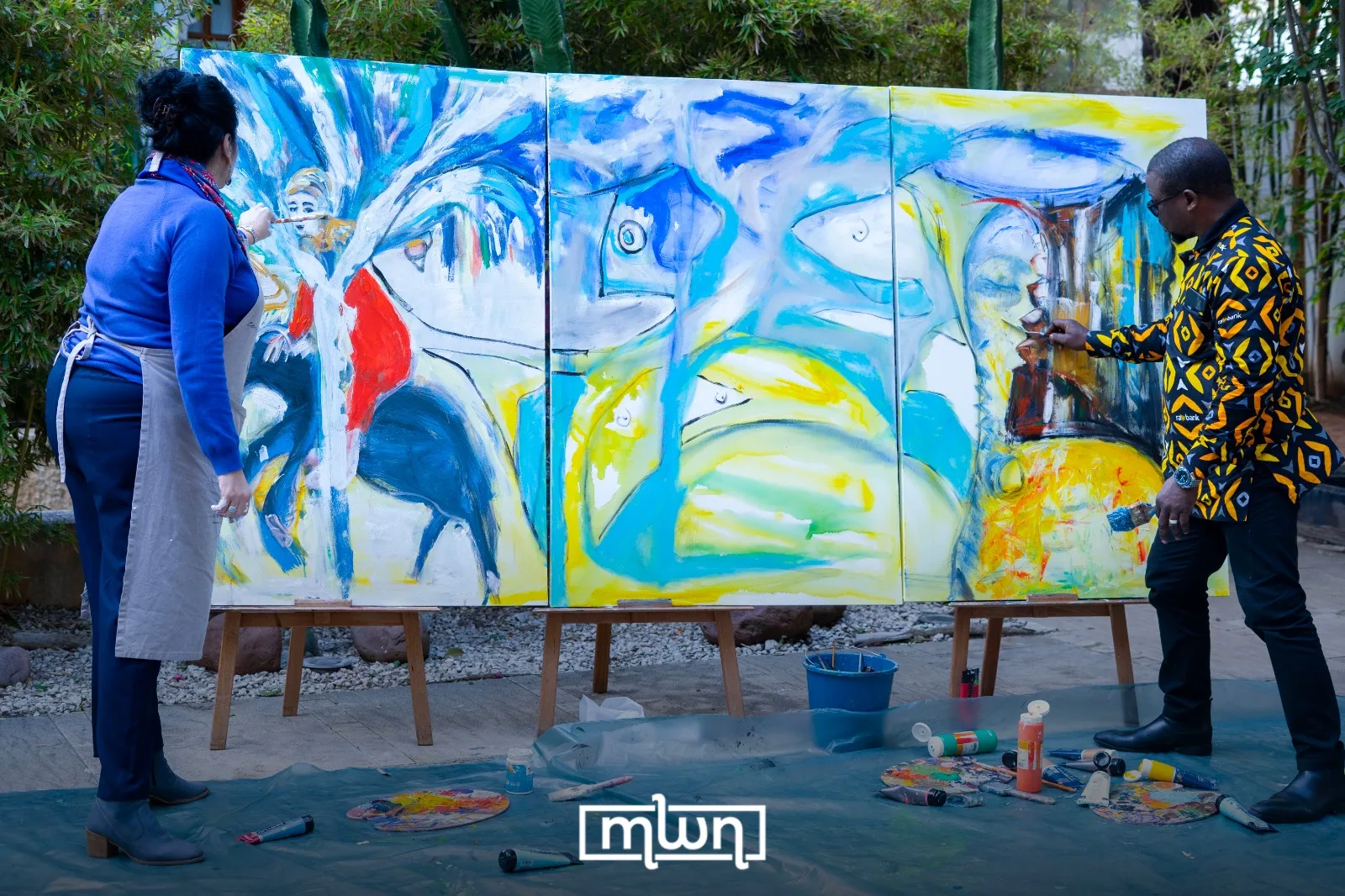
Fez — The exhibition “Colors and Voices of Change” opened this week at Rabat’s Mohamed El Fassi gallery, marking the first stage of a multi-country artistic residency built around intercultural cooperation between Africa and Europe.
Hosted in Morocco for its inaugural phase, the project brings together Moroccan painter Laila Benhalima, Senegalese painter Zulu Mbaye, Congolese painter Franck Dikisongele, and Belgian filmmaker Roberto Roméo. The residency is designed as a journey across four countries, beginning in Morocco, continuing to Senegal and the Democratic Republic of Congo, and concluding in Belgium with a final presentation and documentary.
Art as a journey across borders
Benhalima described the residency as a long-term process rather than a single exhibition. “This project begins in Morocco, continues next year in Senegal and the Congo, and will conclude in Brussels with a presentation of all the works and a documentary tracing the experience,” she told MWN.

She emphasized that the initiative is rooted in cultural exchange supported by multiple institutions, including Villa des Arts, the Moroccan Agency for International Cooperation, and the Ministry of Culture. The Rabat exhibition, she noted, represents the project’s first public encounter with audiences.
Transmission at the center of the residency
Beyond collaborative creation among artists, the residency places strong focus on education and engagement with young people unfamiliar with visual arts. “What mattered most was the transmission,” Ben Halima told MWN. “We worked collectively, created individual pieces, and shared knowledge with young people who had never practiced plastic art — and they surprised us with the quality of their work.”

Congolese painter Franck Dikisongele echoed that focus, highlighting the importance of youth engagement at every stage of the project. “What gave me the greatest pleasure was sharing this experience with Moroccan youth,” he told MWN. “I know it will be the same in Senegal, and later in the Democratic Republic of Congo.”

Dikisongele also framed the residency as a multidisciplinary collaboration. “This is a project that brings together three artists, and even four if we include the filmmaker,” he told MWN, pointing to the role of film in documenting and extending the project’s impact.
Institutional support and intercultural cooperation
The residency is supported by a mix of public and private partners across continents. Naima Amara, who works with the Commune of Saint-Gilles’ International Solidarity Service, described the initiative as a structured model of cooperation. “This project of intercultural cooperation is presented in four stages, with a first residency here in Morocco,” she told MWN, noting that the program combines periods of artistic exchange with moments open to the public.
At the opening in Rabat, Chiraz El Fassi, Deputy General Delegate of Wallonia-Brussels in Morocco, underscored the broader cultural context of the initiative. “This residency brings together Moroccan, Belgian, Senegalese, and Congolese artists, and the works on display show the richness that comes from mixing all these cultures,” she told MWN.

She also situated the project within existing ties between Morocco and French-speaking Belgium. “We already have a very rich partnership in the cultural field,” El Fassi told MWN, adding that the exhibition’s journey from Rabat to other African countries and then to Brussels reflects that continuity.
Moving into its next stages, the “Colors and Voices of Change” residency presents the Rabat exhibition as both a starting point and a clear statement. Art is a shared language capable of connecting continents, generations, and disciplines through sustained collaboration, rather than isolated events.