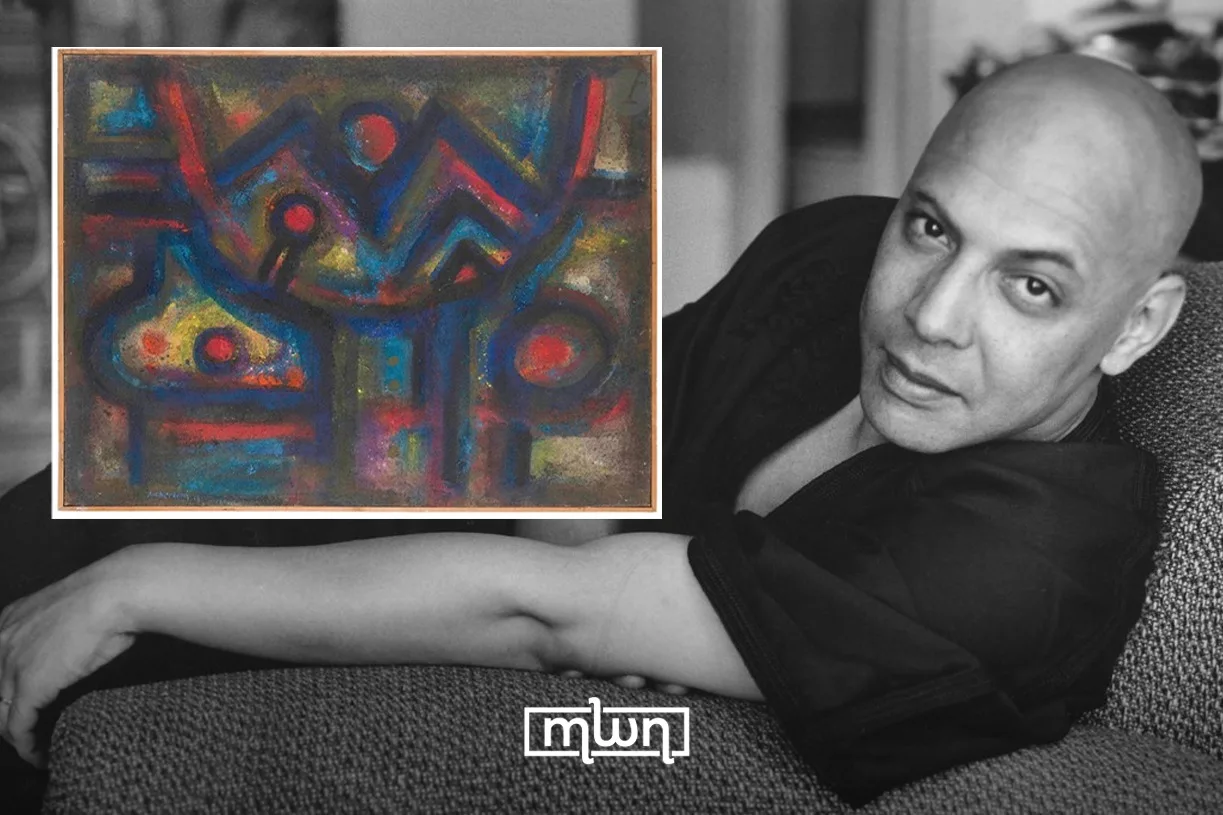
Fez — A major work by Moroccan painter Ahmed Cherkaoui has sold in Paris for €868,265 (MAD 9.3 million), setting a new world auction record for the artist and placing one of Morocco’s modern art pioneers back at the center of the international market conversation.
The painting, “Signes au ciel” (signs in the sky), was sold by auction house Ader at the Hôtel Drouot in Paris yesterday. Ader’s listing shows that the oil on canvas, measuring 89 by 116 centimeters, carried an estimate of €250,000 (MAD 2.68 million) to €400,000 (MAD 4.28 million) before reaching €868,265 with fees.
La Gazette Drouot described the sale as a world record for the Moroccan painter, calling the 1964 canvas a testimony to his artistic achievement.
A painting from Cherkaoui’s decisive period
Painted in 1964, “Signes au ciel” belongs to a key moment in Cherkaoui’s career, when the sign became the foundation of his pictorial language.
Ader described the work as part of Cherkaoui’s mature phase, where the sign no longer functions as simple decoration or description. Instead, it becomes an autonomous visual entity, carrying both intimate and collective memory.
The painting draws from a vocabulary rooted in Moroccan popular art, including tattoos, textile motifs, protective symbols, calligraphy, and pottery forms. Yet Cherkaoui did not reproduce those sources literally. He transformed them into abstraction, creating a language that felt both Moroccan and universal.
That synthesis is what gives “Signes au ciel” its importance. The “sky” in the title is not treated as a landscape. It becomes an open field where signs float, gather, disappear, and return like a suspended writing system.
From Bejaâd to Paris and Warsaw
Born in Bejaâd in 1934, Cherkaoui grew up in a spiritual environment where Quranic calligraphy shaped his early visual education. His later work would carry that sensitivity to the written sign, but remove it from strict readability.
In 1956, he moved to Paris to study at the School of Arts and Crafts, where he explored lettering, decoration, and poster design. He later enrolled at the School of Fine Arts in 1960, before a scholarship took him to Warsaw.
There, encounters with the works of Paul Klee and Roger Bissière helped push him further toward abstraction. But unlike many artists shaped by European modernism, Cherkaoui’s breakthrough came from bringing Moroccan signs into that language rather than abandoning them.
His work became a meeting point between the Atlas, calligraphy, Amazigh symbols, Sufi memory, and the European avant-garde.
Why the sale matters
The record price is not just a market headline. It signals renewed international recognition for a painter whose career was cut short when he died in Casablanca in 1967 at just 33.
“Signes au ciel” also carries strong provenance. Ader’s listing says the painting came from Galerie Jeanne Castel in Paris and the collection of Marie-José Lefort, and was exhibited at Galerie Jeanne Castel between September 25 and October 16, 1964.
That history matters because 1964 was a decisive year for Cherkaoui’s visibility in Paris. Ader notes that the Galerie Jeanne Castel exhibition, with a catalogue prefaced by Gaston Diehl, placed the work within a moment of recognition on the Parisian art scene.
For Moroccan modern art, the sale adds another sign that collectors are paying closer attention to the generation that helped free painting in Morocco from imitation of European models.
Cherkaoui’s market rise is therefore also a cultural correction. It reminds viewers that Moroccan modernism was not a delayed copy of Western abstraction. In Cherkaoui’s hands, it became a language built from local signs, inherited memory, and a deep search for form.
Nearly six decades after his death, “Signes au ciel” shows that Cherkaoui’s signs still travel. This time, they moved through a Paris auction room and returned as a record for Moroccan art.