Fez — Remember when “Cowboy Bebop” suddenly felt Moroccan? Not in a vague “North African/Middle Eastern” sci-fi shorthand, and not just as a dusty, exotic backdrop, but in a way that felt strangely specific, almost familiar.
It echoed places many Moroccans have actually walked through: a market street at dusk, a small corner cafe, older men lingering over cigarettes and cards, and sun-worn reddish walls that could easily belong to Marrakech, carrying a quiet weight of lived-in memories.
The scene comes from “Cowboy Bebop: The Movie,” also released as “Knockin’ on Heaven’s Door,” the 2001 film continuation of Shinichirō Watanabe’s celebrated anime series.
The film is set in 2071 on Mars, where the Bebop crew investigates a deadly biological weapon plot before a Halloween parade.
But for many viewers, especially Moroccan and North African fans, one of the film’s most memorable moments has little to do with the main villain.
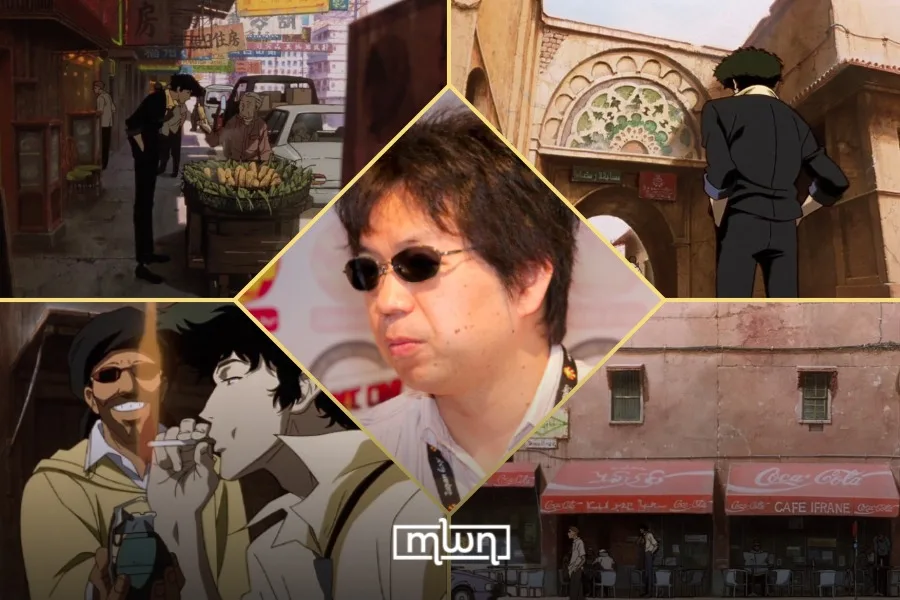
It happens when Spike Spiegel walks through Moroccan Street, a bazaar-like district in Alba City on Mars. The location is a popular street with shops and restaurants, including a cafe called Cafe Ifrane.
That strange feeling of recognition
The first surprise is not that Morocco appears in anime. It is how calmly it appears.

There is no giant announcement. No character turns to the camera to explain the “Moroccan district.” Spike just enters the space, and the film lets the viewer notice it. The lamps, signs, fabric, food stalls, cafe tables, narrow movement, and background noise do the work.
That restraint is what makes the scene feel nostalgic. It does not behave like a tourist brochure. It feels more like a half-remembered street from childhood, compressed into animation and sent into the distant spacetime of 2071 Mars.
For Moroccan viewers, the pleasure is partly in the small shocks of recognition. The old men sitting around. The slow pace of public life. The way the street seems to know everyone before anyone speaks. The market does not feel empty or symbolic. It feels socially alive.
Spike is the outsider there. He may be the cool bounty hunter, but Moroccan Street does not bend around him. He has to ask, wait, listen, and follow clues through a world that has its own codes.
Morocco as future, not background
What makes the sequence quietly beautiful is that “Cowboy Bebop” imagines Moroccan urban life as something that survives.
A lot of science fiction treats the future as a clean erasure. Cities become glass, steel, English signs, and blank international sameness.
“Cowboy Bebop” does the opposite. Its future is crowded with old earth cultures. Mars has highways, towers, corporations, terrorism, and space travel, but it also has cafes, street vendors, neighborhood gossip, and memories of Morocco from an almost abandoned Earth.
That choice gives the Moroccan Street sequence emotional weight. It suggests that the future will not only be made by technology. It will also be made by migration, habit, food, language, music, and the stubborn human need to recreate familiar corners wherever people go.
The film’s Moroccan atmosphere was not accidental. Production notes and interviews cited by fan archives say Watanabe wanted an Arab and Arabesque atmosphere for the movie, and that he used inspiration from a visit to Morocco while shaping the film’s look and mood.
That detail explains why the scene still circulates online. It has the slightly imperfect but sincere texture of observation. It is not documentary Morocco; it is remembered Morocco, filtered through Japanese animation, jazz, noir, and space western melancholy.
Rashid and the medina-noir mood
The district also introduces the man wearing the djellaba-amama-belgha-sunglasses combo, Rashid, one of the film’s most mysterious and cunningly wise figures.
His words, “You can find anything at Moroccan Street.” prove that he’s exactly the kind of guy Spike needs to move forward in his investigation.
He is later connected to Doctor Mendelo al-Hedia, the scientist behind the nanomachine weapon at the center of the story, but let’s not spoil anything for those who haven’t watched the movie yet.
Rashid, with his sebsi (traditional smoking pipe), matters because he turns Moroccan Street into more than an exotic backdrop. He belongs to the neighborhood’s mood of hidden knowledge. He knows things, but he does not reveal them directly. He moves like someone protected by ambiguity.

On a very surface level, he’s just another false guide showing Spike around the medina and even tricking him at a certain point to buy a vase from a bazaar, but beneath that he’s truly guiding him towards the truth he seeks.
That is where the sequence becomes almost medina-noir.
Spike is entering a maze of partial answers. Every face could be a witness. Every shop could hide a clue. Every casual conversation might be part of a larger truth. And everything Rashid speaks carries a deeper meaning.
All the while gnawa music is playing in the background, adding a spiritual depth to Spike’s visit, especially as Rashid starts speaking with double meanings about the “special kind” of beans, the Devil, and human flight.
It is classic “Cowboy Bebop”: cool on the surface, wounded underneath. The Moroccan Street sequence carries that feeling perfectly because it is full of life, but also full of concealment.
Why fans keep coming back to it
Part of the nostalgia comes from the scene’s timing. For many fans, “Cowboy Bebop” arrived through late-night television, DVDs, grainy downloads, or shared clips long before anime became as mainstream as it is today. Seeing a Moroccan-coded neighborhood in that context felt almost unreal.
It was not a representation in the modern corporate sense. It was deeper than that. Morocco appeared inside a Japanese space western, scored through global music, carried by a hero modeled on noir loneliness, and placed on Mars as if that made perfect sense.
More than two decades later, Moroccan Street feels like a small miracle of animated world-building. It shows that culture travels, adapts, and reappears in unexpected places.
In “Cowboy Bebop,” Morocco is more than a country on Earth. It is a mood strong enough to reach Mars, perhaps even beyond.