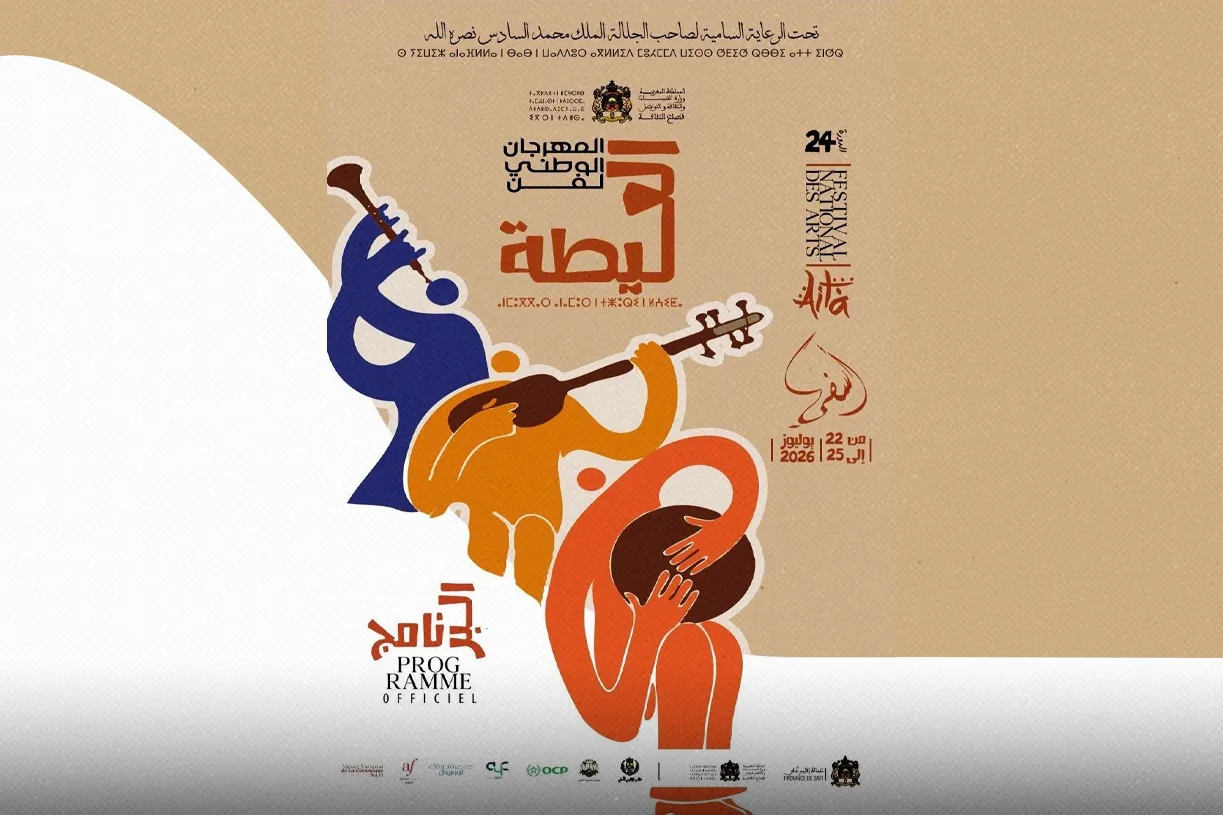
Safi – The 24th National Aita Festival will return on July 22-25, bringing together some of Morocco’s best-known Aita performers for four days of concerts and cultural events.
The festival is led by Morocco’s Ministry of Youth, Culture and Communication, in partnership with the Safi province, local authorities, and cultural institutions.
This year’s edition arrives under unusual circumstances. After recent floods hit parts of the city, the festival has stirred discussion among residents about the role of culture during a period of recovery.
Some see it as a chance to revive Safi’s image, draw visitors, and support local businesses after a difficult stretch.
Others believe the focus should stay on reconstruction and on the communities the floods displaced.
One of Morocco’s oldest musical traditions
At the heart of the festival is Aita, one of Morocco’s most important forms of oral musical heritage.
The word aita, meaning “the call” or “the cry,” reflects a centuries-old tradition through which performers give voice to stories of love, resistance, daily life, and social change.
Traditionally, Aita is carried by the cheikhat, the female singers long at its center, alongside their male counterparts, aka chioukh.
It pairs poetic storytelling with the loutar, a long-necked lute, the violin, the bendir frame drum, and hand percussion.
Rooted in regions including Abda, Doukkala, Chaouia, and Haouz, the genre remains a living archive of Morocco’s collective memory and regional identities.
The organizers frame the festival as part of Morocco’s broader effort to preserve intangible cultural heritage and bring younger generations to traditional arts.
Four days of performances
The festival will open on July 22 with Weld Sbaïmia, Walid Rahmani, and El Mehdi Weld Hajib at the Karting Stage, alongside an Opening Ceremony at the City of Arts Stage beginning, both, at 9:00 p.m.
The following day will bring Larbi Lachhab, Mohamed Mahfoudi, and Badr Oubbi to the Karting Stage at 9:00 p.m., while Jamal Ez-Zarhouni, Ahmed Zouid, and Weld Essouba will perform at the City of Arts Stage at 9:00 p.m.
Earlier that day, a seminar titled “The Art of Aita: Between Authenticity and Renewal” will run at the Regional Library at 6:00 p.m.
On July 24, audiences will hear Zohra Rabatia, Zakria Sfiani, and Hasba Groove at the Karting Stage at 9:00 p.m., while the City of Arts Stage will host Abidine Ez-Zarhouni, Amouri Mostafa, and Bouchaib Dekkali at 9:00 p.m.
A training workshop, “Theatricalizing the Aita,” will take place at the Alliance Française (French Institute ) in Safi at 5:00 p.m.
The festival will end on July 25 with Neama El Abdia, Safaa El Maaroufi, Fawzia El Abdia, and Imane Bent El Hout at the Karting Stage at 9:00 p.m., alongside Anouar Ez-Zarhouni, Marouane Es-Selmouni, and Ouled Benguida at the City of Arts Stage.
Honoring the guardians of Aita
Alongside the concerts, the festival will pay tribute to veteran artists Essaadia Zkida, Mohamed Ez-Zouini, Zohra Mourane, and Mahjoub El Fatimi, in recognition of their work preserving and promoting the Aita tradition.
Organizers describe it as a stage for both established names and emerging voices, and as a reminder of Safi’s historic ties to one of Morocco’s most emblematic musical traditions.