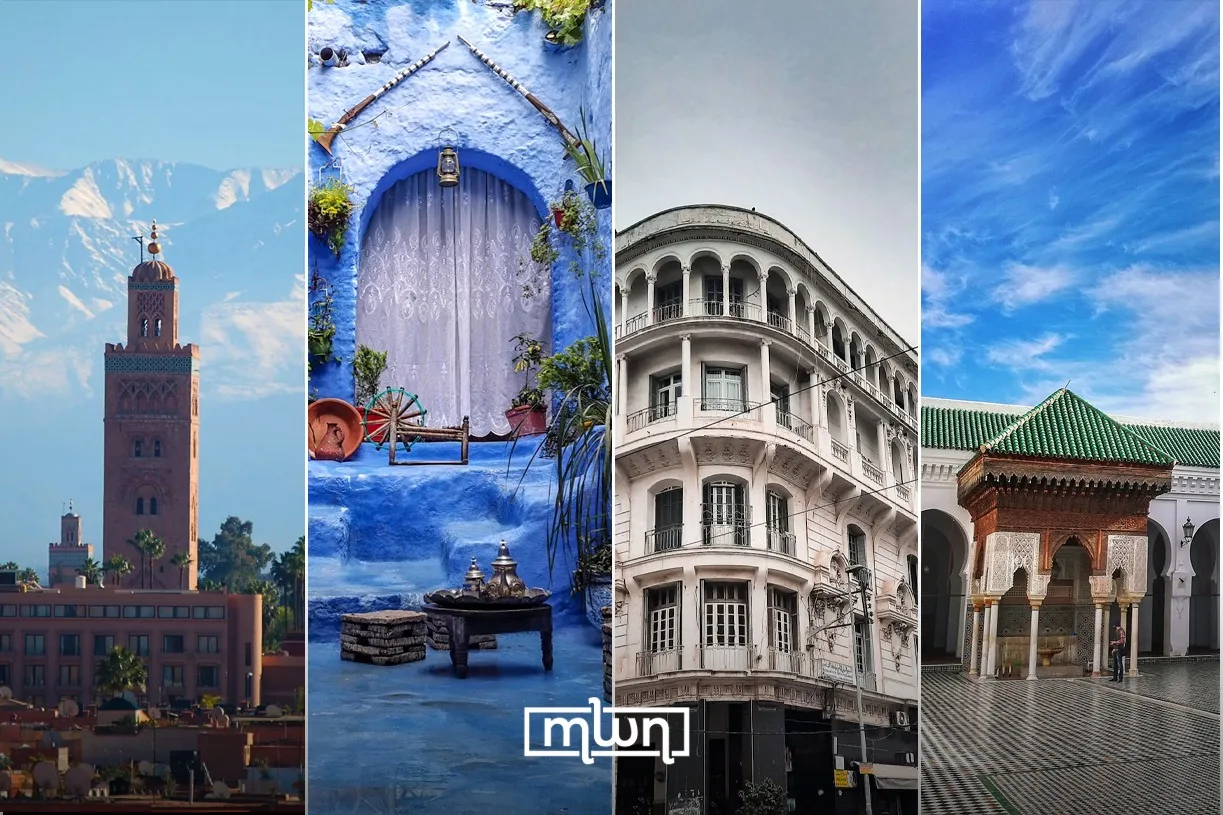
Rabat – The red walls of Marrakech, the blue streets of Chefchaoun, the white architecture of Casablanca, and the green tiles of Fez are much more than just decoration and aesthetic.
They reflect geography, history, climate, and the way people interact with their cities.
Marrakech
When in Marrakech, the touristic capital of Morocco, you cannot help but notice the red ochre walls.
They are definitely part of the visual signature of the city, but its inspirations have deeper roots.
Marrakech’s warm tones are inspired by its surrounding landscape; the desert, the Atlas Mountains, and the colors of the soil itself.
The red city feels timeless. The medina, the riads, the luxury hotels, and the restaurants continue to reinterpret this palette creatively which makes the whole city feel cohesive and welcoming.
Chefchaouen
On Morocco’s northern Rif mountains lies the city of Chefchaouen, known as the blue city.
Chefchaouen’s blue streets have become one of Morocco’s most recognizable images.
The blue city is a small town, perfect for a weekend getaway to escape the city’s chaos and to relax.
The color’s origins are debated. Some say it is part of the city’s jewish heritage as the color blue is seen as a reminder for heaven and God.
Others say painting the houses blue was an effort to keep mosquitos away and to cool the buildings during the summertime.
Only a few neighbourhoods were painted blue before the whole city engaged in the practice around forty years ago.
Today, all buildings are repainted twice a year to maintain the aesthetic.
Casablanca
Casablanca’s white architecture reflects a different Morocco. It represents the modern and post-colonial state. It is urban and connected to the ocean.
White is a symbol of movement and openness. Unlike Morocco’s imperial cities, Casablanca’s color palette speaks of modernity.
However, the origins of the color are far from being contemporary. The name, Casablanca, which means the white house, originates from the 15 century when the city was called “Anfa.”
It refers to a specific white house the Spaniards and Portuguese used as a landmark to anchor their ships and as a sign that they have arrived at “Anfa”.
Then, following the 1755 Lisbon earthquake, Sultan Sidi Mohammed ben Abdallah oversaw the city’s reconstruction. The rebuilt district was named “Dar el Beida,” meaning “The White House.”
Since then, the entire city adopted the white-washed structures and the color white not only became part of its name but of its identity too.
Fez
The color green is deeply connected to Moroccan Islamic tradition and Fez is considered the spiritual capital of the country.
It is also a city of craftsmanship and knowledge, where green features prominently in its tiles, doors, and zellige designs.
Fez is also associated with the colors red, blue, and yellow. This is mostly due to the fact that artisans often use these colors in their products.
The city’s palette is also a testimony to the medina’s old history and its rich textures: zellige, leather, wood, and centuries-old artisan work.
A country painted by its landscape
Morocco’s colors are far from being random, they come from materials, environments, symbols, and histories of each region.