Rabat – Lose your map and follow your senses through Fez’s ancient medina, where Morocco’s history speaks through scent, sound, touch, and sight.
Into the labyrinth
As soon as you pass through Bab Boujloud – Fez’s famed blue gate and main entrance into its labyrinthine medina – you are transported into the still-beating heart of ancient Morocco. With each step, the mechanical whirs and rhythms of the modern world fall away, and you sink deeper into a realm where time folds in on itself and the past walks beside you.
As the glossy allure of Bab Boujloud’s blue and green tiles fade behind you, the boulevard contracts like an artery tightening in anticipation, only to spill you into the tangled veins of the medina – each quietly humming with its own rhythm, history, and purpose. Winding through these ancient streets with their smoothed cobblestone paths and sunbaked walls, you begin to understand that Fez’s medina is not meant to just be visited – it is meant to be experienced.
Though the maze and the swirl of everyday life in the medina may be overwhelming initially, allow your curiosity to guide you through the streets and narrow alleyways as if following a thread spun by time itself, pulling you toward hidden courtyards, quiet mosques, and smoky kitchens within the very walls of the medina.
There is so much to explore in Fez, like the scent-laced souks overflowing with brass, leather, and any other handcrafted treasure you can imagine. Or ancient universities, tanneries, and mosques you can stumble upon in the most unassuming places. Here, ancient history and culture are not hidden behind glass; they are etched into the walls you walk by, stitched into the goods for sale, and echoing through the call to prayer that guides the medina’s rhythm.
In the following passages, we will wander through Fez’s medina together, tracing its winding markets and simply soaking in the hum of everyday life within walls that have stood for over a thousand years. This is not a guide in the traditional sense, but an invitation for you to experience Fez in the way that many agree is best – slowly and intimately, through your feet, your senses, and above all, your openness to the unexpected.
While some other places in the world attempt to market themselves as “authentic” for tourists by staging tradition, Fez’s ancient medina lives and breathes authenticity with every step you take. Its presentation is not a performance; it is a way of life. Founded in the late 8th century – nearly 1,200 years ago – and continuously inhabited ever since, Fez’s medina is not only the oldest in the world but also the largest pedestrian zone.
The maze comprises nearly 10,000 streets of all shapes, widths, sizes, and lengths – some barely wide enough for a single person, others large enough to accommodate the donkeys and mules that dutifully weave their way through the crowds, balancing crates of goods, just as they have done for centuries.
Markets of color, sound, scent, and variety
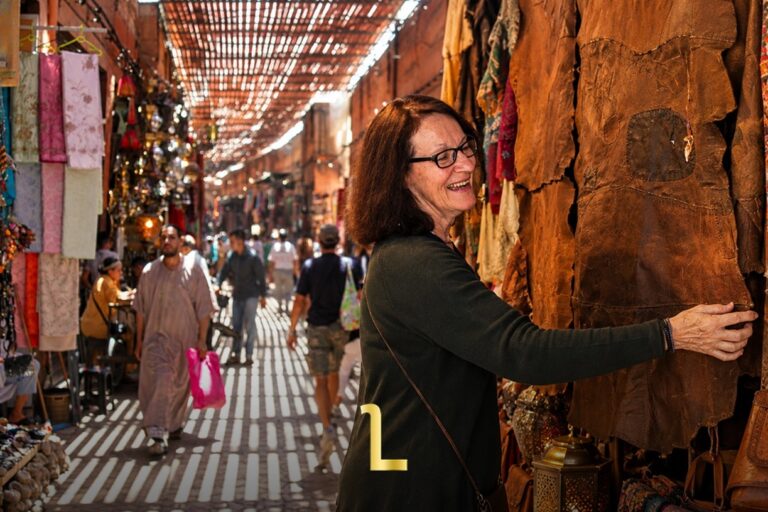
As you continue inward from Bab Boujloud, you will likely find yourself on one of the main streets of Fez’s medina. As you look from side to side, you will see endless rows of shops swelling with life and bursting with color, sound, texture, scent and movement. Handcrafted brass lanterns swaying gently overhead, handwoven rugs made of camel wool, sheep wool, cactus silk, or cotton, cascade down medina walls like waterfalls of pattern and culture. Mounds of spices and dried herbs rise like minarets of flavor, which guide and enchant the culinary soul of Morocco.
With every few steps, the air around you seems to change – sometimes subtly, sometimes all at once. One moment, you are enveloped in the warm, earthy aroma of spices, and in the next, the sweet fragrance of dried rose petals, fresh jasmine and orange blossom quietly calls to you like a breeze from an unseen garden.
As you search for the origin of this new scent, the sweetness gives way to something deeper, something richer. As you look around, you notice wisps of incense curling and wrapping around you in a warm embrace as if the medina itself was gently exhaling on you. Thick with musk at first, the fragrance is softened and warmed by notes of sandalwood, amber, and resin. As you follow this aroma in a trance, you find yourself arriving at the beacons of smoke, tiny stalls tucked under wooden awnings filled with hand-rolled incense sticks, bundles of dried flowers, stacks of handmade soaps, and glass bottles filled with infused argan oil, glimmering like the golden Moroccan sun above you.
Choreographies of craft
As you let yourself drift, you notice the smell in the air shifting again, away from incense and floral sweetness to something sharper and more metallic. As you try to discover its source, the medina guides you through another sense – you hear a rhythmic clicking in the distance, metal striking metal. Curious and intrigued, you let your ears guide you. As you near the source, the sound grows louder, and it begins to echo through Fez’s stone alleyways like the medina’s own heartbeat. You turn a corner and suddenly find yourself in a plaza where artisans are sitting cross-legged on worn mats surrounded by the gleam of their craft: copper.
With just a flame and a hammer, these artisans breathe life and meaning into these blank sheets of metal, ultimately transforming them into objects of precision, purpose, and poetry. As you watch them work, a process that looks like a dance of persuasion between craft and craftsman, you notice how the flat metal slowly curls, bends, rises, and falls beneath the artisan’s touch, becoming a teapot, a tray, a lantern, or any item desired.
Solitude and stillness
Just as you start to flow with the rhythm of the hammers, the medina shifts again. The metallic sounds and scents begin to fade, replaced by a striking new presence in the air; a pungent earthy scent far stronger than the brass. Unlike the earlier fragrances, which crept up on you like a whispered invitation to their wonders, this one hits you like a crashing wave.
As you move closer to the source, you notice the ground and walls darkening from the weight of time, and the streets around you narrowing like veins tightening towards the medina’s laboring heart. On this journey led by your senses, you realize that you have taken a more unconventional path, one that has separated you from the crowds and left you wandering alone through alleys of the medina that feel long-forgotten. As you move, the only sound accompanying you is the soft echo of your own footsteps. This stillness is strangely beautiful and relaxing.
You pause to take in your surroundings. The walls are aged and textured, faded stone peeks through crumbling plaster and cracked tile, and wooden beams above you stretch between the narrow walls like ribs holding the medina upright. As the sun peeks through, it kisses the dust in the air, turning the drifting haze to flakes of gold that enshroud you.
Born of scent and stain
As you make your way through the glimmering snowfall and reach the end of the alley, you are greeted by a kind shop owner who offers you a handful of mint and beckons you up a set of uneven stone steps. Intrigued, you oblige. As you work your way up the steep incline, the raw smell from before grows stronger, thick and animal-like, earthy and sour, an unforgettable breath – you press the mint to your nose, breathing in the Moroccan remedy.
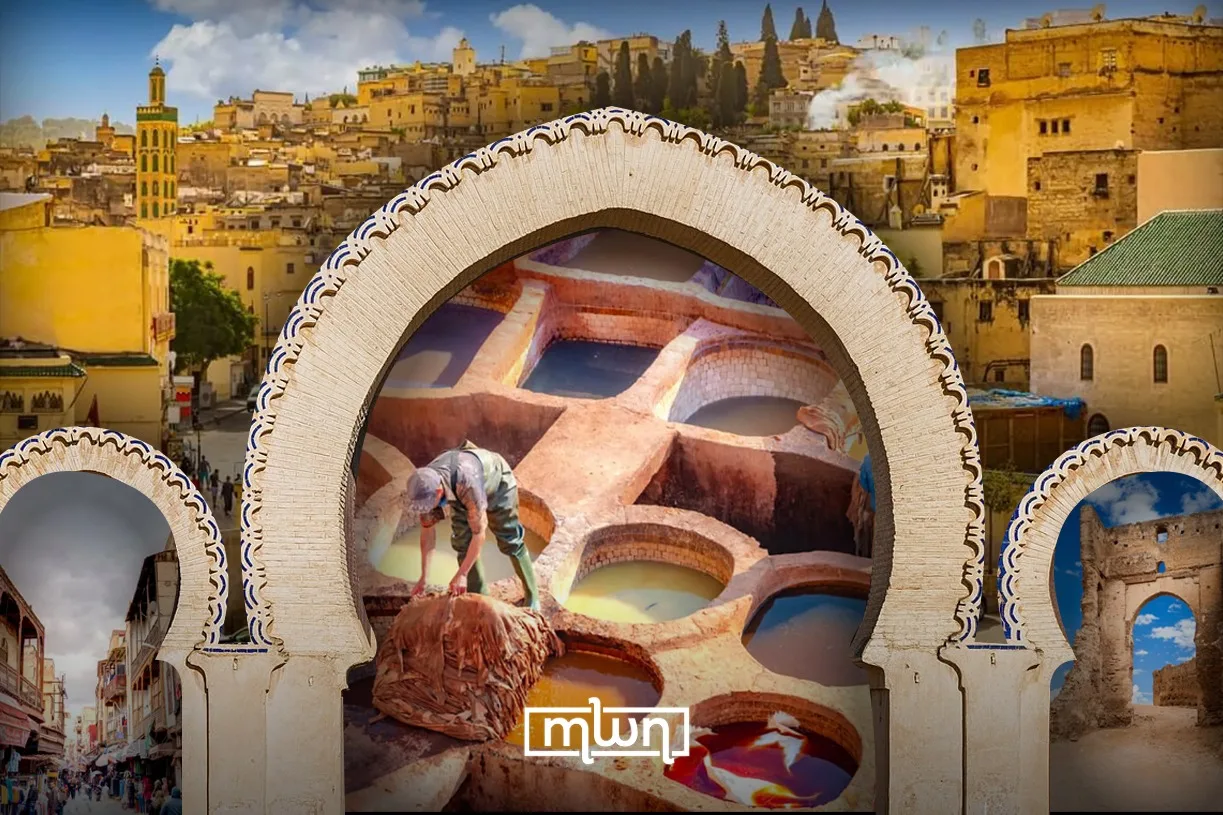
Suddenly, with one final step, the narrow stairway gives way to an open terrace – and what lies ahead feels almost unreal: a sprawling patchwork of hundreds of circular stone vats, each one brimming with vibrant color. From above, this scene looks like a work from Van Gogh himself – wild, natural, textured, and bursting with swirling colors.
The pools of crimson, saffron, indigo, and ochre stretch below, as if poured straight from his palette. You see men standing knee-deep in the liquid color, stirring with wooden paddles and lifting dripping bundles from one circle to another. Their work is grueling, physical, and raw, and you wonder to yourself what craft could demand this much devotion.
Mulling over the possibilities, you move along the terrace until a nearby doorway catches your attention. Intrigued, you approach. As you pass through the frame, you are greeted by shelves overflowing with the answer to your question: leather. Endless rows of jackets, handbags, belts, shoes, and countless other items line the entirety of the room. The same bold colors from moments ago have finally been put to rest in each of these pieces, settling into each seam and fold with quiet permanence.
What you have just seen is the Chouara Tannery, one of the world’s oldest continuously operating leather tanneries i, dating back to the 11th century, nearly 900 years old, and still producing leather using ancestral methods that have changed little over the centuries.
Despite the passing of centuries, everything about Fez’s history feels undeniably alive. The tanneries are yet another example of this; the scent of this ancient practice lingers in your nose, the sounds of labor hum in your ear, and the fruits of that labor sit in rows in front of your eyes.
Not a place, but a feeling
In Fez, tradition does not struggle to survive through preservation; instead, it endures through practice. And yet, even after the souks, the streets, the metalwork, and the tanneries, Fez still holds so much more – whispers of its soul echo in the shadowed arches of its more than 300 mosques, in the quiet courtyards of the world’s oldest university, in the heat of tiled hammams, and in the entrancing scent drifting from hidden kitchens.
Around each corner and after each turn, another alley, another scent, another sound, and another feeling waits. Fez is not a place you simply visit; it is a place that seeps into your skin, hums in your ears, and lingers on your mind, not as a memory of what you saw, but of how you felt: tangled in its alleys, cradled in its warmth, and held for a moment in the living breath of its past.