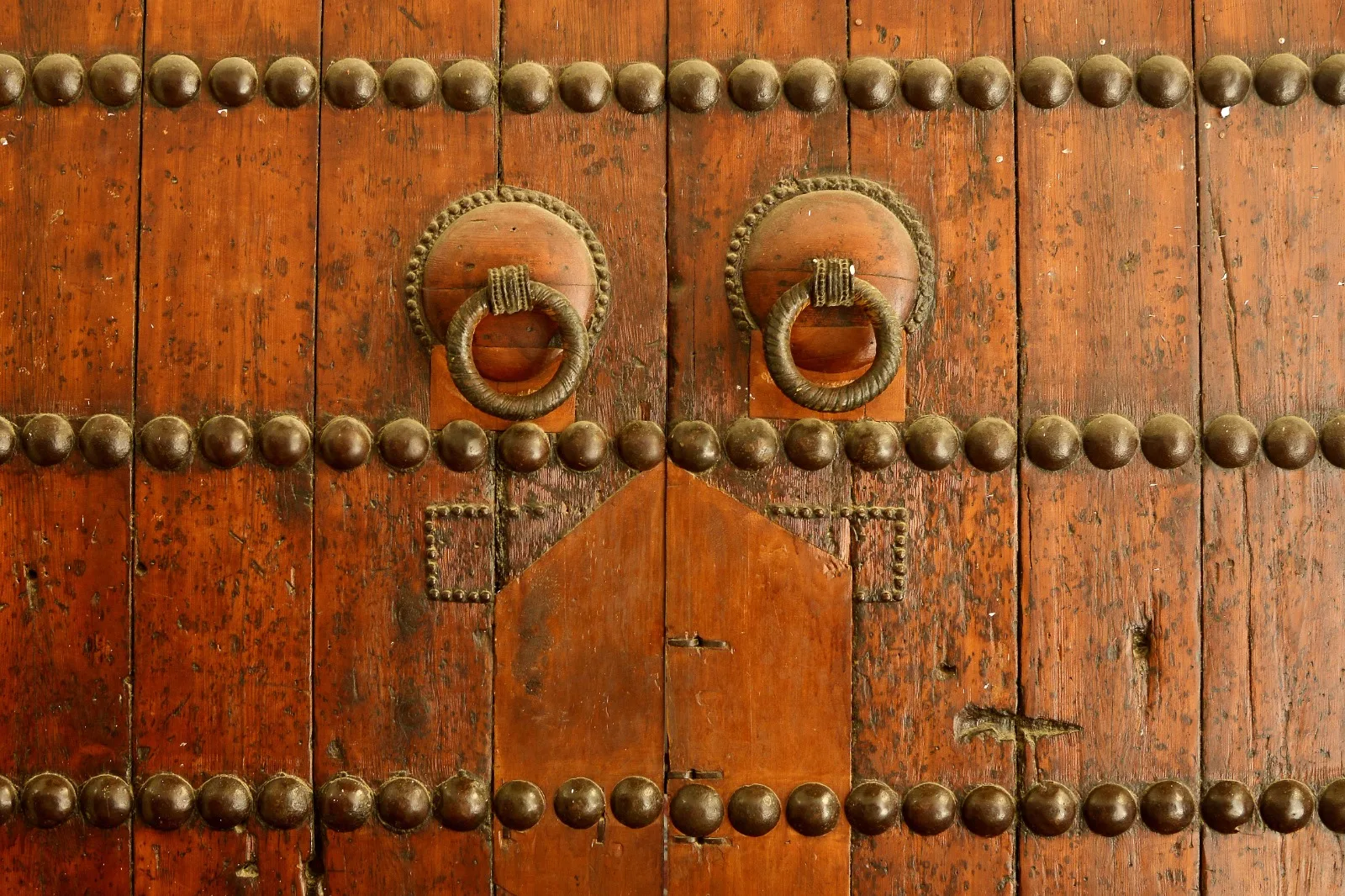
Safi – On 1stDibs, the marketplace where collectors and decorators shop for rare designs, an antique Moroccan door sells for anywhere between $773 (MAD 7,146 ) and $26,850 (MAD 248,228).
They go as art, hung on a wall, set into a garden, or rehung as the front door of a house far from the medina the wood came out of.
Most are cedar or walnut, hand-carved and studded, from the 18th and 19th centuries, a few older still.
The listings keep the original knockers and ironwork, and the site sells them as “timeless artisanship,” architectural pieces with a past. A single door can stand more than ten feet tall.
The house behind the door
To understand the price, look at what the door was built to do. A Moroccan house turns inward, its life and light kept in a courtyard the street never sees, a private world the architecture guards under the idea of hurma, the sanctity of the home.
The blank wall gives nothing away. The door is the one thing the house shows the street, so it is made to carry everything.
The craft
The wood is usually cedar, cut and carved by a maâlem, a master who has spent a life with the chisel.
The brass studs in their tight ranks are not only ornament. Each one pins the heavy timber against warping and against force, beauty doing the work of armor.
The meaning in the pattern
Look closer and the geometry turns devotional. Islam’s old reluctance to picture living things sent its artists into the abstract instead.
They worked in stars and polygons and an interlace that repeats without end, a pattern with no edge that reads as a small argument about the infinite.
Where it pauses, calligraphy takes over, a line of Quran or a blessing cut into the lintel.
The hand
Then there is the knocker, often a khamsa, the Hand of Fatima, five fingers of brass against the evil eye.
It is older and wider than any single faith, the five at once the pillars of Islam, the books of the Torah, the hand of Miriam, the hand of Mary.
Time greens the brass, and the green only seems to make it stronger.
So a stranger pays thousands for a slab of old cedar and brass. What they are really buying is everything the wood was made to hold: the privacy, the prayer, the warding hand.
A door that once shut on a Moroccan courtyard now opens onto someone else’s life, half a world away. It carries Morocco with it.