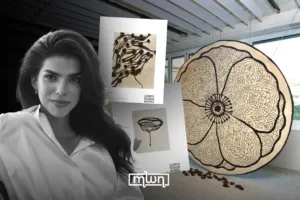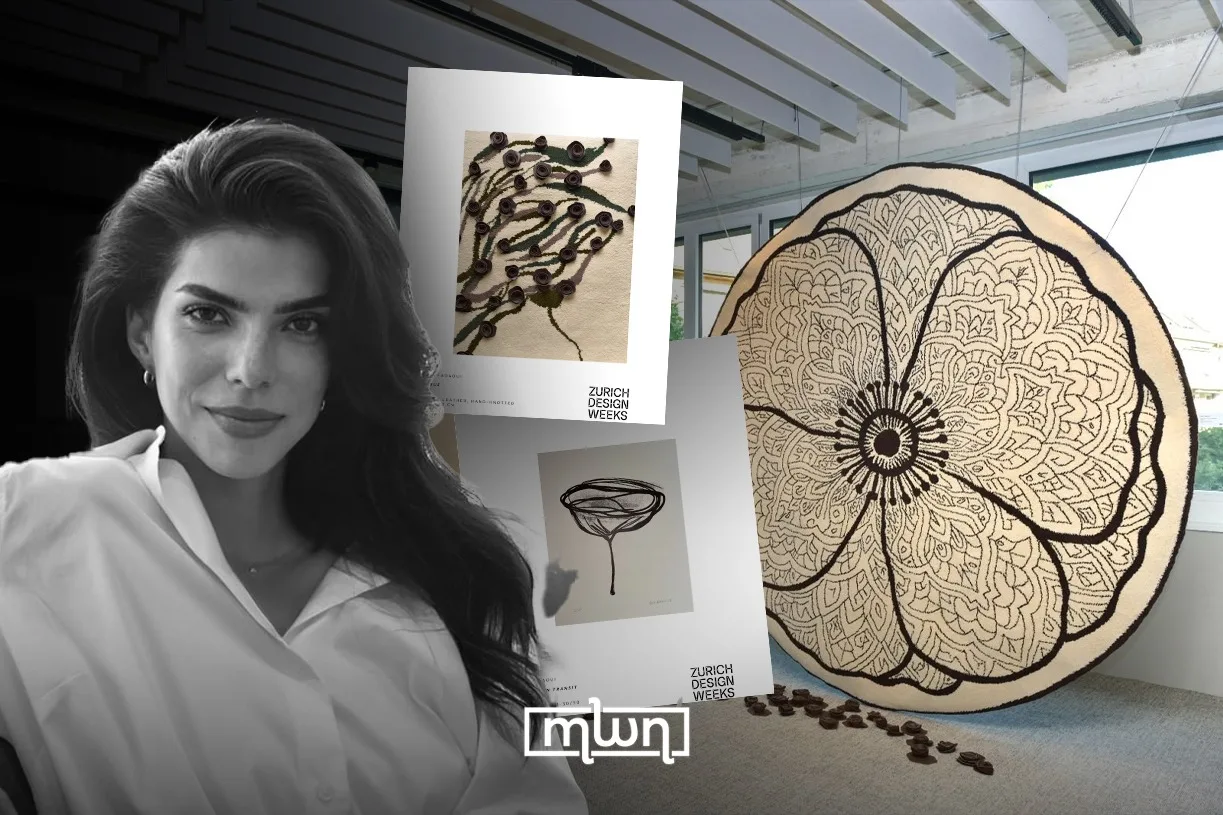
Casablanca – For its first participation in Zurich Design Weeks 2026, Myriem Himmich Gallery is presenting “Where the Hand Remembers,” an exhibition dedicated to Laila Fadaoui’s textile and mixed-media practice.
The exhibition brings together wall-based works in wool, leather, and paper at House of Interiors, where her Mrirt atelier is also present.
Running from September 18-27, the presentation places Moroccan craftsmanship in a setting where art, architecture, and design naturally meet.
But the exhibition is not simply about bringing Moroccan craft to a new city. At its center is a more intimate question: What happens when a traditional gesture leaves its original object and enters the language of contemporary art?
When craft becomes a language
Fadaoui’s work begins with materials that carry their own histories.
Wool brings warmth, protection, and a connection between people, animals, and the land. Leather brings another kind of presence, with its density, structure, and distinct texture. Paper introduces yet another surface, allowing the artist to move between softness, rigidity, texture, and form.
Rather than treating these materials as decorative elements, Fadaoui gives them room to speak.
Her works move beyond the traditional function of the Moroccan rug and onto the wall as sculptural compositions.
Threads, knots, textures, volumes, and organic shapes come together in pieces that invite the viewer to step back and see the whole. That distance matters.
A single thread may seem insignificant on its own. A knot may look like nothing more than a small detail. But once these elements meet, they begin to form a larger image.
Fadaoui uses that idea to reflect on the human experience itself. Life often presents itself as a collection of separate moments, some meaningful and others seemingly random. With time and distance, however, connections begin to appear.
Her works follow a similar logic. Each element keeps its own identity, yet contributes to something larger.
The women behind the work
At the heart of “Where the Hand Remembers” is not only the artist’s hand, but also the hands of the Moroccan women who help bring her ideas into existence.
Fadaoui’s artistic vision comes to life through a close dialogue with Moroccan artisans whose knowledge comes from generations of practice. Their role goes far beyond simply executing a design.
Their hands carry techniques that have traveled through families and communities for years. Their gestures hold a kind of knowledge that does not always appear in written form. It lives in repetition, touch, rhythm, patience, and familiarity with the material.
That is where the exhibition’s title becomes especially fitting.
“Where the Hand Remembers” points to a form of memory that lives in the body. It is the kind of knowledge that someone can inherit without ever reading a manual for it. The hand simply knows.
Through this collaboration, Fadaoui places women artisans at the center of a contemporary artistic conversation while keeping their craft connected to its origins.
From Mrirt to the world
Fadaoui’s relationship with Moroccan craftsmanship developed gradually.
Born in Zurich in 1996 to Moroccan, Italian, and Swiss heritage, she initially studied finance and pursued an entrepreneurial path before turning more deeply toward materials, territories, and the communities preserving Morocco’s traditional crafts.
Her research took her to different centers of Moroccan craftsmanship, including Fez, where she explored leatherwork, and eventually to Mrirt, the Middle Atlas city whose textile tradition would become central to her practice.
She then founded MRIRT in 2023, a project built around preserving and transmitting the textile knowledge that had increasingly become part of her own artistic identity.
At first, the focus remained close to the traditional rug. Fadaoui developed a pared-back approach that allowed the wool itself and the expertise behind it to take the lead.
But the more she worked with the artisans, the more the women behind the weaving came into focus.
The rug became more than an object. It became a language. A language of memory, resilience, creativity, and female transmission.
From the rug to the wall
By 2024, Fadaoui’s practice began moving beyond design and toward a more personal artistic exploration.
Around the same period, another form entered her work: the flower.
It began as an instinctive drawing during a period of personal transformation. Over time, it evolved into a recurring symbol in her work, representing the cycles of life.
A flower can open, unfold, lose its petals, and begin again. That cycle gave Fadaoui a visual language for transformation and renewal.
In 2025, she created her first wall-based work centered around the floral form. Myriem Himmich Gallery presented the piece in Casablanca during the Nuit des Musées et des Espaces Culturels, marking an important shift in her practice.
The work no longer belonged solely to the world of design. It had begun entering the territory of contemporary art.
In 2026, leather joined wool more prominently, bringing new depth and structure to the compositions. The combination creates stronger reliefs and more pronounced volumes, pushing the works further toward textile sculpture.
Yet wool remains central. It carries the warmth and softness tied to the textile traditions of Mrirt, while leather creates a natural contrast through its weight and density.
The result feels tactile before it feels decorative. You want to look at the pieces, but you also want to understand how they feel beneath your fingers.
A return to Zurich
Perhaps the most poetic part of this exhibition is where it is happening.
Fadaoui was born in Zurich. Today, she moves between Zurich and Marrakech, two places that sit at very different points on the map but both belong to her story.
Returning to Zurich with work deeply rooted in Moroccan heritage gives “Where the Hand Remembers” a personal dimension that goes beyond the exhibition itself.
The journey from Mrirt to Zurich becomes a journey between parts of the artist’s identity. Rather than choosing one side over another, Fadaoui allows them to meet through her work.
Her Moroccan roots provide the materials, references, and craftsmanship. Her life between different cultures gives those elements a contemporary setting and another way of being seen.
At House of Interiors, that meeting feels particularly natural. The space brings together art, interior architecture, and design, allowing Fadaoui’s works to exist somewhere between an artwork and an object, without needing to settle for either definition.
Myriem Himmich Gallery’s wider vision
For Myriem Himmich Gallery, the presentation also reflects a broader interest in artists who treat heritage as something alive rather than something frozen in time.
Founded in Casablanca in 2021, the gallery works across contemporary art, design, craftsmanship, and cultural diplomacy. Its program includes Moroccan, African, and international artists whose practices explore memory, identity, spirituality, territory, and transformation.
The gallery has also expanded its international presence through events and fairs including 1-54 Contemporary African Art Fair in Marrakech, MENART Fair in Paris, AKAA in Paris, and 74th Arts in Marseille.
Its collaboration with Fadaoui follows that same desire to create connections between Moroccan artistic practices and international audiences.
For gallery founder and director Myriem Himmich, Fadaoui’s work represents an approach to heritage that keeps it moving.
“I feel a special attachment to artists who preserve Moroccan artisanal heritage while reinventing it within a contemporary language,” Himmich stated in a press release shared with MWN Lifestyle magazine.
“Laila Fadaoui has become one of those artists. Her work does not seek to freeze our heritage, but to keep it alive.”
The artist does not simply reproduce traditional techniques. She places them in conversation with contemporary art, femininity, spirituality, transformation, and renewal.
That approach also explains why Zurich matters. The exhibition creates a meeting point between an artist’s birthplace and the cultural landscape that continues to nourish her practice.
‘Where the hand remembers’
“Where the Hand Remembers” ultimately asks the viewer to slow down.
In a world where design often moves quickly from idea to trend to something new, Fadaoui’s work gives time another role.
Here, repetition matters. The thread matters. The knot matters. The texture matters. The artisan’s hand matters. And so does the history carried by every material.
At Zurich Design Weeks, these Moroccan techniques do not arrive as museum pieces or distant reminders of the past. They arrive transformed, shaped into contemporary works that still carry the memory of the hands that made them possible.
From Mrirt to Marrakech, and now to Zurich, Fadaoui’s journey traces more than a geographical route. It traces the path of a craft becoming art while keeping its memory intact.
And perhaps that is where the hand remembers best: in the moment when an old gesture finds a new form.
Read Also: Nassim Gryech: The Moroccan Artist Who Speaks Through Color