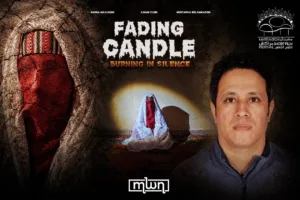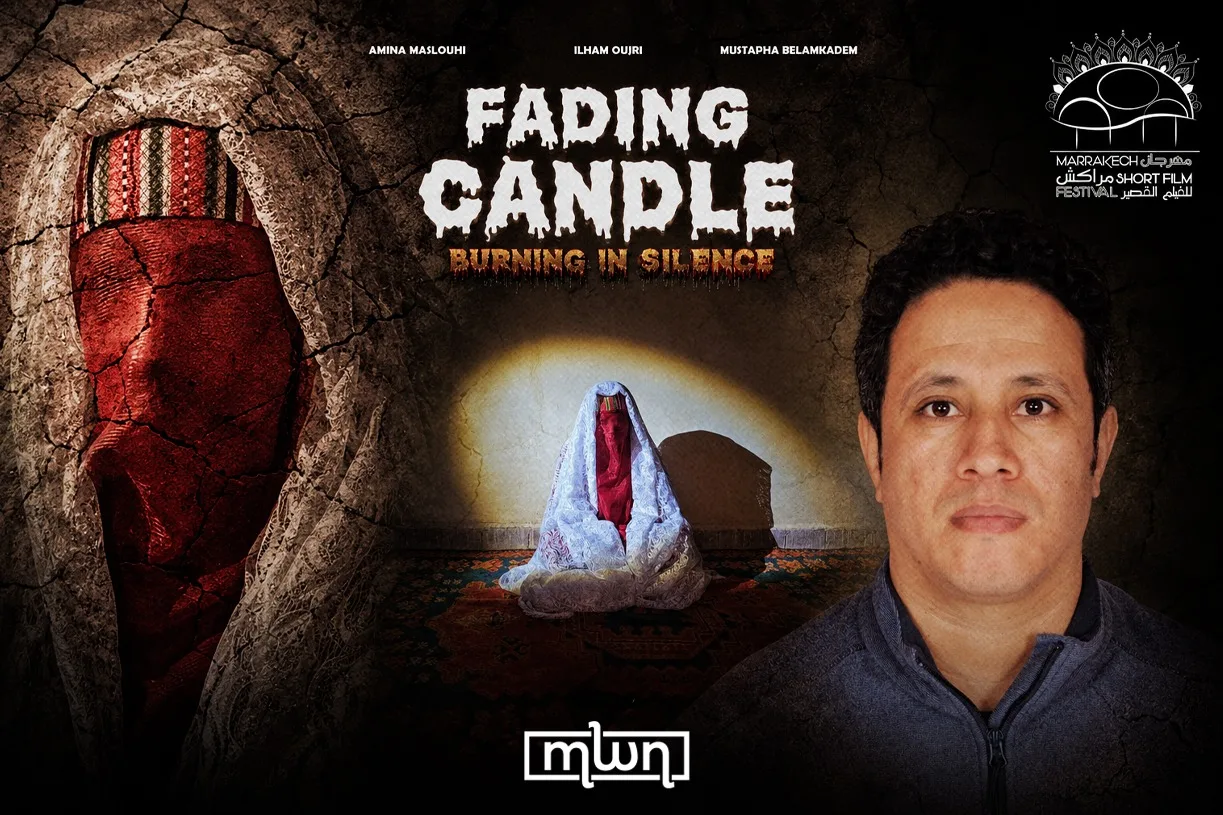
Fez — For Moroccan filmmaker Ismail Ait Lahcen, “Fading Candle” was never meant to focus only on the moment something terrible happens. He was interested in what remains afterward.
The short film follows Fatima, a woman in a deserted Moroccan village whose encounter with a wedding scarf and a candle brings back memories connected to an underage bride, a forced marriage, and an escape.
“Fading Candle” is part of the Moroccan selection at this year’s Marrakech Short Film Festival (MARRAKECHsFF), giving Ait Lahcen an opportunity to bring its quiet treatment of trauma to a new audience.
The filmmaker said the project began with an interest in what happens after violence is technically over but continues shaping a person’s life.
“‘Fading Candle’ began with an interest in what remains after a traumatic experience has ended. We often speak about an event itself, but I was more interested in what happens afterward, what remains in a person’s memory, in their relationships, and in their everyday life,” Ait Lahcen told MWN Lifestyle magazine.
That idea shaped not only the film’s subject, but also the way he chose to tell the story.
Letting memory break the chronology
Rather than presenting Fatima’s experience as a straightforward sequence of events, Ait Lahcen built the film around fragments, objects, and sensations that allow the past to enter the present.
“I deliberately chose not to tell the story in a completely linear way. Trauma does not always return to us as a clear, chronological story. It can come through fragments, images, sensations, and objects. I wanted the structure of the film to reflect that,” he explained.
A wedding scarf, a candle, a gesture, or a particular sound can therefore carry more narrative weight than a conventional flashback.
For Ait Lahcen, that fragmented structure was also a way of shifting attention away from the violent event itself and toward its emotional consequences.
“At its heart, ‘Fading Candle’ is not only about the moment of violence. It is about its aftermath, the silence, the grief, the endurance, and the emotional weight that can remain long after the event itself,” he said.
That distinction is central to the filmmaker’s approach. Child marriage provides the story’s immediate context, but the film looks at what happens when an experience continues through memory, relationships, responsibility, and grief.
A candle caught between light and disappearance
The title emerged from the same interest in memory and endurance.
Ait Lahcen explained that the candle carries several meanings at once.
“A candle gives light, but that light is fragile and temporary. As it burns, it is also slowly disappearing. I saw something deeply human in that contradiction: something can be vulnerable and still continue to give light,” he said.
For the filmmaker, its gradual disappearance also reflects the way memory changes without necessarily vanishing.
“For me, the fading candle represents memory, innocence, and the passage of time, but also the persistence of something that refuses to disappear completely,” he added.
The image also connects to the film’s wider concern with experiences that remain hidden or unspoken.
“There is also a connection between light and visibility. Some experiences are pushed into darkness or surrounded by silence. The candle becomes a small source of light inside that darkness and not necessarily resolving the pain, but allowing us to see it,” Ait Lahcen explained.
He deliberately avoided turning that symbolism into a simple moral conclusion.
“I did not want to give the audience a simple message or a ready-made conclusion,” he said.
Instead, he wanted the film to leave viewers with questions about survival, silence, and what society expects from people after trauma.
“What does society expect from someone who has suffered? How much are women expected to carry in silence? And what happens when painful experiences are never truly given a space to be expressed?” he asked.
Choosing restraint over spectacle
That same refusal to over-explain shaped the film’s visual language.
“The creative approach was built around restraint,” Ait Lahcen said.
The deserted village was chosen not simply as a backdrop, but as an extension of Fatima’s emotional state.
“The deserted village is not simply a location. It reflects a sense of isolation and emotional emptiness, while also giving the film a dreamlike quality. I wanted the physical environment to feel connected to Fatima’s internal state,” he explained.
Light became equally important.
“Light was also central to the visual approach. We worked with darkness and limited sources of light, allowing the candle/the bride and other small sources of illumination to become meaningful within the frame,” he said.
Sound follows the same restrained logic.
“Silence is a major part of the film. I wanted the audience to feel that silence rather than simply hear dialogue filling every moment. The Amazigh chants help create the psychological atmosphere,” Ait Lahcen explained.
Working with such a sensitive subject also forced him to think carefully about how much the audience actually needed to see.
“The greatest challenge was finding the right distance from the subject,” he said.
“When dealing with child marriage and trauma, it would have been easy to make the film more explicit or emotionally aggressive. I felt that doing so could take something away from the dignity of the characters and from the audience’s own emotional engagement,” he explained.
That decision became one of the most important lessons he took from making the film.
“The film also taught me that what you choose not to show can sometimes carry as much meaning as what you put in front of the camera. Restraint is not necessarily the absence of emotion; sometimes it allows the emotion to remain with the audience for longer,” he said.
Taking ‘Fading Candle’ to Marrakech
For Ait Lahcen, MARRAKECHsFF gives the film another opportunity to continue its journey through Moroccan short cinema.
“Being selected for the Marrakech Short Film Festival is particularly meaningful. For ‘Fading Candle’, the Marrakech Short Film Festival is another step in its journey. It gives the film an opportunity to reach new audiences and to participate in the broader conversation around contemporary Moroccan short cinema,” he said.
He also hopes audiences connect with the way the story has been told, not only with its subject.
“I am also grateful for the opportunity to present a film that deals with a difficult subject through a quiet and poetic approach. I hope audiences will engage not only with the subject itself, but also with the cinematic language we chose to tell it,” Ait Lahcen added.
The experience has also helped him clarify the kind of filmmaker he wants to become.
“With ‘Fading Candle’ , I discovered more clearly the kind of stories and cinematic language that interest me. I want to continue exploring human experiences that are sometimes difficult to express directly, while experimenting with visual storytelling, atmosphere, and non-linear narratives,” he said.
He also sees short films as an important space for Moroccan filmmakers to test ideas and develop their voices.
“Short cinema allows filmmakers to experiment with form and subject matter, and it can be an important place for new voices to develop,” Ait Lahcen explained.
For him, “Fading Candle” represents one step toward making stories rooted in Morocco without limiting their emotional reach.
“For me, the goal is to make films that remain rooted in their cultural environment while still speaking to experiences that audiences elsewhere can recognize. Fading Candle is one step in that direction,” he concluded.