Fez — The auction house’s Modern and Contemporary Middle Eastern Art sale gathers landmark works from six influential names. It reads like a condensed survey of the region’s visual story – from Egyptian modernism to Palestinian geometric abstraction.
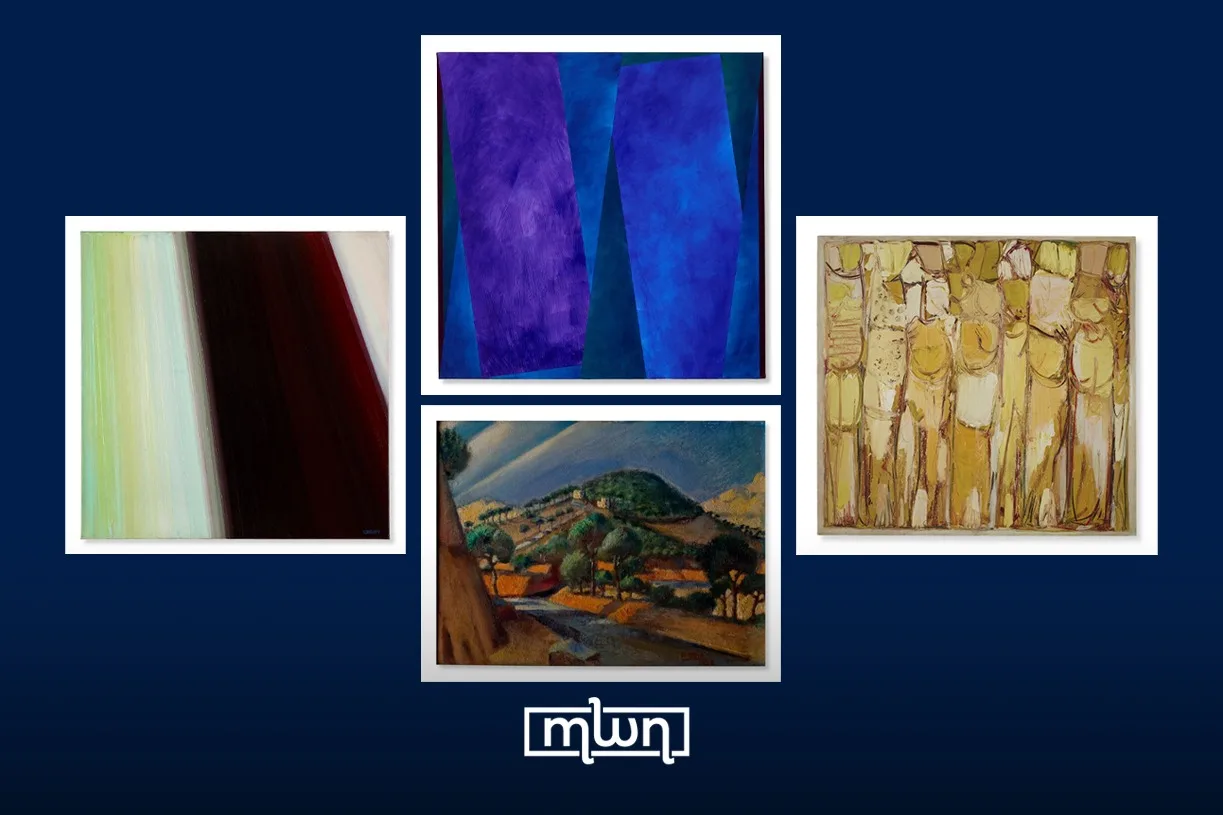
Lebanese master Paul Guiragossian’s “Automne” anchors the selection with towering, elongated figures that blur the line between figuration and abstraction. The thick impasto and radiant yellows speak to the painter’s lifelong themes of displacement and resilience, while keeping color at the center of the emotion on canvas.
From Saudi Arabia, Abdulhalim Radwi appears with an untitled cityscape that folds arabesque curves and Arabic letterforms into a semi-abstract scene. Radwi’s palette is saturated and architectural, a bridge between local visual memory and global modernist language.
Two Palestinian pioneers highlight the power of abstraction and its ability to hold personal history. Samia Halaby’s “Gardenia,” from her sought-after “Diagonal Flight” series, builds motion and depth with angled grids and prismatic color inspired in part by Islamic geometry. Kamal Boullata’s “Nocturne I” pushes precision to a lyrical edge. The artist lays out a mathematical structure with ruler and pencil, then floods the frame with carefully tuned color, turning measurement into music.
A lyrical landscape by Mahmoud Said, the Alexandrian often called the father of Egyptian modernism, widens the frame. “Mekarzel Hill,” once owned by former Egyptian Prime Minister Hussein Pasha Sirry, captures rolling Lebanese hills and summer light with a measured calm that defined Said’s modern style.
The late Laila Shawa, another Palestinian voice, adds a political and personal register with “City of Peace (Jerusalem).” The work balances longing with a forward gaze, channeling the artist’s reputation for direct socio-political commentary and a fearless studio practice.
Together, the lots chart how artists from the Arab world have used color, geometry, script, and landscape to carry layered stories. Guiragossian turns paint into a chorus of human silhouettes. Radwi treats the city as a living calligraphy. Halaby and Boullata refine abstraction into a precise language of flight and return. Said brings the eye back to earth and light. Shawa insists on memory and a future worth naming.
Christie’s positioning of these artists in London is also a mirror of the market’s broadening focus. It signals steady interest in Arab modernism, growing demand for women artists from the region, and a deepening appetite for cerebral abstraction that still carries heat and heart.