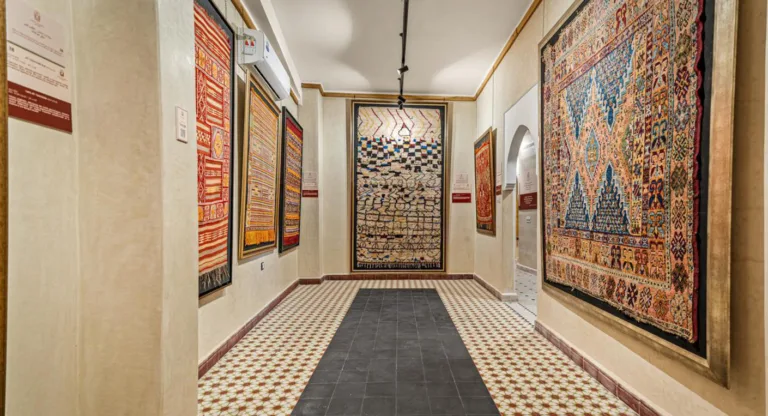
Fez — Moroccan carpets are not one single style. They vary by region, tribe, city workshop, and even by household tradition.
Some are thick and soft. Some are flat and light. Some are made from new wool, while others are made from recycled fabric.
The differences often come down to climate, materials, and what the carpet was meant to do in everyday life.
Middle Atlas classics: Beni Ourain and Beni Mrirt
In the Middle Atlas, wool is central. “Beni Ourain” rugs are known for a light background and dark diamond patterns, with a soft pile designed for warmth in cold mountain areas.
Nearby, “Beni Mrirt” rugs are also dense and plush, but they are often tighter in weave and more refined in finish. Many descriptions focus on their high knot density and a smooth, almost polished feel after repeated washing.
High Atlas storytelling: Azilal
“Ailzal” rugs come from the Atlas as well, but they tend to look freer and more personal. They often mix bright colors with abstract or asymmetrical symbols. Many sources describe them as expressive pieces where the weaver’s choices shape the final result more than a fixed template.
Haouz and central plains: Boujaad
“Boujaad” rugs are widely linked to warm palettes, especially reds, pinks, and oranges. They often have a worn-in look that people describe as “vintage” or “patina,” with bold geometric layouts that feel less minimal than Beni Ourain.
Southern Morocco: Taznakht, Zanafi, Akhnif, Kharita, and Glaoui
In the south, especially around Taznakht, many carpets lean into strong geometry and skilled structure. Some are flat-woven, some have short pile, and some combine techniques. Several guides highlight that Taznakht pieces are often made with prized local wool and may alternate woven and knotted sections depending on the style.
Within this family, “Zanafi” is often described as a flat-weave style with graphic diagonal or linear patterns and a tighter, more resistant build than many basic kilims.
“Akhnif” is typically presented as a refined flat weave with small repeated embroidered motifs. “Kharita,” which takes its name from the Arabic word for “map,” is described as dense blocks of color that read like a landscape from memory.
“Glaoui” rugs are often explained as mixed-technique pieces that combine weaving, knotting, and added embroidery details, which gives them texture shifts across the surface.
City-made distinction: Rabat’s R’Bati rugs
Rabat has its own well-known urban style. “R’Bati” rugs are commonly described as bold and structured, often built around a large central diamond or multiple diamonds, with framed borders and strong color choices like red and blue.
Some sources also describe Rabat carpets as dense and dominated by red, with fine decorative work across the center and edges.
Reuse and improvisation: Boucherouite
“Boucherouite” rugs stand apart because they are built from recycled textiles. Multiple sources explain that the name is tied to the idea of scraps or used clothing, and the look is usually bright, irregular, and playful.
These rugs are often less about matching a regional color code and more about using what is available. That is part of their appeal.
Flat weaves and mats: Hanbel and Hassira
Not all Moroccan floor coverings are thick pile rugs. “Kilim” is a global term, but many guides note that Morocco’s flat-woven tradition is often called “Hanbel,” valued for being lighter, reversible, and easy to move.
Some regions also produce straw or palm-leaf mats, often described as “Hassira,” which are practical in hot weather and common for simple floor use and prayer settings.
Why these differences matter
Moroccan carpets are often sold as one category abroad, but inside Morocco they reflect local identity. A cold mountain home needs thick wool. A warmer region may favor flat weaves. A city workshop may prefer symmetry and strong framing. A rural household may turn old fabric into something new.
Even when the patterns look modern in a global living room, they usually started as practical design choices tied to place, weather, and daily life.