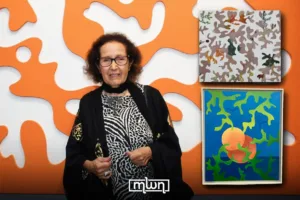
Rabat – In the story of Moroccan modern art, Malika Agueznay holds a distinctive and deeply influential place.
As a pioneering figure of the Casablanca School, Agueznay helped shape a new visual language that moved beyond representation, placing form, color, and movement at the center of the canvas.
Her journey into art began in 1966, when she entered the Casablanca School of Fine Arts after an initial scientific education.
At the time, the school was a vital place for artists and thinkers reimagining what Moroccan art could be in a newly independent country.
Under the direction of Farid Belkahia, Agueznay joined an artistic generation exploring geometry, craft, heritage, and the expressive potential of pure colour.
Her work soon developed a rhythm of its own.
A language of forms
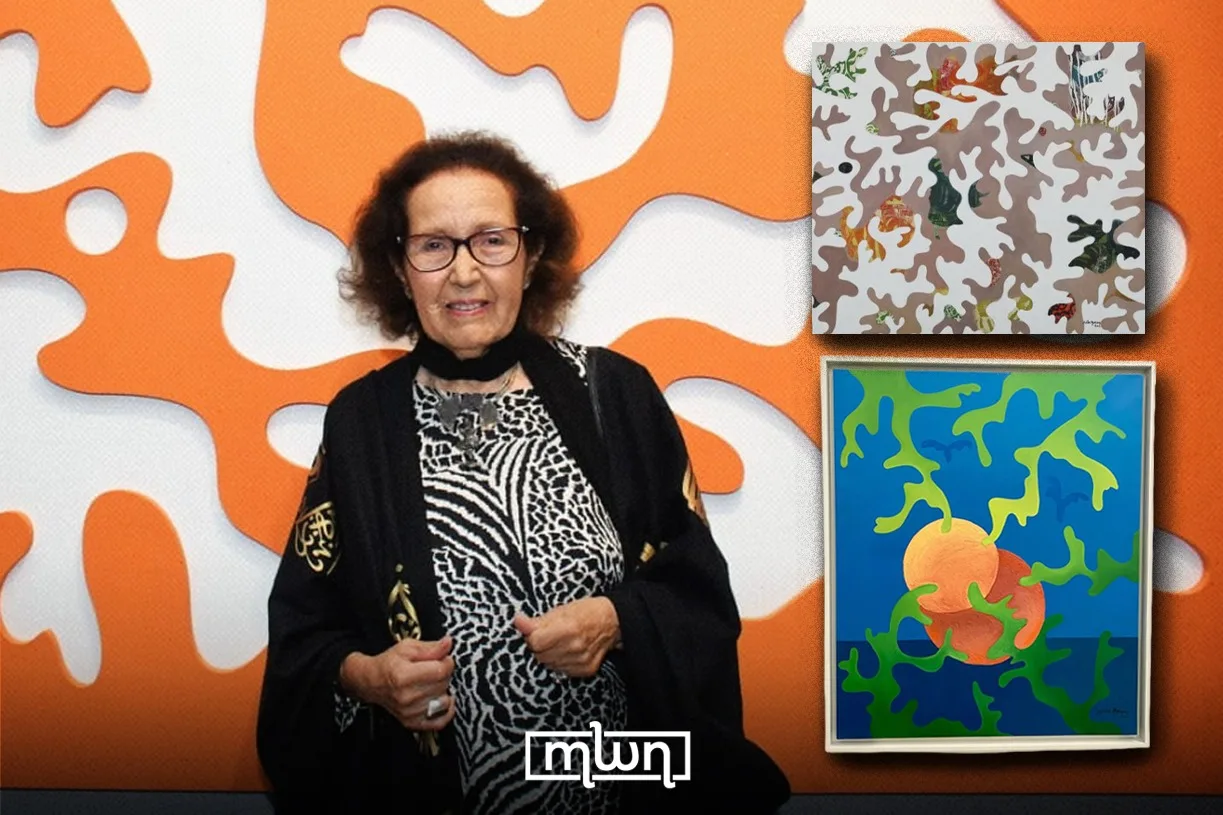
At the heart of Agueznay’s practice is a recurring organic motif, often compared to seaweed.
It appears in flowing, layered, and interwoven shapes, shifting from one work to the next while remaining instantly recognisable.
Sometimes these forms feel botanical. At other times, they evoke the curves of the human body, the movement of water, or the microscopic energy of cells.
Their repetition creates a sense of motion, giving the surface of the work a living visual pulse.
There is a quiet power in this approach. Agueznay doesn’t need literal imagery to tell a story. Her paintings and prints invite viewers to slow down, follow the lines, and find their own meaning in the spaces between color and form.
Beyond the canvas
Printmaking has played an important role in Agueznay’s artistic language. The medium gave her another way to explore texture, repetition, and material, while deepening the connection between her graphic work and painting.
Her creative development also took her beyond Morocco, including periods of technical exploration in New York and Paris.
Yet her connection to the country’s artistic community has remained strong. For years, she has returned to Asilah to take part in its international arts festival and support printmaking workshops.
This commitment reflects an important part of her legacy: art is not only something to be displayed. It’s also something to be shared, taught, and continuously renewed.
Color, calligraphy, and memory
Agueznay’s work is often charged with bold, warm colors that bring an almost kinetic energy to her compositions.
In some pieces, calligraphy and words associated with values such as peace, love, generosity, and modesty add another emotional layer.
The result feels both contemporary and rooted, as it speaks to Morocco’s visual heritage without reducing it to decoration.
Instead, she transforms it into an evolving language that’s personal, abstract, and unmistakably her own.
After an artistic legacy spanning five decades, the Moroccan artist continues to hold an important place in the country’s modern art history.
Her work reminds us that abstraction can carry memory, identity, movement, and life and that a single form can take on an entire world when it’s endlessly reimagined.