Fez — Sale is preparing to revive one of Morocco’s most distinctive Mawlid traditions: its centuries-old Candle Procession, held each year to mark the birth of the Prophet Muhammad.
The procession is a religious and cultural tradition through which Sale’s residents commemorate the Prophet’s birth, with participants carrying elaborately decorated candle structures through the city before heading toward the shrine of Sidi Abdellah Ben Hassoun, a central figure in Sale’s religious heritage.
The candle structures themselves are among the procession’s most striking features. Built around wooden frames shaped like minarets, domes and other forms inspired by Islamic architecture, they are covered with colorful wax decorations and religious inscriptions.
Some of these elaborate structures can weigh up to 50 kilograms, making the procession as much a display of traditional craftsmanship as a religious celebration.
Morocco’s Ministry of Endowments and Islamic Affairs confirmed that Mawlid will fall on August 25, after the sighting of the Rabi Al-Awwal crescent established August 14 as the first day of the Hijri month.
Sale traditionally stages its procession on the 11th of Rabi Al-Awwal, one day before Mawlid.
According to the Sale municipality, the procession begins after the Asr prayer and makes its way through the city toward the shrine.
A tradition stretching back centuries
Sale’s municipality traces the custom to Saadian Sultan Ahmed Al-Mansur Al-Dhahbi, who was reportedly impressed by candle celebrations he encountered in Istanbul before becoming ruler of Morocco.
After taking the throne, Al-Mansur introduced a similar celebration in Morocco. The municipality dates Sale’s first candle procession to 986 AH during his reign.
The Ministry also attributes the tradition to the Saadian ruler and his exposure to Ottoman Mawlid festivities.
The craftsmanship behind the procession has itself become part of Sale’s heritage. Several families have produced and decorated the structures across generations.
The municipality identifies the Belakbir family as the current custodians of the craft after earlier families including Oubia, El Mir, El Hoceyni, El Mernissi, and Benchekroun.
The structures are traditionally kept at the mausoleum of Sidi Abdellah Ben Hassoun for 11 months.
About a month before Mawlid, they are taken out so their elaborate wax decorations can be renewed for the next procession.
More than a parade
The candle procession forms the opening spectacle of a wider religious and cultural celebration.
The route traditionally passes through major streets of Sale’s old medina and Bab Bouhaja before continuing toward the mausoleum.
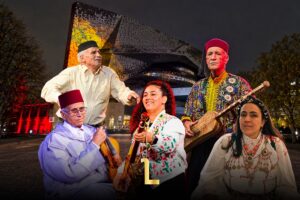
Musicians, Sufi groups, religious figures, craftsmen, and residents accompany the decorated structures through the city.
After the procession, celebrations continue with the traditional candle dance, Andalusian music, madih, and samaa performances praising the Prophet Muhammad.
Previous editions have also included lectures, activities for children, and cultural programming.