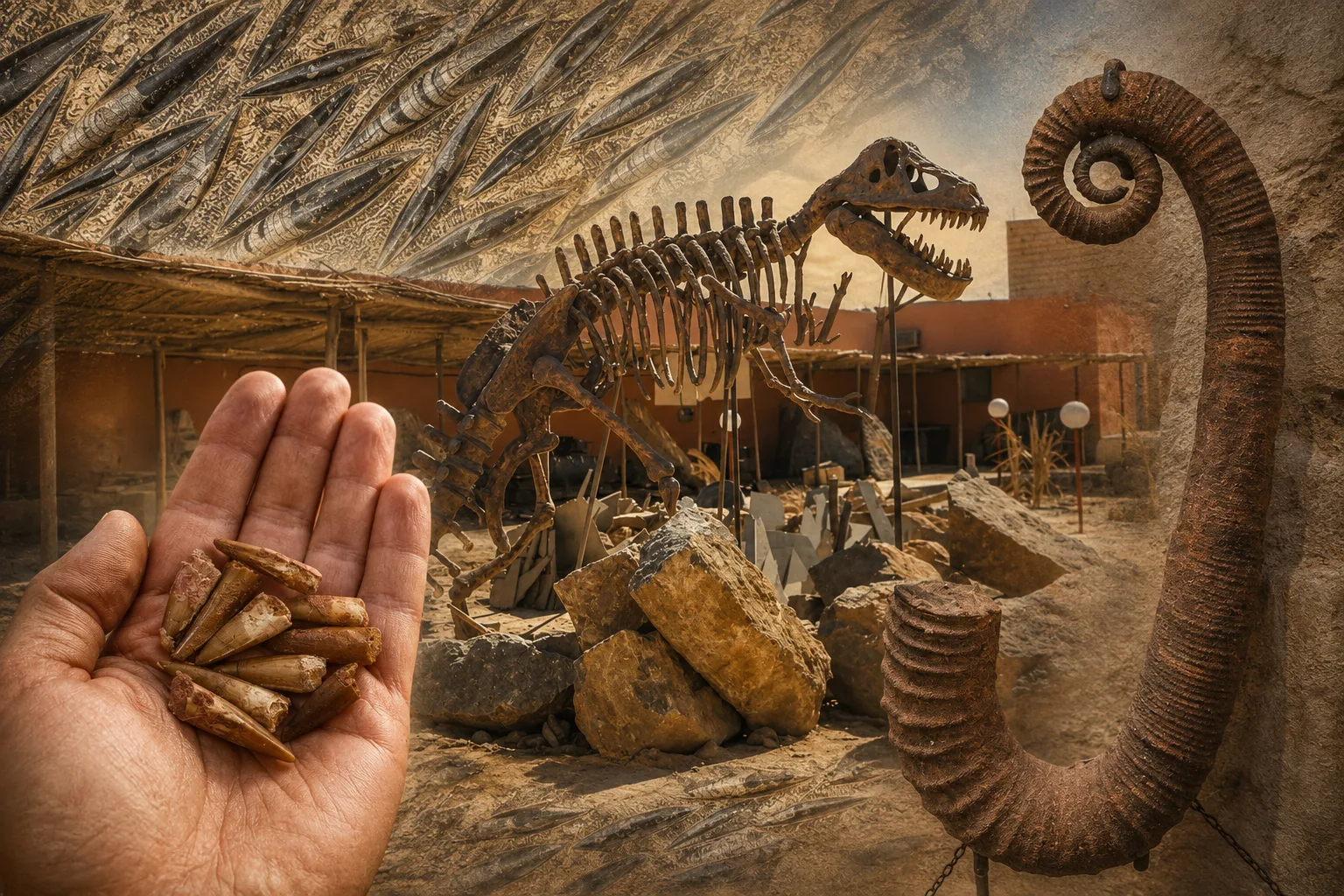
Fez — In Erfoud, dinosaur fossils are ordinary enough to appear beside ammonites, trilobites, and polished stone in shops catering to tourists.
Spinosaurus teeth can sell for a few hundred dirhams. Larger or better-preserved specimens can cost thousands. But behind this visible souvenir economy, a far less transparent trade moves rare dinosaur bones, jaws, vertebrae, and other scientifically valuable material out of Morocco.
A recent investigation by “Le Monde” documented an informal parallel market centered around Erfoud, a southeastern oasis that has become one of Morocco’s best-known fossil trading hubs.
The city sits near fossil-rich deposits including the Kem Kem beds, whose Cretaceous rocks have produced remains of dinosaurs, crocodilians, fish, and other prehistoric animals.
For many visitors, the trade looks harmless. Shops sell fossilized marine animals and dinosaur teeth alongside decorative pieces carved from fossil-bearing rock.
The rarer material, however, often stays away from the tourist-facing storefronts.
Rare fossils move through a hidden market
In Erfoud’s workshops, fossil preparers clean and reconstruct specimens extracted from surrounding sites.
One preparer interviewed anonymously by “Le Monde” described working on vertebrate jaws and a well-preserved unidentified dinosaur bone.
He said rare specimens could fetch up to MAD 15,000 and acknowledged selling some clandestinely to buyers abroad, particularly in the United States and China.
According to his account, fossils can be concealed inside luggage to avoid customs controls. He said some pieces later appear in museums or private collections.
That distinction matters because Morocco does regulate fossil extraction, collection, commercialization, and export.
The Ministry of Energy Transition and Sustainable Development requires technical approval for licenses involving the export of mineralogical specimens and fossils. Regulations linked to Morocco’s mining law also establish procedures for fossil extraction and collection.
“Le Monde” reported that legislation adopted in 2025 further strengthened protections for Morocco’s cultural, natural, and geological heritage, restricting the export of categories that include dinosaur bones, vertebrae, jaws, and teeth.
The issue is therefore not Morocco’s fossil trade itself, much of which operates openly. It is the movement of protected or undocumented specimens through channels that bypass those controls.
Morocco’s fossils are scattered around the world
The scale of the trade has consequences for scientific research.
Paleontologist Nour Eddine Jalil, a professor at France’s National Museum of Natural History and associate researcher in Marrakech, told “Le Monde” that Moroccan fossils from the Kem Kem region are now widespread in museums, universities, and private collections internationally.
He warned that fossil deposits are finite and said some areas around Erfoud have already been exhausted.
Foreign customs seizures offer another indication of the scale. French paleontologist Patrick Auguste told the newspaper that more than half of the fossils seized annually in France originate in Morocco.
Some important specimens have eventually returned.
A plesiosaur skeleton offered at auction in Paris in 2017 was later restituted to Morocco. French customs also discovered dozens of fossils without certificates of origin in Sète earlier this year.
The scientific problem goes beyond ownership. Once a fossil is removed without reliable information about exactly where and how it was found, researchers can lose geological context that may be essential for dating the specimen or understanding the environment in which the animal lived.
A trade that also supports livelihoods
The picture is not entirely one of trafficking.
Erfoud has developed an extensive economy around fossil extraction, preparation, polishing, tourism, and export. Workshops employ local preparers whose technical skills can be crucial when fragile specimens are removed from rock.
Moroccan authorities have also created legal channels for approved companies to prepare and export permitted fossils.
The Ministry outlines regulations designed both to organize the fossil trade and preserve Morocco’s geological heritage.
That creates a difficult balance. The fossil industry generates income in southeastern Morocco and has helped bring globally important specimens to scientists. At the same time, commercially valuable discoveries can disappear into private hands before researchers ever see them.
Even some people inside the trade argue that fossil dealers have contributed to paleontology by finding material that formal institutions might otherwise never recover.
But Morocco’s extraordinary fossil abundance can also make its geological heritage appear limitless.
It is not.
Every rare dinosaur jaw or vertebra removed without documentation is a piece of a finite scientific record. Erfoud’s fossil shops may make prehistoric Morocco unusually accessible, but the illicit market behind some of those specimens raises a much larger question: how much of the country’s deep past can leave before Morocco loses the chance to study it itself?