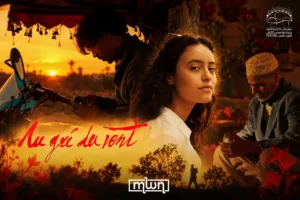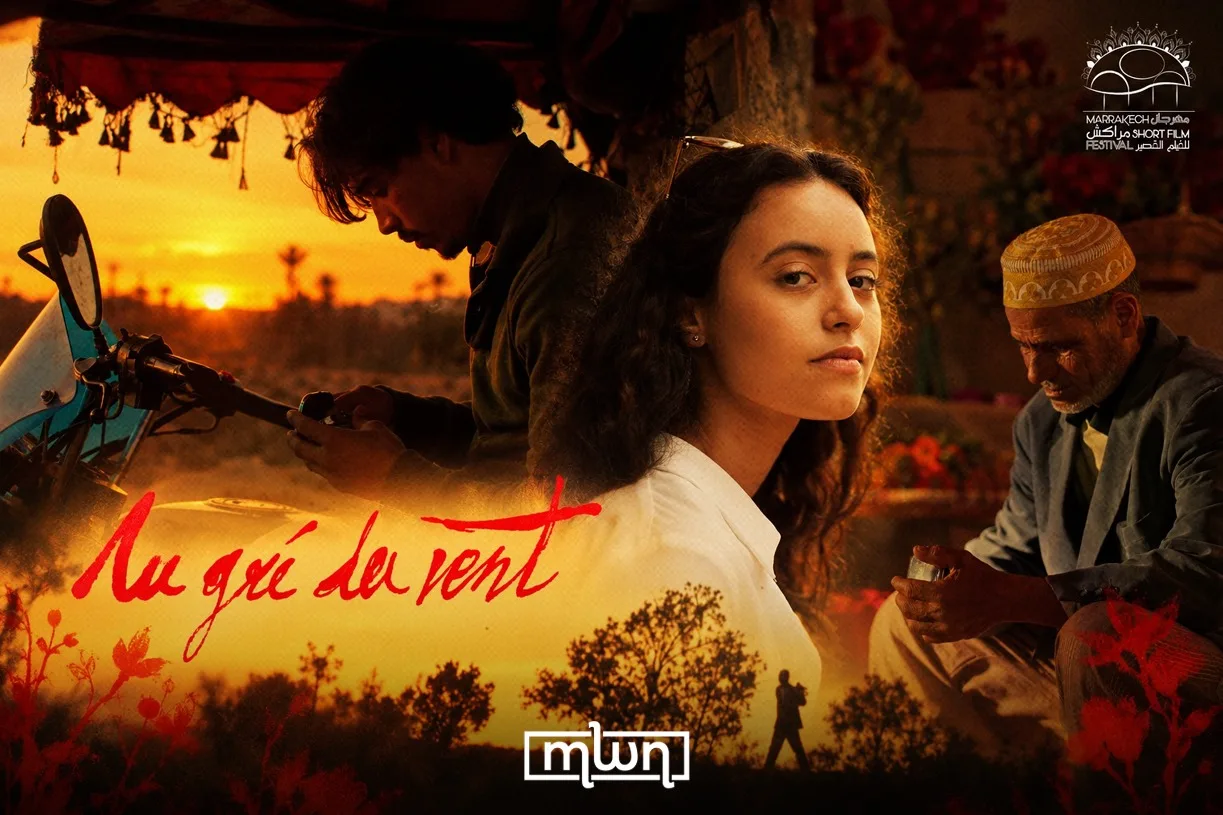
Fez — An old florist prepares to close his shop for the last time. With a young deliveryman beside him, he sets out to give away the flowers that remain.
The premise of Ines Lehaire’s “With the Wind” is simple, but the questions underneath it are much larger.
What happens when work has consumed most of a person’s life? What does freedom mean when it finally arrives at the end of that life? And what becomes of all the time that can no longer be recovered?
The 2025 Moroccan short, directed and written by Lehaire, stars Massoud Ettounsi and Ossama Fal. The 11-minute film was produced by Alaa Eddine Aljem, with Hassan Souhail serving as cinematographer.
“With the Wind” is part of the national selection out of competition at the sixth Marrakech Short Film Festival, which runs from September 25 to 30.
For Lehaire, the story grew from observing a generation of men for whom retirement can remain distant or disappear altogether.
“In Morocco, as in many other countries, retirement remains a privilege that some never truly get to experience. Men from my grandfather’s generation work until they are 70, 80 years old, and even beyond,” Lehaire told MWN Lifestyle magazine.
When freedom arrives too late
Lehaire was less interested in work itself than in what a lifetime spent working can quietly take away.
“Out of necessity, out of habit, they devote their lives to work, often without ever realizing what they are giving up along the way. Every day spent working is also a day taken away from their families, from their loved ones, and sometimes from their own lives,” she explained.
That tension became the emotional foundation of the film.
Its elderly protagonist believes that walking away from his job could finally create room for a different life. But Lehaire complicates that hope by asking whether the decision has come too late.
“Through this film, I wanted to give form to that complex emotion: a mixture of regret, nostalgia, and late awareness. It is the story of an elderly man who still believes that one radical decision, finally leaving his job, could give him the freedom he has never had,” she said.
The possibility of freedom therefore carries its own sadness.
“But that decision, however courageous, comes too late. The freedom he imagines may already be nothing more than an illusion,” Lehaire added.
At its core, she explained, “With the Wind” is ultimately concerned with something everyone spends but no one can recover.
“It is also a story about time: the time we give away, the time we lose, and the time we can never get back.”
Letting images carry the emotion
Lehaire did not want those ideas delivered through heavy dialogue or a conventional plot structure.
Instead, she built “With the Wind” around atmosphere, landscapes, visual observation, and the emotional presence of its central character.
“My initial desire was to make a film that does not necessarily rely on a traditional narrative, but rather focuses on sharing a feeling of nostalgia, beauty, and tenderness, through its visual language,” she explained.
That decision allows the protagonist’s interior life to emerge without requiring him to constantly explain what he feels.
“I wanted the images themselves to carry the emotion, creating an atmosphere and a sensory experience that could evoke memories and feelings beyond words,” Lehaire said.
She hopes viewers enter the film on those terms, allowing themselves to observe rather than waiting for every emotion to be verbalized.
“In watching the film, I would like the audience to take away the emotion of the main character, who needs to say nothing to draw us into his inner world,” she said.
Lehaire also wants the natural environment to become part of that experience.
“I would also like viewers to let themselves be carried away by this metaphorical journey, immersing themselves in the contemplation of this universe, its landscapes, and nature,” she added.
Finding authenticity in a non-professional actor
That restrained approach placed particular pressure on the performance at the center of the film.
For Lehaire, one of the production’s biggest challenges was working with a non-professional actor in the lead role while preserving the spontaneity she wanted.
“The most challenging part of making the film was working with a non-professional actor as the main character,” she said.
Rather than forcing the performance into a rigid dramatic style, she tried to balance direction with the authenticity the actor naturally brought to the character.
“I wanted to preserve a sense of authenticity and spontaneity in his performance, while also guiding him through the demands of the film and its visual language,” Lehaire explained.
The result fits the film’s wider preference for observation over explanation, allowing gestures, silence, movement, and surroundings to communicate what the protagonist does not say aloud.
“With the Wind” has already traveled beyond Morocco. It appeared in the 2025 Carthage Film Festival program and was selected for the student film lineup at the 2026 Durban International Film Festival. It has also screened at the International Film Schools Festival in Uruguay.
Bringing the film back to Moroccan audiences
Its MARRAKECHsFF selection now brings the film back to the city closely connected to Lehaire’s own development as a filmmaker.
Lehaire, a Franco-Belgian Moroccan filmmaker, studied at the Ecole Supérieure des Arts Visuels (School of Visual Arts) in Marrakech after spending six months volunteering in Morocco. “With the Wind” is her third film.
She sees short cinema as a distinct form rather than simply a smaller version of feature filmmaking.
“I’m particularly interested in short films. They have their own storytelling, economics, production methods, and challenges,” she explained. “They are often made with very limited resources, which creates many constraints for filmmakers. But I also think this is part of what makes the format so interesting: it offers more freedom and allows us to discover very singular and personal visions.”
For Lehaire, festivals become particularly important because they remain one of the main places where audiences can encounter those films.
“As audiences, we often encounter short films mainly through festivals, particularly international ones,” she said. “Through its international competition, the MSFF gives Moroccan audiences the chance to discover films from around the world, while also giving Moroccan filmmakers the opportunity to bring their work back to local audiences.”
That return carries its own importance even for films that have already traveled internationally.
“Many of these films may gain international recognition, but screenings in their country of origin have a different kind of value,” Lehaire explained.
For “With the Wind,” Marrakech therefore becomes more than another stop on a festival circuit. It offers a chance for a quiet story about work, aging, freedom, and irreversible time to meet audiences close to the cultural world from which it emerged.